

There’s a growing emphasis on high speed and sprint actions in elite football. How should practitioners balance developing players’ high velocity capacities with the tactical and technical elements that make these runs meaningful?
Recent data from the English Premier League revealed running and success were interlinked. However, it is not as simple as just running more. [1,2]
Although high speed running and sprint distance show some connection to team success, the associations are only small to moderate (Spearman’s rank correlation ~0.20–0.32 with league position; trivial to small differences between wins and losses). This illustrates that “running more” is not enough. The real challenge is developing players who can reach and repeat high speed running velocities within the flow of the game model and in ways that serve the team’s tactical objectives.
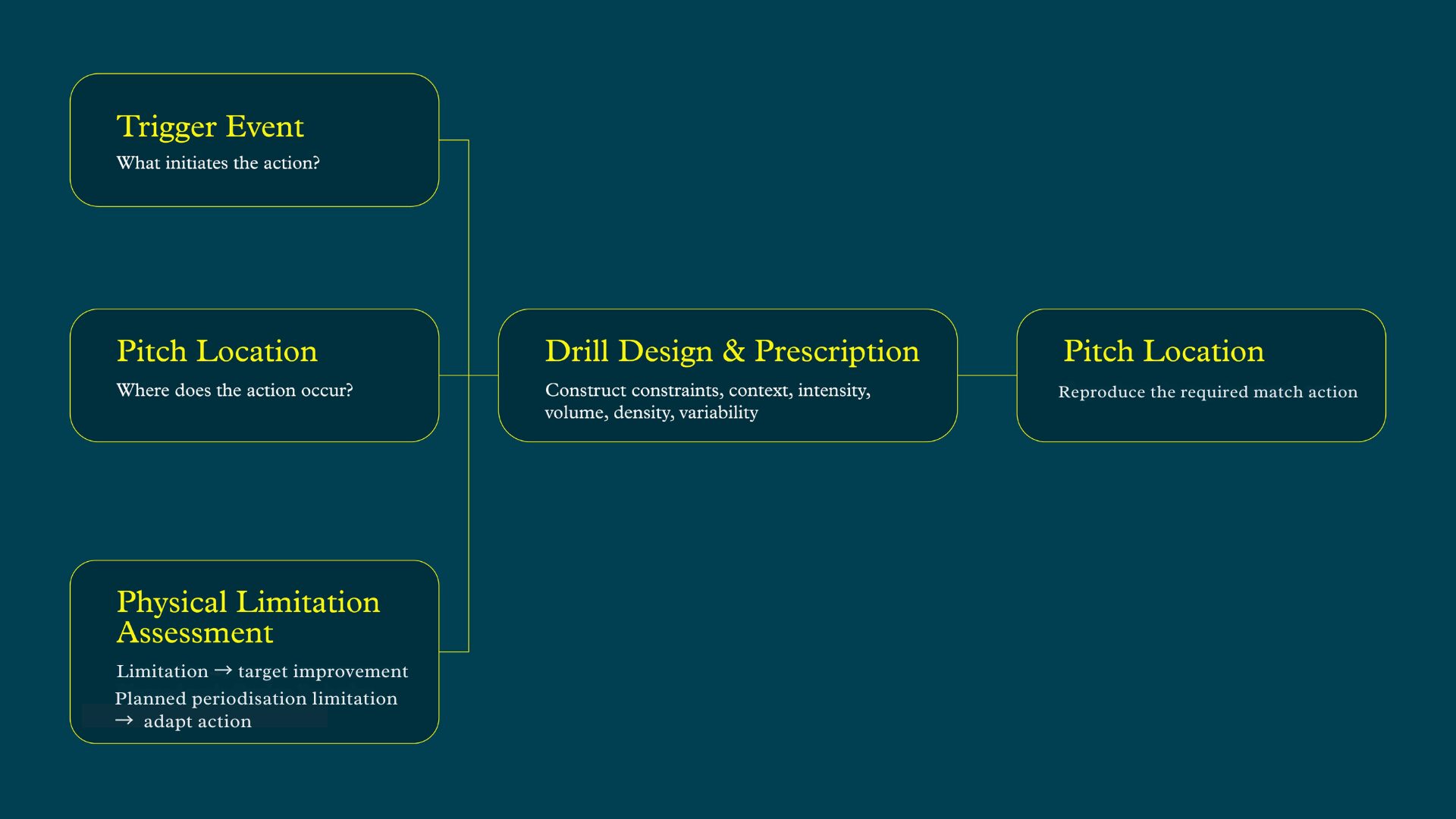
Practitioners can frame this around four key questions.
First, when do we want high speed actions?
High speed actions include penetrating runs in behind, overlaps, underlaps, counter-pressing reactions, recovery runs, distraction runs, and supportive movements that create space for others, such as a cross-field diagonal run to pull defenders away. Map these desired actions onto the relevant phases of play (build-up, final third, attacking transitions, defensive transitions) in your game model.
Then, understand where on the pitch they should occur. The coaching staff and tracking data will both pinpoint the areas where your team currently generates high speed or sprint actions, and the areas where you want to see more. These could be wingers running in behind, midfielders attacking the last line from deep, or defenders performing recovery sprints in transition.
This spatial clarity enhances both training design and each player’s individual development plan.
Next, what technical action must occur at the end of the run?
Crosses, cut backs, shots on goal, pressing actions, tackles, and screening passing lanes are all potential outcomes following a high intensity effort. These outcomes dictate the coaching detail required: body shape, first touch, angle of approach, and the relational positioning of teammates and opponents.
Finally, what physical quality limits that action?
Limitations may stem from maximal velocity, early- or late-phase acceleration, speed-endurance (either producing or maintaining high speeds), or deceleration capacity. Defining the player’s profile clarifies the physical preparation targets needed to reduce these limitations and better support the required tactical behaviours.
An essential consideration is the player’s training age and broader athletic profile. Elite players enter the system with highly varied training histories influenced by their academy environment, their exposure to isolated versus contextually focused speed training, and, most critically, their underlying athletic typology. [3] The latter classification helps guide individualised programming to minimise maladaptive outcomes or non-responses.
Broadly, players can be classified into three typologies. Speed-oriented players integrate high speed actions more naturally but may require more emphasis on repeatability under specific training conditions.
Endurance-oriented players typically benefit from targeted speed and speed-production orientated programming. This maximises their ability to sustain those intensities, rather than their ability to repeat such actions under fatigue.
And hybrid-oriented players are, obviously, a combination or middle ground. They require a balanced approach, with specific emphases shaped by positional requirements, tactical role, and overall game model.
However, it is important to acknowledge the limitations of this framework and their imposed transfer to game demands. Such categorisation primarily informs linear training prescription, whereas key mechanical components of locomotion, critical to game, often occur at relatively low speeds but impose substantial anaerobic demands and contribute meaningfully to peripheral fatigue.
Tweet This“running more” is not enough. The real challenge is developing players who can reach and repeat high speed running velocities within the flow of the game model and in ways that serve the team’s tactical objectives.
@tallen_5 and @MattTaberner
What frameworks or methods would you recommend for helping clubs interpret running load data in context, rather than solely relying on distance metrics to judge performance?
To interpret running outputs meaningfully, begin with a clear understanding of the game model, your club’s playing style, and the components that coaches believe are fundamental to that style: effectiveness in attacking transition, intensity of high pressing, stability in build-up.
From this foundation, we can frame the data within a structured contextual model rather than viewed in isolation.
Begin with the intended playing style.
A high pressing, high tempo team will naturally generate very different running outputs compared to a team operating in a low block or a controlled possession structure. The former will have more explosive actions, characterised by frequent intense accelerations and decelerations, and higher intensity efforts out of possession. The latter will have lower intensity out of possession but greater high speed running during vertical transitions.
This reframes the question from “Did we run a lot?” to “Did our outputs align with the tactical plan?”
Running outputs are strongly influenced by in-game events and the way tactical plans evolve in response. It’s important to account for the contextual factors that unfold throughout a match, as these directly shape running load outputs. Whether you’re chasing the match, holding a large lead, reduced to 10 players, or protecting an advantage will naturally alter tactical behaviours and, in turn, the physical demands on players.
To improve the interpretability of your feedback, consider normalising at least part of the data using appropriate statistical methods that capture variation relative to expected norms. Techniques such as Z-scores, Sten scores, or change-point analysis can offer a more meaningful perspective than relying solely on raw output values, and they support more informed conversations about the data.
Our league-wide analysis revealed strong to very strong correlations between running outputs at home and away, indicating that a team’s physical performance is heavily shaped by the opponent’s behaviour.
Establish relationships between physical data and tactical events such as regains, shots, entries to the box, or breaking the opposition line. A wide player may have an average sprint volume, but the impact of his individual efforts may have high value. For example, if these efforts precede most of your high probability scoring opportunities, this player’s running may be more impactful than a large output that does little to influence the game.
Post-match dashboards and analysis should go beyond a “table full of numbers.” They should be tactically relevant narrative tools that align with the coaching teams’ lens, improving post-match reflection and providing greater potential to impact practice.
Incorporate a tactical / game model rating; z-scores, Sten scores, or change-point analysis of team running outputs; comparisons with opposition profiles; 3-5 “impact runs” supported by video clips; and longer-term trend charts showing the who, where, and when of impactful runs. [4,5]
Tweet ThisTo interpret running outputs meaningfully, begin with a clear understanding of the game model, your club’s playing style, and the components that coaches believe are fundamental to that style.
@tallen_5 and @MattTaberner

How can performance staff better anticipate running demands for upcoming fixtures, considering how strongly a team’s physical output is influenced by the playing style and behaviours of the opposition?
A key take-home from the run more, win more paper was the coupling between teams’ physical outputs when at home vs. away.
Running profiles are largely influenced by the opponent’s in-game behaviours such as responding to tactical adjustments and the influence of the physical profile of players around them.
To forecast expected demands, integrate both historical data and player profiles.
Cluster opponents by playing style using historical data. For each opponent, calculate outputs of interest related to running load, such as their total sprint distance when the game finishes 11v11. Add contextual tags, like possession percentage, scoreline, average line height, directness (long passes), and pressing intensity. In collaboration with the coaching staff, break teams into groups based on their playing style, e.g., high pressing, low block counter, ball dominant but low intensity, vertical transition teams.
Then, map what happens to your team against each group. Look at your past 3-5 games versus that style. Do your full backs’ high speed running increase? Does your centre forward’s sprint output reduce as the team sets up in a low block because they defend deeper?
Consider the effects of scheduling and squad factors. Flag players entering periods with three games in eight days. Is there a reduction in certain locomotor demands during these periods?
Finally, connect that to the opposition’s management team. How have the opposition set up previously? Do they look for certain triggers to release a full-back?
This will help produce a pre-match overview to give you calculated degree of understanding around what may occur. Rough predictions are valuable: they align your weekly loading with anticipated demands and help you justify recommendations to the coaching staff regarding rotation possibilities in a congested calendar.
Tweet ThisAdd contextual tags, like possession percentage, scoreline, average line height, directness (long passes), and pressing intensity. In collaboration with the coaching staff, break teams into groups based on their playing style, e.g., high pressing.
@tallen_5 and @MattTaberner
Many teams are attempting to exploit transitional moments. What practical strategies can sports science and S&C departments use to help players recognise and react faster to the opportunities to run into space?
Higher intensity running outputs are modestly associated with better league position and winning more games, which likely reflects the value of well-timed transitional runs rather than random sprints. The question becomes: how do we train players’ game understanding and reactions, not just their ability to run and continuously run?
Starting with the basics, ensure they are physically capable. Develop a physical preparation programme to target limitations in lieu of player strengths.
Alongside that training, teach the players what the game model dictates. Make sure the players grasp where and when they need to run to achieve the required outcomes from the management team
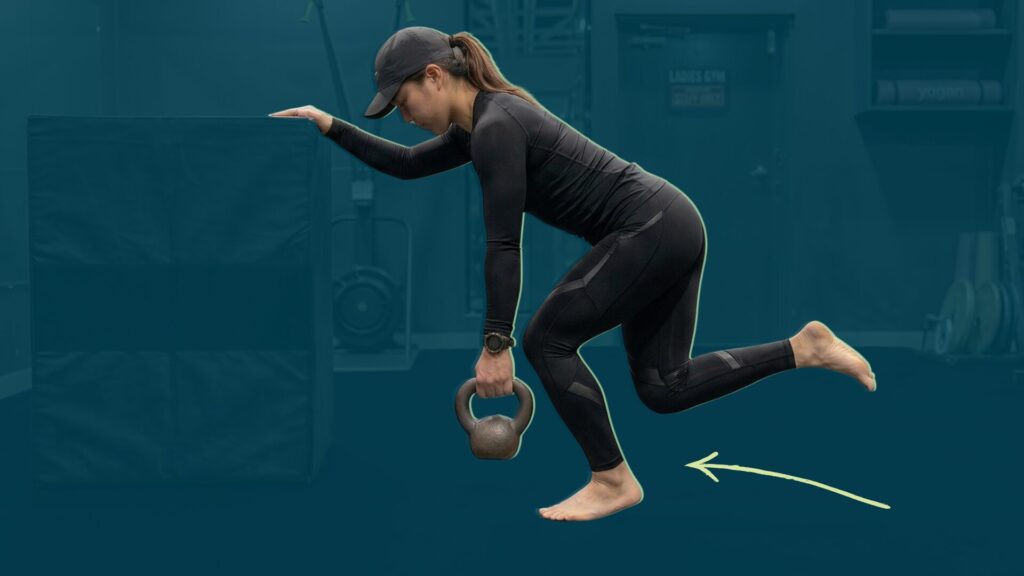
Gym-based “speed” complements this by incorporating specific postures. Although not every component of a gym-based programme requires high dynamic correspondence to game actions, integrating exercises that demonstrate some correspondence to high velocity movements (e.g., proximal-to-distal sequencing associated with sprint running) can enhance intermuscular adaptation while also improving player engagement.
Tweet ThisGym-based “speed” complements this by incorporating specific postures and exercises that demonstrate some correspondence to high velocity movements (e.g., proximal-to-distal sequencing associated with sprint running).
@tallen_5 and @MattTaberner
Outrunning an opponent may offer small advantages, but what separates “impactful running” from simply “more running”? How can training design reflect that distinction?
Winning teams typically cover more total distance and more distance at high speeds than their opponents. But the effect sizes are trivial to small. This provides the biggest indication yet that match outcomes are not primarily determined by running volume. Rather, the observed differences likely reflect shifts in game states that impose periods of increased intensity.
Efficient running are high intensity activities that meaningfully shift advantage. That includes running to create or close space of high value, such as behind the last line of defenders, central zone, or the cut-back area. Another example is running that directly precedes a shot, high probability scoring chance, or to prevent a shot at their own goal.
Any running that forces the opponent to re-organise their structure on the pitch is also “efficient.” And, finally, simply reacting quicker than your direct opponent in a one-on-one situation.
By contrast, inefficient running is high volume with little tactical consequence: chasing lost causes or sprints without tactical meaning, such as unsynchronised pressing.
To reflect this in training, design games with consequence. For example, in large sided games (LSGs), award double goals for moves where a run in behind happens within 6 seconds of winning the ball. Players quickly learn that certain runs drive the scoreline. For the defence, give points for regaining possession within 5 seconds of a coordinated press. Build these rules around the game model patterns you want.
Coach timing and coordination as much as effort, e.g., high press drills where the trigger is clear (poor back pass, bouncing ball into the holding midfielder, goalkeeper on their weaker foot). If three players do not jump together, reset the activity and make the coaching clear that “this is the trigger for when we run together.”
Drill transitions from action specific to game related sequences. Build the sessions around key focuses. If the focus is about runs in behind, start with a passing pattern that allows players to self-organise to find an opportunity to trigger such opportunities. Build in a possession game where the focus of gaining points is by running in behind and receiving the ball. Then go into a large-sided game where the teams earn extra points for completing those actions.
Praise players for producing the runs they make in drills, and highlight those moments in post-training video sessions. Conversely, show 4–5 key examples where they did not go when they should have. That’s not negative, if done right. It’s part of the development process: learning how to solve the problems that open up in game situations.
Shifting the conversation to impact and influence protects players from redundant running volumes (chasing loads within little return or likely little influence on injury risk) and aligns physical effort with the key moments that influence and sometime determine game outcomes.
Tweet ThisShifting the conversation to impact and influence protects players from redundant running volumes (chasing loads within little return or likely little influence on injury risk) and aligns physical effort with the key moments.
@tallen_5 and @MattTaberner
For clubs without the budget of top Premier League teams, what are the most effective ways to develop players who can repeat high intensity actions and hit higher speeds, without relying on expensive recruitment?
We suggest practitioners prioritise four key areas.
First is scientifically-based profiling and simple monitoring. Ensure you have a club-specific testing battery that follows rigorous procedures to profile your players based upon the current and projected physical demands of the game. RPE and its derivatives such as strain and monotony (capturing variance of load), subjective wellness responses, and training / match durations enable a simple approach to tracking any potential drastic changes, or avoiding excessive volume. [6]
Second, ensure your players get consistent sprint exposure. That means about two doses per week of true maximum velocity work (>85% maximal sprinting speed). Something simple like 3-6 reps of 30-40 m with full recovery (>1:10 exercise:rest ratio), ideally as far away from matchday as possible.
Even better: do these in game context to maximise transfer in collaboration with the coaching staff.
That brings us to the next point: use football to build repeatability. Develop small-sided and positional games with pre-determined work:rest segments. Football-specific circuits build conditioning, while adding movements specific to the game model.
Integrate strength development and power expression with two full-body sessions each week (dependant on periodisation around games). Target adaptations that support players’ capacities to develop stiffness and attenuate the forces required to jump, accelerate, run at high velocities, decelerate, and change direction.
Finally, invest in coaching education and the training environment rather than technology. If staff can explain why high intensity running and actions matter (with the notion that more is not always better), and design sessions that integrate training of physical qualities that match the team’s playing style, you get buy-in that money cannot buy.
Tweet ThisThat brings us to the next point: use football to build repeatability. Develop small-sided and positional games with pre-determined work:rest segments. Football-specific circuits build conditioning, while adding movements specific to the game model.
@tallen_5 and @MattTaberner