The term “intent” has grown in popularity around the strength & conditioning industry in recent years. In our world, intent shows up in the context of the ability to move an implement or one’s body at maximal velocity. This can include exercises that sit on all parts of the force-velocity curve: heavy squats, weighted jumps, med ball throws, sprints etc. When compared to intentionally slower repetitions, research suggests that isotonic resistance training moved with maximum intent is superior in developing qualities such as peak force and rate of force development [1,2,10]. Despite its popularity, peer reviewed evidence is scarce to support the use of slow eccentric resistance training for the purpose of hypertrophy. That being said, there is still a place for slow isotonic resistance exercise with regards to teaching/engraining new movement patterns, addressing early & mid stage soft tissue injuries and tendon management.
This article will focus on what leads to higher levels of athlete intent and how it can be manipulated, specifically in a weight room setting.
Motivation is the driving force behind intent. I have seen athletes’ motivation levels vary in response to three main factors: competition, buy-in and encouragement.

Within a training setting, athletes can compete with themselves or with others. This motivates different athletes in different ways. Some have a bias towards constantly striving to beat their own previous best, while others are only focused on beating another individual or group of athletes.
Athletes’ level of motivation can also change as a result of their understanding of the potential benefits of a particular type of training or individual exercise. Educating the athlete properly can be much more powerful than any type of programming style or exercise selection.
A great example here is when working with middle and long distance runners, and the sometimes taboo subject of resistance training. The potential benefits of resistance training and plyometrics on running economy have been well-documented [1,2]. Even so, if no one has ever properly taught the athlete about these benefits and how S&C training transfers to endurance performance – if previous coaches had simply ordered them to do their S&C program without justification – motivation and athlete intent will probably be low.
An example from the opposite end of the spectrum would be baseball pitchers and ballistic rotational training.
The vast majority of professional and collegiate pitchers I have worked with clearly see the benefit of these exercises. Consequently, they try to break any medicine ball they throw. The clear mechanical similarities between their sport and rotational medicine ball exercises make buying in easy. Athlete education, then, is not the most important aspect to increase motivation. Coaches should find other methods for driving intent.
Performance coaches should shy away from becoming the stereotypical meathead that simply screams at their athletes and neglects technical mastery. There is probably a happy medium that allots an appropriate time and place for us to yell at athletes.
Tweet ThisPerformance coaches should shy away from becoming the stereotypical meathead that simply screams at their athletes and neglects technical mastery
@lukerstorey
Verbal encouragement can have significant effects on an athlete’s motivation. Research suggests verbal encouragement produces between 5-12% improvement in physical outputs [3,4].
Although “peer pressure” tends to be associated with negative connotations, it can also contribute to encouragement with athletes ultimately trying harder if they know they are being observed by coaches or other athletes.
As coaches, we may simply tell ourselves that athletes will of course put 100% intent behind everything they do in the weight room. It’s what we ask of them and ultimately they want to get better.
The harsh reality is that athletes – although gifted at their sport – are human just like us, and quite simply may have days where they need a little more motivation to excel.
With that in mind, it is our responsibility to use whatever we have at our disposal to drive intent in the weight room.
Immediate visual feedback
The general consensus within strength & conditioning is that providing immediate objective feedback on exercises is a great way of increasing athlete intent. This can be from velocity-based training devices (e.g., linear position transducers (LPT), wearables or 3-D motion capture systems), jump mats and force plates.
Unfortunately, published research in this area within an athletic population is scarce, with only a handful of papers available on the topic. These studies examine either acute assessment or chronic training.
Acutely, studies have shown 1.3- 7.6% average improvement in a rep’s output (mean or peak velocity) when an athlete was given immediate feedback from an LPT [5,6]. Chronic physical changes (4-6 weeks) from training with feedback has also improved horizontal jump, 10-, 20-. and 30-meter sprint time [7], countermovement jump peak powerand 3RM back squat [8].
We decided to look into this further with our student-athletes at University of California – Santa Barbara, specifically the men’s basketball and softball teams.
Over a 4-week training block in the off-season, each team completed 3×3 barbell squat jumps with 40 kg or 25 kg (men’s basketball and softball, respectively), once a week.
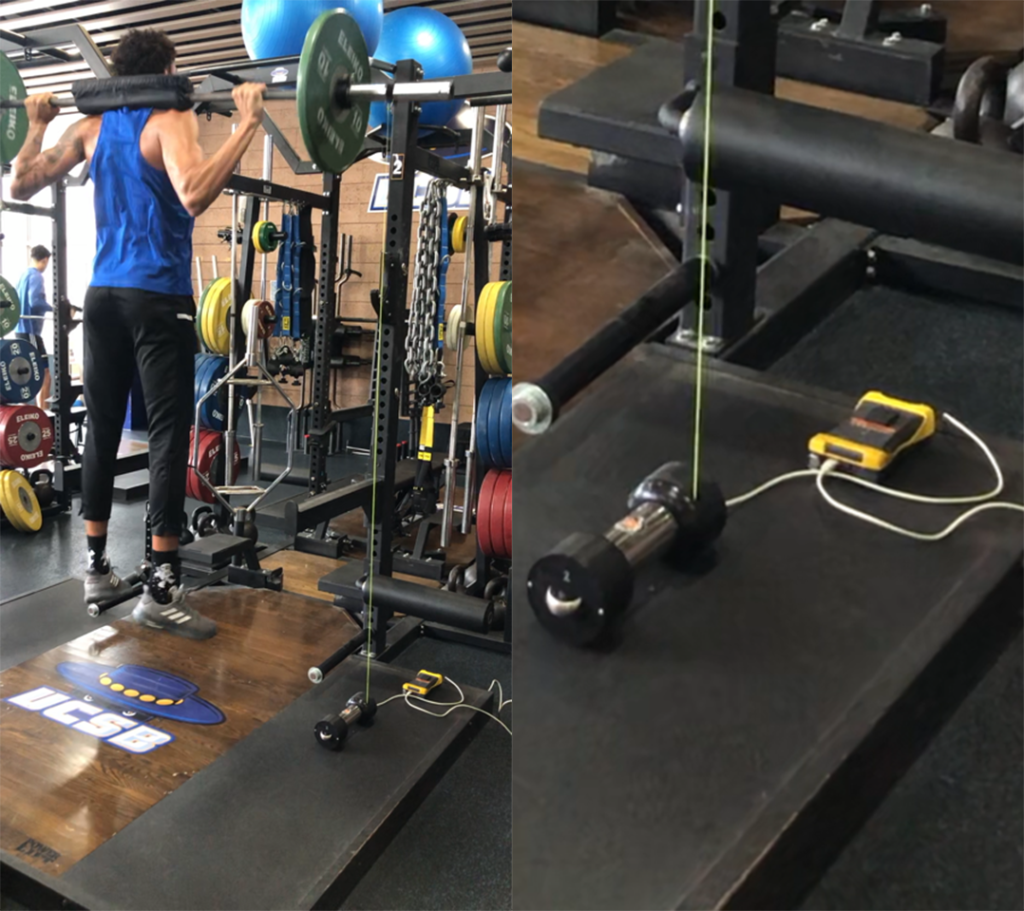
All variables were constant throughout the four weeks: same day, same time of day, same weekly practice court / field time, same cueing (jump as high as possible) and same verbal encouragement. Only one variable was different. In weeks 1 and 3, the Tendo units were attached to the bars and set to display peak velocity so the athletes could receive instantaneous feedback every rep. In weeks 2 and 4, we explained to the athletes that the Tendo units were acting up and giving faulty data. This sounded believable to the athletes because in the prior year we had to repair two units due to similar issues. We then turned the unit upside-down so the athletes could not see any of the scores (figure 2). We also set the display to peak power, a metric that the athletes were not familiar with,. in case an athlete happened to turn the unit around to see if it was working.
If an LPT is attached to a barbell but the feedback display is not visible, the athlete still believes they are being monitored. Therefore, we chose to give the perception that their jumps were not being recorded, thus giving us a true level of their intent in the exercise. This is different from earlier research where the subjects knew their reps were being recorded but simply did not receive feedback.
Ideally we would have had 3 different conditions: feedback; no feedback and athlete not knowing they are being recorded (LPT “not working”); and no feedback, but athlete knowing they are being recorded. Unfortunately due to logistic and time constraints we were only able to study the first two.
For data analysis we split the softball players into two groups. One group was just freshmen and the second group had everyone else. We were not able to do this with the men’s basketball team because only three freshmen participated.
| Athlete group | N | Age | Exercise assessed | Feedback vs no feedback % difference |
| UCSB – men’s basketball | 13 | 20.9 (0.6) | BB CMJ – 40kg (peak velocity) | 3.5% |
| UCSB – softball (freshman) | 6 | 18.6 (0.4) | BB CMJ – 25kg (peak velocity) | 6.1% |
| UCSB 0 softball (soph/junior/senior) | 17 | 20.8 (0.6) | BB CMJ – 25kg (peak velocity) | 2.4% |
| Pro rugby union [7] | 9 | 22.1 (2.1) | BB bench throw – 40kg (peak velocity) | 1.3% |
| High school rugby union [8] | 15 | 17.1 (0.5) | Back squat (mean velocity) | 7.6% |
Age and level of participation have large effects on output differences between the feedback and no-feedback groups. The smallest change in output came in the Argus study (1.3%), which also happened to be the highest level of competition (professional rugby) and the oldest athlete group. On the other hand, the highest discrepancy of 7.6% was with the lowest level of competition (high school rugby) and youngest cohort.
Although there likely were physical factors behind these findings, I believe the results were more closely related to motivation and buy-in.
Athletes that have better buy-in to strength and power development training will likely have higher intent with each rep, even if they do not receive immediate feedback. At higher levels, they understand the benefit of each and every rep. However, athletes with less buy-in will tend to have higher levels of intent when they know they are being observed or recorded by teammates or coaches, hence the larger discrepancy between feedback and no feedback within this population. This is also clear in the differences between the freshmen and older softball athletes (6.1% vs. 2.4%).
With these results in mind, we changed some of our education strategies for our younger incoming athletes to increase athlete buy-in to strength and power development.
When should coached not give immediate feedback on repetitions?
Despite the clear benefits of moving with intent for strength and power development, there are still some instances where providing immediate feedback can be counterproductive.
1. Teaching / coaching new exercises
This is a non-negotiable in my eyes. Athlete attention and focus should be honed in on movement quality and execution, not intent. Things tend to go very wrong when athlete intent precedes movement quality.
Tweet ThisWhen coaching new exercises, athlete attention and focus should be honed in on movement quality and execution, not intent. Things tend to go very wrong when athlete intent precedes movement quality
@lukerstorey
2. Exercises that pair poorly with tracking bar velocity
Two examples here are trap bar countermovement jumps and hang clean pulls at lighter loads. Both are great exercises that we regularly prescribe to our athletes at UCSB. With both movements, though, too much upper body involvement can increase bar velocity at the expense of the lower body’s contribution. This negatively affects the kinematics of the movement and reduces lower body power development, which is the goal of both exercises
However, if you are using clean pulls or trap bar CMJ to target strength-speed (higher relative intensity and load), then overemphasizing the upper body doesn’t change barbell velocity too much.
Our solution to trap bar CMJ’s was simply to use jump mats and give jump heights instead of bar velocity feedback. Calculating jump height from flight time is certainly not perfect, due to different landing strategies manipulating heights. But jump mats are a much more team training-friendly technology than force plates. Not many organizations have 6-8 force plates to be able to use with large teams of 20-45 athletes in one training session.
Finally, with lower load clean pull derivatives (e.g., from blocks or the hang) we tend to stay clear of providing any form of immediate objective feedback to avoid the risk of athletes negatively changing mechanics just to chase higher barbell velocities.
Data dissemination and visualization
We display our training leaderboards on monitors in our weight room and also send PDF reports to our athletes. There is absolutely nothing new about athlete leaderboards, but hopefully the following will provide some insights on how we display the data.
Figure 3 is an anonymized training leaderboard from the UCSB men’s basketball team.

Unweighted jumps vs. weighted jumps vs. max force compound lifts
We tend to choose different variations of weighted jumps instead of unweighted jumps or traditional compound lifts like deadlifts, squats or split squats.
Although a great tool for monitoring progress and readiness, unweighted jumps in the weight room are not an ideal stimulus for adaptation. High volume jumps are often already performed in team practices, and doubling down will likely have negative outcomes. We certainly strive to continually progress loads on our all of our big compound lifts, but avoid adding these to our training leaderboards. Too often, when athletes – especially collegiate athletes – are overly encouraged and motivated to constantly hit PR’s with these lifts, form breaks down and injury follows.
Exercise selection
We use slightly different exercises and loads with different sports and sometimes positions depending on their constraints and specificity of training target for their event. The premise and layout of each leaderboard remains similar. Our leaderboards are designed for weekly training purposes, not monthly or annual assessments. We are less concerned with the overall error or reliability of the exercise (to an extent), but more focused on whether the exercise logistically works well in our environment. The equipment used for the exercise in Figure 3 are jump mats, Tendo units and Keiser cables pulleys. We have all three in abundance at UCSB, and can easily use them regularly with large groups of athletes without negative effects on the flow of a training session. We also choose exercises that require minimal technical proficiency to be able to execute well. Athlete intent should be focused on force output rather than mastery of technique.
Concise terminology and display
Less is more. As coaches we are not here to impress or defend a PhD thesis to our athletes. Nine times out of ten they do not care about your knowledge of Newtonian physics and statistical analysis… although that 1 out of 10 athletes is always fun and rewarding to justify your methods to. With this in mind, we keep our leaderboards as clear and concise as possible. No signs of standard deviations or change of velocity scores, we show units in small fonts, etc.
Is the term “strength” relative to the task or quality being assessed?Absolutely. But athletes can relate better to the term “strength” rather than “max force.”
Motivate > Belittle
This area can and should change slightly to suit the competitive environment you’re in.
Some athletes that are at the bottom of a leaderboard will be highly motivated to push themselves to improve. However, many athletes in this position may completely lose faith in that particular exercise or training stimulus after feeling belittled by being towards the bottom. We have addressed this by removing the names of the bottom half of athletes. This has worked well for us, with a healthy balance of athletes striving to have their name displayed while others remain anonymous to avoid ridicule.
Another scenario where this has worked well is when you end up having your best player at the bottom of a leaderboard. This is almost always an outlier: an athlete who happens to be incredibly skillful at their sport and doesn’t need to rely on their athleticism.
If other athletes see their best player at the bottom of a leaderboard they may be be less motivated with that particular exercise.
Side note: if most of your best players are on the bottom half of your leaderboard, it’s time to rethink your exercise selection or the stimuli you are chasing. Are these truly KPI’s for that sport?
Competition between teams
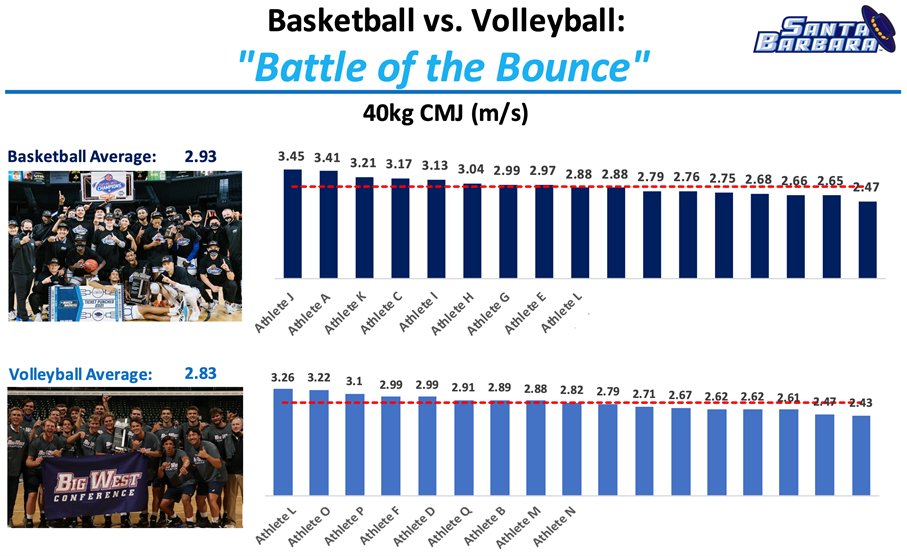
A concept that we have been trialing recently is having teams from different sports competing against each other. We have the luxury of doing this in the collegiate setting, with many different teams and sports sharing the same space. The simple premise behind this was: Why compete against your teammates when you can band together as a team and compete against another group? This breeds a pack mentality within your team, with everyone constantly pushing each other forward.
Figure 4 shows our two highest jumpers at UCSB: men’s basketball and men’s volleyball. Early anecdotal feedback from athletes on this has been positive.
Being intentional about integrating athlete intent
Intent is an integral part of output in the weight room and is affected by an athlete’s motivation to train. Coaches have a range of interventions that can positively affect an athlete’s intent, provided the coach adapts the intervention for the team and individual athletes. The wrong pairing of method and athlete can be counterproductive.
Future research should focus on how an athlete’s background can potentially affect their motivation to train. Gender, age, training age, sport and position may all influence an athlete’s motivation and, therefore, readiness to buy-in. The better coaches can understand their athletes, the better able they will be to optimize whatever drives the athlete forward.
Acknowledgements
I would like to thank our UCSB Sports Performance Staff Sam Smith, Alex Lopez and Ashley Kalleberg – for their help with data collection on these projects and their general patience of having to work with me on a daily basis.