
Adductor related groin pain is prevalent in elite football (soccer) players, accounting for 12-19% of all time loss injuries [1,2]. Adductor avulsions, in general, and proximal adductor avulsions, more specifically, are a key subset of this category.
Traditionally, full adductor tendon avulsions have been treated surgically, but some studies suggest that surgical treatment may prolong return to sport, without providing superior results [3]. The literature around treatments for adductor longus avulsions in elite and sub-elite football players is limited to case reports. These case reports describe non-surgical return to sport timelines of 10-15 weeks[4].
Tweet ThisAdductor-related groin pain is prevalent in elite soccer players, accounting for 12-19% of all time-loss injuries. Adductor avulsions, in general, and proximal adductor avulsions, more specifically, are a key subset of this category
Stacey Hardin
Frameworks such as the Strategic Assessment of Risk and Risk Tolerance (StARRT) may be helpful in organizing and synthesizing relevant information to ultimately improve communication, alignment, and accountability.
The StARRT framework aims to organize various factors that may be relevant to the RTP process.
The first step is an assessment of health status. Health status can include factors such as patient age, sex, previous health status, patient reported symptoms, physical examination signs, and additional tests such as imaging.
The second step looks at activity or participation risk. Participation risk can include the type of sport the person wants to return to, their position, their competitive level, objective functional testing, and psychological readiness.
Last, the StARRT considers risk tolerance modifiers. These include when in the season the injury happened, pressure from the athlete, pressure from coaches and other staff, conflict of interest, and fear of litigation.
These variables and their complex interaction may impact decisions around the player’s return to performance. Especially in elite sport, where efficient and effective decision making is essential and may take place in the context of elevated emotions, an appropriate framework can be helpful to ensure stakeholders recognize and consider all factors.
One important limitation of the StARRT framework is the lack of acknowledgement of sport specific loading. This includes sport specific training capacity (quantitative, qualitative, representative design). Adding these components on top of the StARRT’s considerations was essential to the player’s success in this case.
The StAART framework is not a return to sport protocol. It does not provide specific criteria or cut off points. Nor does it guide the “how” of a high quality decision making process. It simply provides a framework to help identify and organize factors relevant to your specific case.
Tweet ThisFrameworks such as the Strategic Assessment of Risk and Risk Tolerance (StARRT) may be helpful in organizing and synthesizing relevant information to ultimately improve communication, alignment, and accountability
Stacey Hardin
Late season adductor longus avulsion
A 25 year old male professional football player sustained an injury to his right adductor after lunging for a ball, without making contact, while attempting to stop a counterattack during match play. The player initially rejected on field evaluation. However, his pain increased and function decreased over the subsequent 18 minutes, leading to him coming off the field.
Observation revealed no immediate signs of acute injury. Evaluation revealed a palpable mass and moderate tenderness of the adductor longus tendon at the origin on the pubis and distally through the musculotendinous junction.
MRI revealed a full grade avulsion of the proximal adductor longus from the pubis with 2 cm of distal tendon retraction. Prior to this injury, the player had no known injury to either hip complex. He had an 87% availability rate over the four years of his professional career on various senior teams in the league prior to this injury.
| Step 1 – Evaluation of Health Status | Medical Factors |
| Patient Demographics | 25 years old, male; Professional athlete, landlord, college graduate in physics |
| Symptoms | Pain at rest, tenderness to palpation, weakness, loss of function |
| Personal Medical History | Right hamstring strain x 2, Right quadriceps strain x 1 |
| Signs (Physical Exam) | Palpable mass |
| Moderate tenderness at adductor longus tendon at the origin on the pubis and distal through the musculotendinous junction | |
| Unable to initiate hip adduction + flexion | |
| Lab Tests | None |
| Functional Tests | Walking |
| Psychological State | Determined, motivated, focused, detail-oriented |
| Potential Seriousness | Moderate |
Step 1 of the StARRT revealed this player was highly educated, exceptionally determined, self motivated, focused and detail oriented. This allowed his rehabilitation plan to be executed with precision and with the highest level of intent. He also was able to make an informed decision about the potential risks associated with his preference for an accelerated, non-surgical management plan.
| Step 2 – Evaluation of Participation Risk | Sport Risk Modifiers |
| Type of Sport | Contact |
| Position | Center-mid |
| Limb Dominance | Right (involved side) |
| Competitive Level | Professional |
| Ability to Protect | Minimal |
Step 2 did not turn up any significant information that was not already known.
| Step 3 – Decision Modification | Decision Modifiers |
| Timing & Season | 3.5 weeks from beginning of playoffs |
| Pressure from Athlete | Strong preference towards playing, first year on team |
| External Pressure | None |
| Masking the Injury | Minimally effective |
| Conflict of Interest | Contract year |
| Fear of Litigation | N/A |
Step 3 revealed important factors that influenced the level of risk that we were all, collectively, willing to assume.
The player was new to the team and his contract would expire at the end of the season. His regular role on the team was as a substitute during most matches. He would start when players were on international duty.
He strongly preferred non-surgical management on an aggressive timeline as he tried to secure a new contract. Team physicians and sub-specialists supported the non-surgical option, as did the coaching staff and team management. Because he wanted to be available for post-season selection and was willing to assume the attendant risks, all stakeholders agreed to an accelerated return to sport progression (return to pre-injury performance levels was not possible due to the timeline).
Tweet ThisThe StARRT framework organizes factors relevant to the RTP process, including health status, activity risk, and risk tolerance modifiers. These variables and their interactions can impact decisions regarding a player’s return to performance.
Stacey Hardin
Making smart decisions about risk
Shared decision making is best practice in medical contexts, and is an attribute of high performing teams. Having a framework to organize relevant factors was important to give key stakeholders visibility to the same information.
Steps 1 and 3, in particular, revealed several relevant factors that led to the collective acceptance of increased risk.
Team physicians and subspecialists supported non-surgical management. However, they had limited professional experience with non-surgical approaches that did not adhere to the timelines documented in the literature. Coaching and management were supportive of the player’s decision, and did not add any pressure.
The player’s overarching goal was being eligible to participate in the team’s first playoff match. Most importantly, he understood that the injured tissue would only be partially healed at his desired return to play time of 25 days post-injury. However, functionally sufficient healing was possible over that timeframe, and the staff discussed this with him.
The major physical risks were exacerbating the current injury and injuring other structures. Upon the conclusion of the team’s playoff matches (which were single elimination / “knock out” rounds), he would have an 8-11 week offseason. This provided more cushion for a full return to play if the player’s injury worsened or another structure was injured.
Tweet ThisShared decision-making is best practice in medical contexts, and is an attribute of high-performing teams. Having a framework to organize relevant factors was important to give key stakeholders visibility to the same information
Stacey Hardin
Blended rehab
My preference is for a blended rehabilitation method, including local tissue intervention that targets specific muscles and principles of intersegmental control, as described in Dr. Enda King’s work[5]. King focused on footballers with athletic groin pain, not players with avulsions, so there is still an open question about applying his techniques and findings.
| Adductor | Glute Max | Glute Med/Min | Core/Trunk |
| Gradual tissue loading | Strength gains and hypertrophy | Strength gains and hypertrophy | Strength gains |
| Bent knee ISO ball ADD to straight leg | Split Squat | Side plank | Front plank variations |
| Sliding lateral lunge | SL RDL | SL squat | Modified hundreds with ADD ISO hold |
| Side plank feet staggered | SL hip thrust | SL RDL | Reverse plank with deadbug ISO hold |
| Copenhagen (knee to ankle through full series) | Step-up | SL squat off box to heel touch with hip hike | Farmer’s carry and suitcase carry (add off-set) |
The phase of healing, desired goal of that phase, involved muscles, and current function dictated the exercises selection.
Maintaining load while manipulating intensity
The StARRT framework lacks the acknowledgement of sports specific loading. Using Dr. Matt Taberner’s proposed revision to the framework, we planned and monitored components of sports specific training capacity.
Using a combination of the arm bike, battle ropes, med balls, and punching bags, the player completed internal loading sessions which replicated, as closely as possible, the demands that were planned on the field and what a standard training week would include.
As soon as he was able to begin walking (day 1), he completed comparable on field distances at a modified level of intensity. Over the first seven days post-injury, he was able to achieve a regular volume (20,000m) of total training distance and over 50% (1,250m) of his regular total training high speed running distance.
The performance team had many conversations about the potential advantages and disadvantages of returning to running when in the earliest days of tissue healing. Given the lower intensity and linear nature of the activity (jogging), we decided the benefits of loading for the rest of the body outweighed the potential of hindering local tissue healing. We discussed the importance of maintaining load to help mitigate risk of injury to other body parts and detraining of other systems. We felt confident that our close monitoring would surface any early signs of an adverse reaction, and that we would be able to adjust accordingly.
Tweet ThisOne important limitation of StARRT is the lack of acknowledgement of sport-specific loading. This includes sport-specific training capacity. Adding these components on top of the StARRT’s considerations was essential to the player’s success
Stacey Hardin
Monitoring strength, activity, and performance
We monitored the player nearly every day via bilateral isometric abductor and adductor testing on a fixed frame device (bent knee and straight leg); and unilaterally using a hand held dynamometer (bent knee, straight leg and end range straight leg hip abduction and adduction).
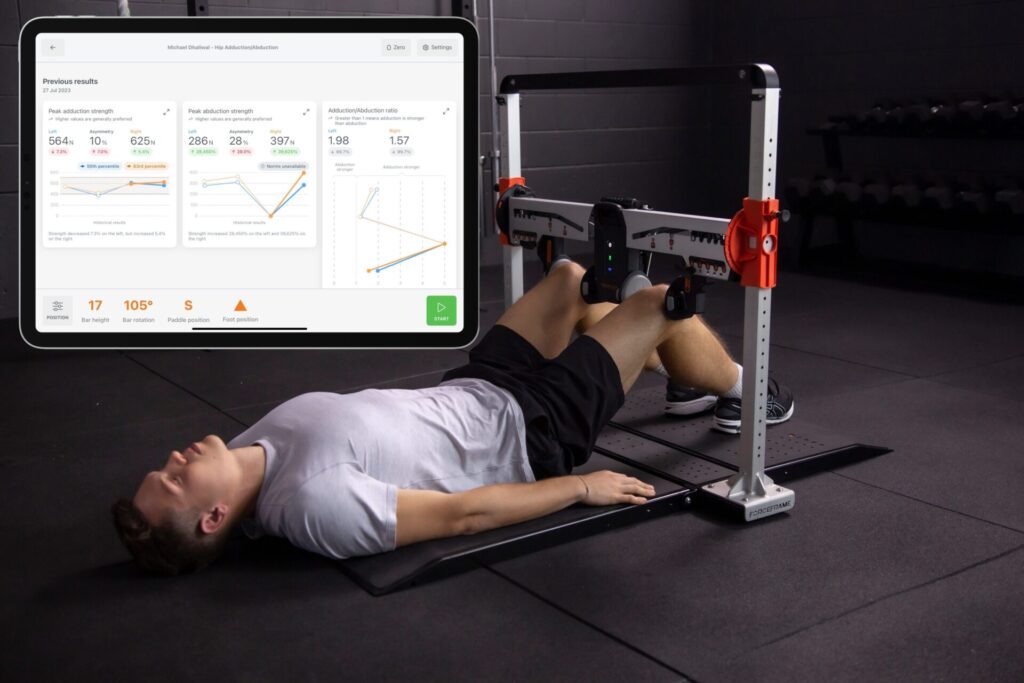

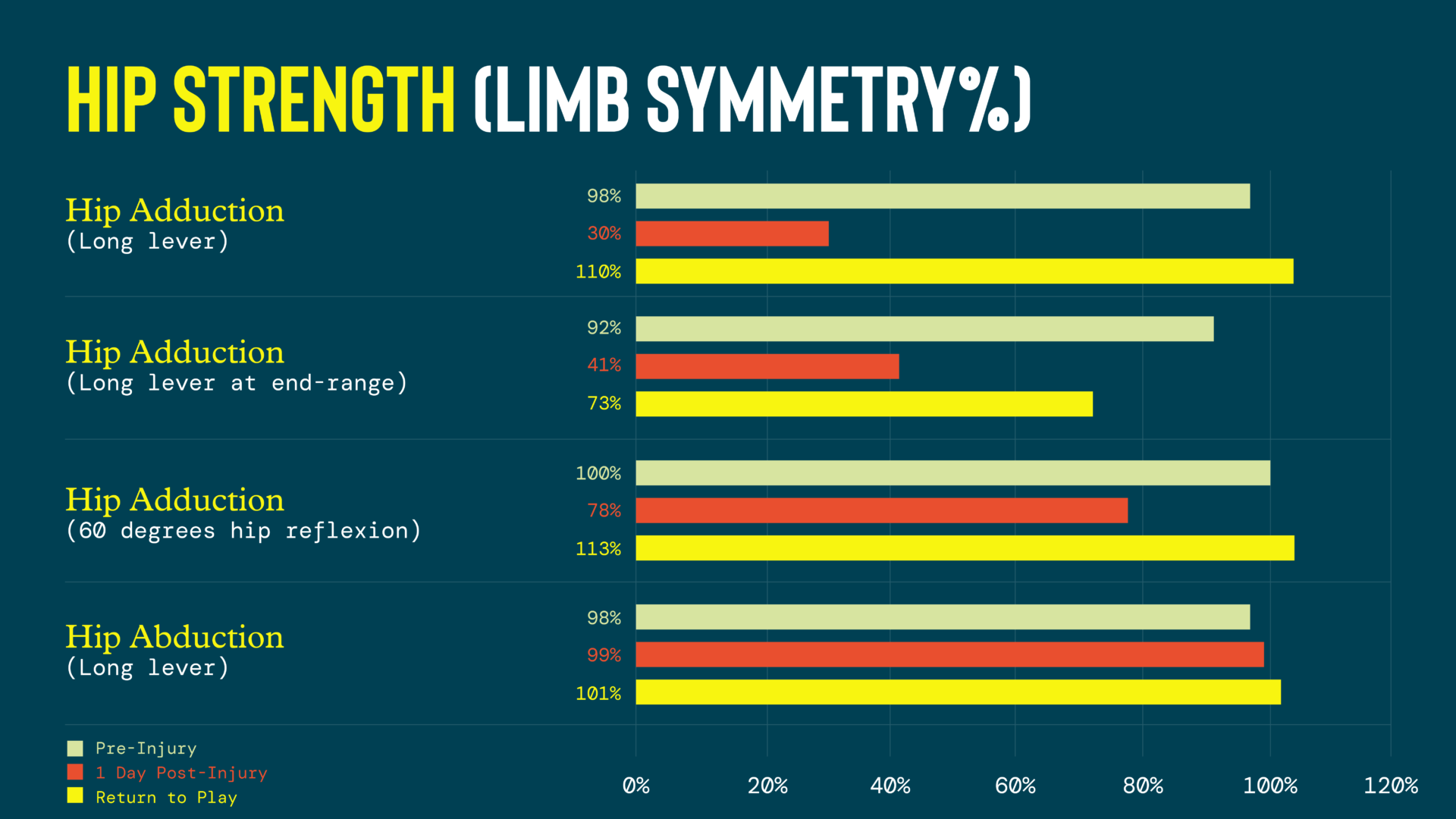
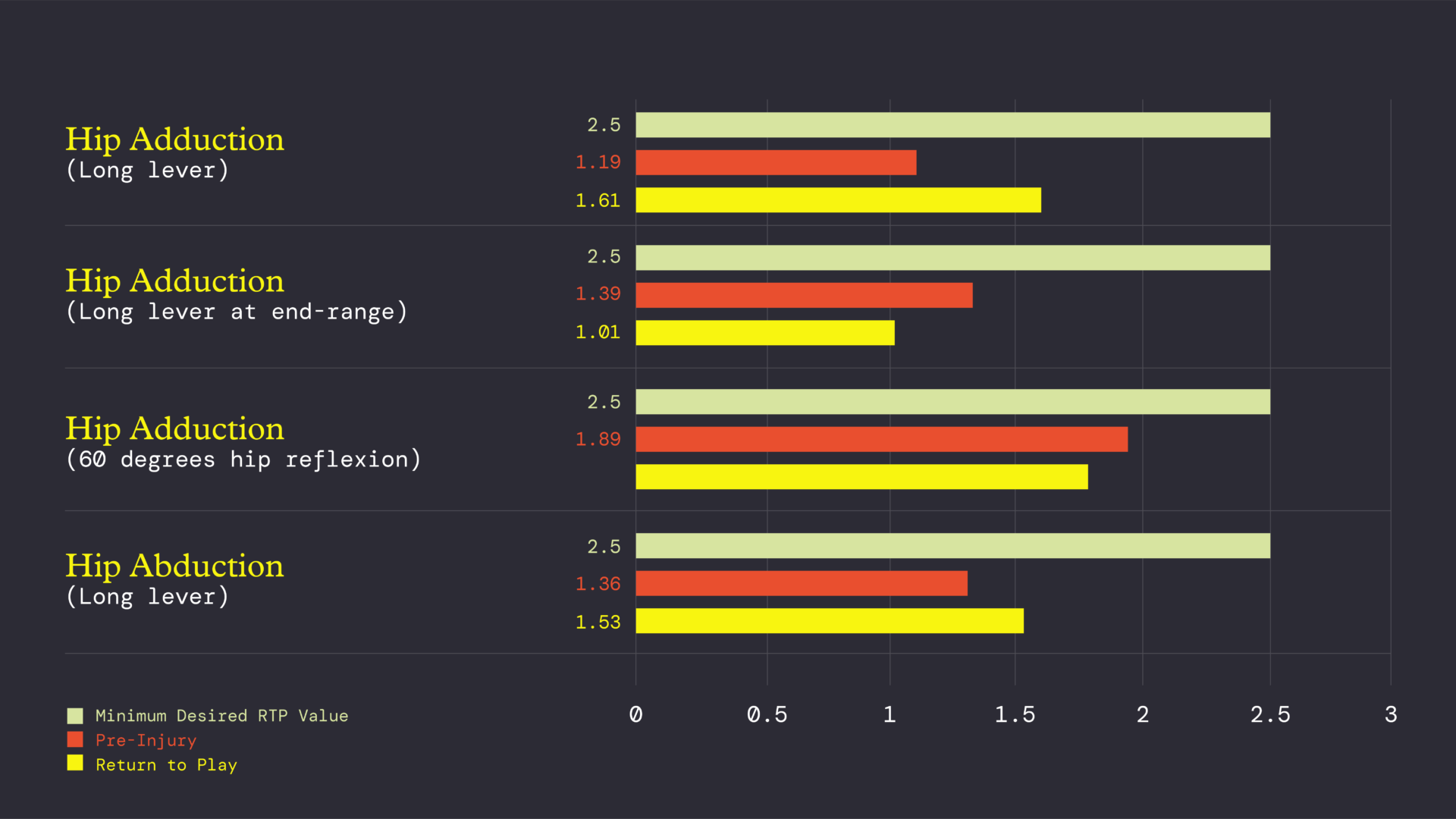
Relative to his weight and leg length, his hip strength was very weak when he arrived at the team. This, however, put him in a position to regain and improve upon his hip adduction limb symmetry index relatively quickly. We also considered this weakness as a risk factor to sustaining the avulsion in the first place.

The player completed a progressive return to play protocol.
| Activity | Day Post-Injury |
| Stationary Biking | Day 1* |
| Walking | Day 1* |
| Jogging (<5.5m/s) | Day 4* |
| Running (5.5m/s-7.0m/s) | Day 5* |
| Sprinting (>7.0 m/s) | Day 6* |
| Change of direction (predictable) | Day 6* |
| Kicking (>5 yds) | Day 7* |
| Sudden change of direction (reactionary) | Day 10* |
| Long ball distribution | Day 12^ |
| Full training session | Day 14^ |
| Eligible and featured in match | Day 25^ |
| Patient-Reported Pain-Free (0/10) or Symptom-Limited (<2/10) Activity Level | |
He also completed routine testing on the force plate (countermovement jump, drop jump), and finally a 5-10-5 test that we compared to his preseason baseline.
Successful outcomes… but what if?
We were successful in accomplishing the primary goal we set out to achieve. The player was eligible for selection and played in playoff matches without reinjury during the process, or in the 24 months following the injury. Close monitoring of strength, activity level, and performance were essential to minimizing the risk of re-injury and adverse events.
That said, just because an athlete can, does it mean they should? Which compensations are allowable, and which are dangerous?
Thinking about athletes returning from ACL reconstruction, many of them achieve similar outcomes on tasks such as forward hopping, but we know their strategies may be significantly different. How might this player’s movement strategies have factored into this case, and did we capture that information appropriately?
The StARRT framework supported the non-surgical, accelerated return to play from a full adductor longus avulsion. The StARRT framework (with Taberner’s revisions) provided a common organizational language that improved communication, alignment, and accountability to the plan that the team developed. It did not provide prescriptive programming nor management protocols.
Two elements made our task a bit easier. First, the player was relatively weak to begin with, making it easier to return him to his baseline strength on the abbreviated schedule. Second, he was committed to keeping internal and external loading as similar as possible to regular training and competition. This meant walking and jogging to maintain total distance, performing intense and long duration cardio circuits, and keeping up with full body lifting to maintain the mechanical load that he would experience on the field.
One external factor particularly helped us out with the time frame. The injury occurred during a favorable time of the season. Knowing that the off season was imminent, we knew the player would soon have the chance to perform a significant amount of rehab without having to miss competitive matches.
Adverse outcomes were always possible
The StARRT protocol is about carefully weighing and managing risks. It can’t eliminate them.
In this case, incomplete physiological tissue healing at the time of desired return to play could have led to an unfavorable outcome. For some practitioners and coaches, that fact alone may have been enough to decide against or even block an accelerated RTP timeline.
Activity progression was planned and continued based off a combination of the player’s physical impairment testing, physical performance testing, his progressing through quantitative milestones, and his subjective reporting of absent to low grade (< 2/10) pain.
Upon return to play, this player only achieved 73% LSI (1.01 Nm/kg) on unilateral straight leg isometric adduction testing. This was one of the KPIs that we selected based off information identified during step 1 of the StAART. By standard RTP protocols, this level of symmetry and his relative strength should have made him ineligible to continue his progression. But the player expressed his comfort with moving forward. We were satisfied quantitatively because he was able to meet all other impairment, performance, and activity progression criteria, which provokes the question: were these the right KPIs?
The levels of desired and acceptable risk is variable and personal. Decision making in elite sport requires a delicate balance between art and science, which must be reassessed with every athlete, every injury, and every unique circumstance.

Tweet ThisThe StARRT framework supported the non-surgical, accelerated RTP from a full adductor longus avulsion. With Taberner’s revisions, it provided a common organizational language, enhancing communication, alignment, and accountability to the plan
Stacey Hardin