


From GPS-derived training load and match exposure to force plate outputs, gym performance, wellness, sleep, and blood biomarkers, sport performance practitioners can monitor almost every aspect of an athlete’s performance with increasing ease.[1] This should make decision-making easier. But instead, the challenge has simply changed.
We are no longer clamouring for more data. We have enough. Now we must decide what matters, when it matters, and what to do with it.[2]
Monitoring systems rarely become bloated overnight. They grow one decision at a time. A metric gets added because the software now provides it. Another stays because “that is what we have always done.” A wellness question remains because it was already in the system. A new assessment is introduced because another club seems to be using it.
Each decision may make sense on its own. But together, they create a monitoring system with too many outputs and not enough structure. Before long, the workflow becomes heavier, interpretation becomes slower, and the performance staff ends up with too many variables, and not enough action.[3,4]
Shifting from “measuring more” toward “measuring better” means, in many cases, measuring less.
When the system takes more than it gives
Every measure takes time to collect, attention to interpret, and energy to communicate. That cost is worth paying when the information improves a decision or helps support the athlete. It becomes harder to justify when the metric rarely changes what happens next.
When monitoring starts to shift from a performance-support tool to a collection habit, it often reveals itself in three ways.
First, the signal gets buried. Additional variables stop creating additional understanding. Some measures duplicate information already captured elsewhere; some fluctuate in ways that are difficult to interpret; and others produce weak, inconsistent, or highly context-dependent messages.[3,5]
Second, the system creates more burden.
Athletes quickly recognise when data collection feels disconnected from action. Questionnaires become routine, tests rarely lead to feedback, and monitoring starts to feel like something done to them rather than something that supports them.
When that happens, buy-in drops, and data quality often follows.[6]
The same applies to staff. Every monitoring system needs people to collect, clean, interpret, and communicate the data. When that work takes time away from coaching, observing, discussing, and deciding, the system starts to use the practitioner rather than support them.
Third, and most important, decisions get slower, not sharper. When monitoring expands without purpose, staff do not just collect more. They also have to interpret more, explain more, and defend more. The result is often slower, less confident decision-making.[2,7] The morning meeting becomes a tour of the report rather than a decision forum. More information enters the system, but less clarity reaches the decision.
Tweet ThisWhen monitoring starts to shift from a performance-support tool to a collection habit, it often reveals itself in three ways. First, the signal gets buried. Additional variables stop creating additional understanding.
@NikolaosAsimak1 and @anthonyturneruk
Selective by design, not minimalist by default
The solution is not stripping back monitoring for the sake of simplicity, but raising the standard for what earns a place in the system.
Minimal effective monitoring (MEM) seeks the smallest set of core measures that consistently improves important decisions, fits the environment, and can be sustained over time.[8] The idea is similar to the minimal effective dose in training: we want to do enough to create the desired effect without adding unnecessary cost.[9]
The usefulness of a measure depends in part on what it takes to produce it. If a measure is scientifically interesting, but obtaining it disrupts the current workflow, creates excessive staff burden, lowers athlete engagement, or adds confusion rather than clarity, it has limited applied value.
That is why the system should be different in every environment. A Premier League first team, academy programme, women’s professional squad, and semi-professional club may all need different monitoring solutions.
For example, an academy may prioritise growth, maturation, long-term athletic development, and the progressive exposure required to prepare players for senior soccer.[10] A first team environment may place more emphasis on match availability, recent training and match exposure, recovery status, and tactical readiness.
Across a league, one team may have dedicated analysts, data engineers, and several performance staff. Another may rely on one practitioner managing collection, interpretation, and communication. Neither needs more than its environment can sustainably support.
Similarly, two teams with similar technology may still need different systems if their playing style, training model, or development priorities ask different questions. The question defines the system, not the technology.
Tweet ThisIf a measure is scientifically interesting, but obtaining it disrupts the current workflow, creates excessive staff burden, lowers athlete engagement, or adds confusion rather than clarity, it has limited applied value.
@NikolaosAsimak1 and @anthonyturneruk
Turning minimal effective monitoring into a working system
MEM needs a practical architecture to move from a concept into a repeatable working process.
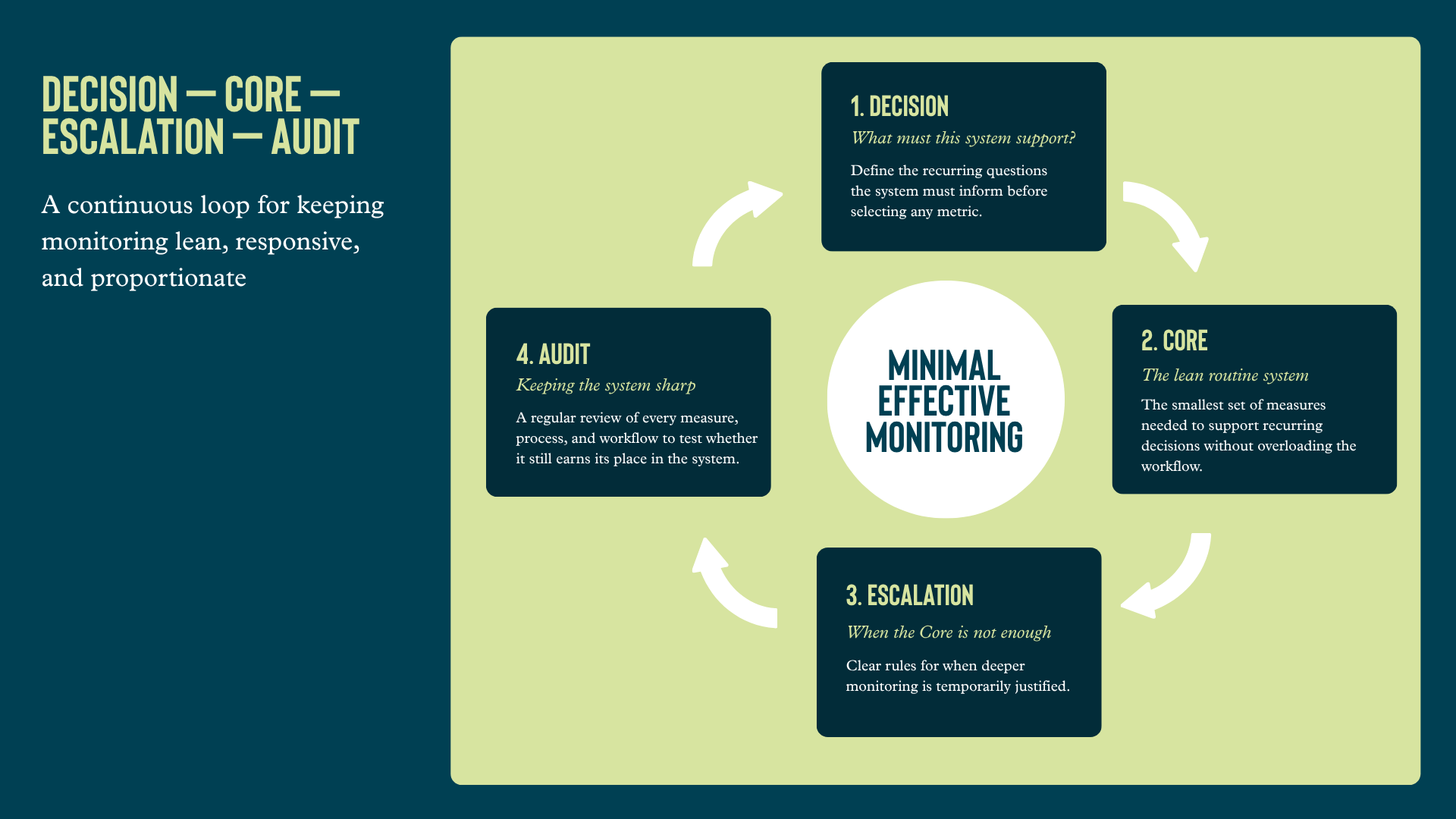
A simple way to build that architecture is through four checkpoints: decision, core, escalation, and audit (Figure 1). Together, they create a continuous loop that keeps the system focused on one question: what information earns a place in the monitoring process?
What decision are we trying to support?
The first step in MEM is defining the decisions the system needs to support (Figure 1). This moves the process away from available technology and habitual practice, and anchors it to the decisions staff actually need to make.
In most high-performance environments, those questions sit across three broad areas: the demand placed on the athlete, the response the athlete is showing to that demand, and the capacities that need tracking over time. Figure 2 shows how those questions translate into common monitoring decisions.
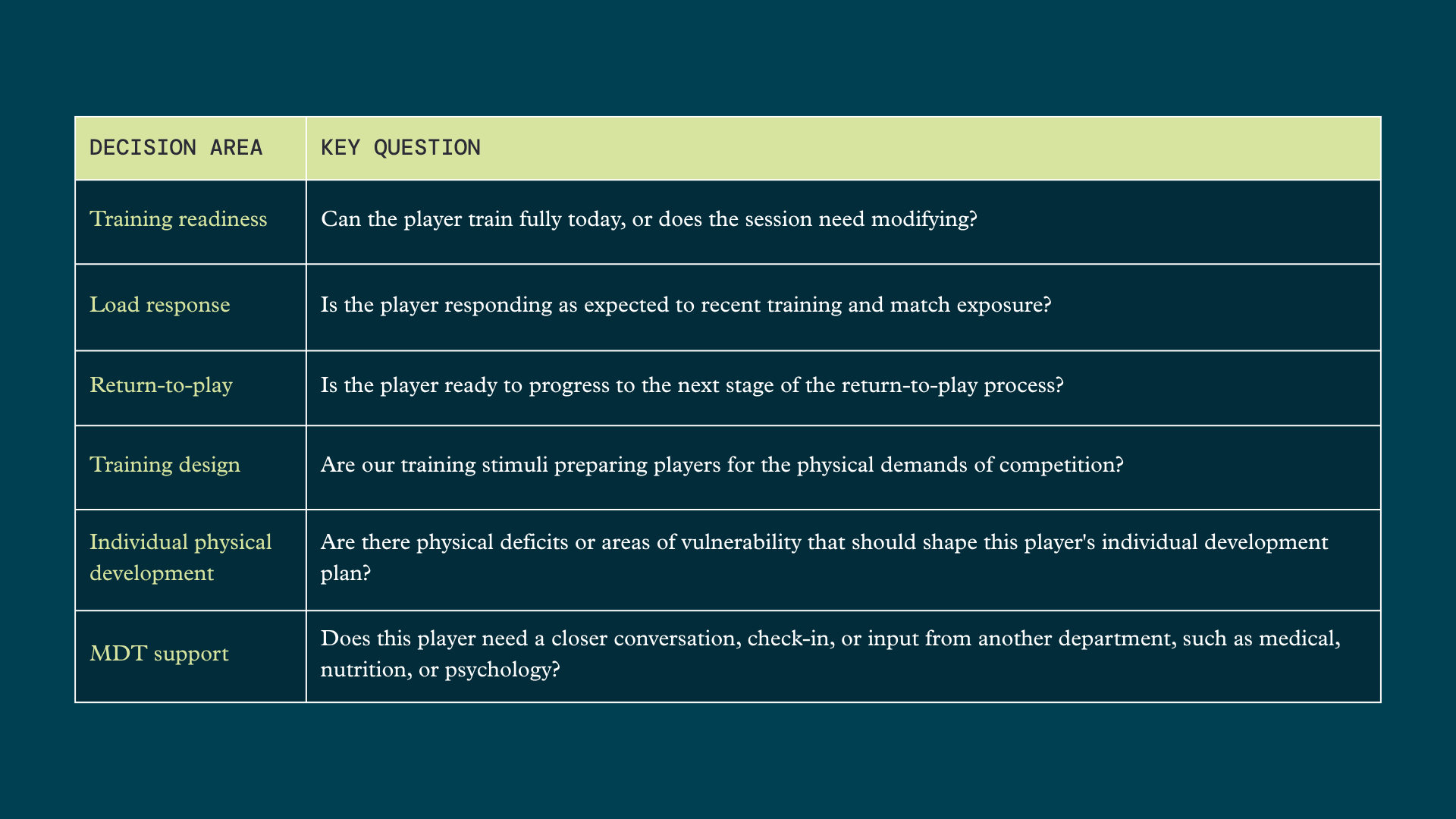
The horizon matters because not every decision needs the same depth. A same-day readiness call needs something fast and easy to communicate, while a return-to-play decision can justify more detail because the cost of error is higher.
Tweet ThisIn most high-performance environments, the questions which shape MEM sit across three broad areas: the demand placed on the athlete, the response the athlete is showing to that demand, and the capacities that need tracking over time.
@NikolaosAsimak1 and @anthonyturneruk
Core: The lean routine system
Once we’ve defined the decision, the monitoring question becomes: what information do we need to support this decision effectively?
The core is the filtered first layer of routine information in the monitoring system (Figure 1). It contains the measures collected consistently because they support recurring decisions with enough confidence, acceptable burden, and clear practical value. The core provides a reliable first picture that practitioners can use repeatedly without overloading the workflow.
In a high-performance environment, candidate measures typically come from several information streams, including external load, internal load, subjective response, objective response markers, and targeted development or capacity markers.[4,8]
Building the core is a filter exercise. Every candidate measure is tested against the criteria in Figure 3.
Tweet ThisThe core is the filtered first layer of routine information in the monitoring system. It contains the measures collected consistently because they support recurring decisions with enough confidence, acceptable burden, and clear practical value.
@NikolaosAsimak1 and @anthonyturneruk
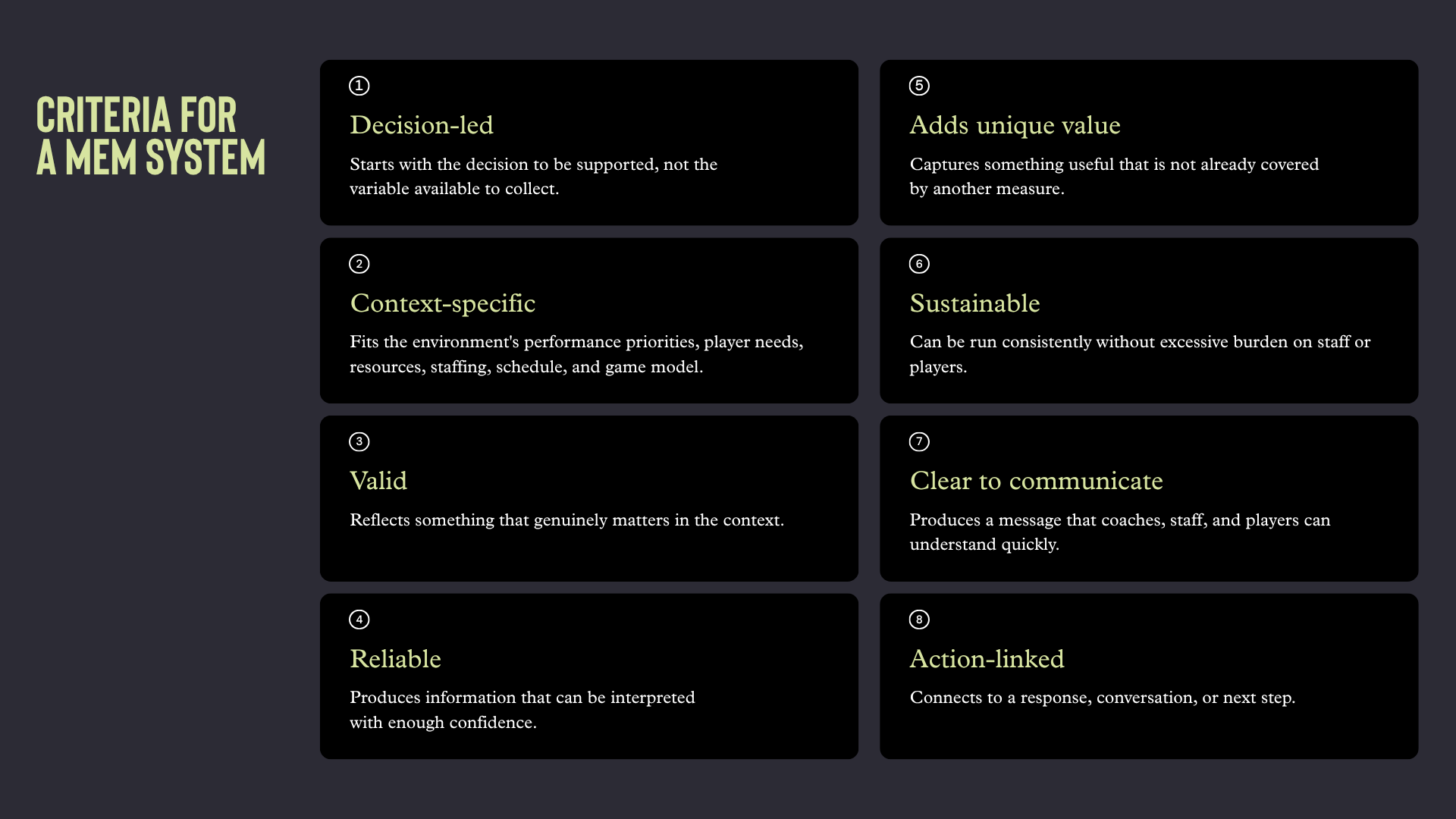
The exact measures will differ across environments. What matters is whether each measure has earned its place. Across contexts, the role of the core stays the same: providing the first layer of decision support without overloading the workflow.
Escalation: When the core is not enough
A good monitoring system builds on a lean routine core via clear rules for when that core is no longer sufficient.
Some athletes, periods, and decisions demand more information than the routine system can provide. Escalation criteria define when staff should move beyond the core to seek a better answer (Figure 1).
A useful escalation checkpoint is: Is the core enough to support this decision, or do we need to go deeper?
In a MEM system, escalation should be temporary, targeted, and reversible. Extra monitoring is added to answer one specific question. It does not automatically join the core, and it is removed once the question has been answered.
Escalation is usually justified in three situations.
The first is meaningful change. A marker may move meaningfully outside the athlete’s expected range, such as a drop in neuromuscular output, unusually high fatigue or soreness, reported pain, or a spike in recent match, sprint, or high-intensity exposure.[8,11]
The second is a mismatch between load and response. The athlete’s load, response, behaviour, and staff observation may point in different directions. For example, the player reports feeling fine but moves poorly; symptoms are present despite normal objective output; well-being is poor after low recent exposure; or a development trend is not matching the intent of the programme.
The third is a higher-risk context. Some situations justify closer attention before a clear problem appears: return to play, fixture congestion, rapid exposure progression, travel, a new player with limited baseline data, recurrent issues, high-priority players, or a managerial change that imposes a different game model.
This keeps the monitoring system responsive without becoming bloated. Escalation is still filtered through the same MEM logic. More information is justified only when it improves the decision enough to justify the added burden.
Audit: Keeping the system sharp over time
Audit reviews the routine system itself and prevents the core from drifting back toward accumulation.
The audit process interrogates whether each measure, report, and workflow still earns its place. Staff should ask whether each measure supported a decision, added unique information, was trusted by staff, was communicated clearly, and justified the burden required to collect, interpret, and report it.
Together, these questions lead to the simplest test of all. If we removed this measure, would our decisions get worse?
If a measure can be removed without making decisions worse, it probably does not belong in the routine core.
Audit also matters when resources improve. More staff, better technology, or new software does not automatically justify expansion. Any new measure still must show that it improves decisions enough to justify the cost, complexity, and burden it adds.
Tweet ThisThe audit process interrogates whether each measure, report, and workflow still earns its place. Staff should ask whether each measure supported a decision, added unique information, and was trusted by staff.
@NikolaosAsimak1 and @anthonyturneruk
Building a monitoring system around real capacity
A professional soccer club had access to a level of technology many departments would envy. GPS and heart rate monitoring, force plates, handheld and fixed dynamometry, NordBord testing, velocity-based training tools, portable point-of-care blood analysis, and sleep tracking wearables.
The club had used different monitoring approaches over the past years, but few had remained consistent. The club had plenty of tools, but no stable system for deciding what to collect, when to use the technology and data, and how the data should influence practice.
As a result, technology often entered the process because it was available, rather than because it answered a specific question.
At the same time, the club was going through a wider performance department restructure following a difficult season. The available staffing resources were reduced, increasing the remaining performance staff’s responsibilities across training, recovery, gym delivery, rehabilitation support, and reporting.
Tweet ThisIn a MEM system, escalation should be temporary, targeted, and reversible. Extra monitoring is added to answer one specific question. It does not automatically join the core, and it is removed once the question has been answered.
@NikolaosAsimak1 and @anthonyturneruk
The system had to be redesigned around real capacity, not ideal capacity. That constraint became useful. It forced the staff to audit the process and define what the season’s monitoring system was actually there to achieve.
The aim for the new system was to engage players less often, but with greater purpose: collect fewer routine inputs, act on them more consistently, and use them to build a clearer picture of each player over time.
Once the weekly questions were clear, each available measure was reviewed against the practical criteria in Figure 3. The filtering process led to several key changes in the routine system.
Streamlining the post-match readiness testing
The first practical change was the post-match fatigue (PMF) battery on MD+2. The inherited battery included countermovement jump (CMJ) testing, a 90/90 isometric hamstring strength test, and a 45° hip flexion adductor squeeze test. Each measure had value, but the routine process had become too heavy. Player engagement was dropping, and staff struggled to process and communicate the findings quickly enough to influence training decisions.
The revised PMF process moved to a leaner core built around exposure and response.
All players who completed more than 60 minutes in the match completed the revised MD+2 PMF core. The core combined an exposure review with a response review, which included subjective wellness, medical notes, and a CMJ. Targeted muscle-specific isometric testing was removed from the routine core, and would only be used as an escalation step.
The trigger was not a single threshold breach, but convergence across recent exposure, response markers, medical notes, injury history, symptoms, or physio observation towards a specific tissue question, such as a hamstring, groin / adductor, hip flexor, or calf concern.
Within the revised core, staff initially built an exposure profile for each player. Staff flagged players who had completed more than 85% of available minutes across the previous four matches, or more than 70 minutes in the latest match after limited recent exposure. They then checked whether high-speed running, sprint distance, accelerations, or decelerations in the latest match exceeded 90% of that player’s match maximum. These exposure markers did not spur escalation on their own. They directed staff attention and helped interpret each player’s response profile in context.
The CMJ tests consisted of four outputs: jump height, contraction time, concentric impulse, and eccentric deceleration impulse. These metrics were retained because internal reliability was strong, with coefficient of variations below 5%, and because they provided a practical picture of both jump output and movement strategy.[12]
Staff compared CMJ outputs with each player’s individual baseline (individual mean ± 1 SD).[8]
Subjective wellness responses for sleep, fatigue and soreness were interpreted against each player’s recent normal, using a rolling four-week mean and SD. A z-score greater than 1 in the unfavourable direction was a warning flag, a sign that there was something for staff to review, not proof of fatigue or injury risk.
For example, one winger completed 82 minutes on Saturday after playing only 24 minutes across the previous three matches.
His high-speed running and sprint distance reached 94% and 98%, respectively, of his season match maximums. Sleep, soreness, and fatigue remained within his normal range. CMJ jump height was also within baseline, but contraction time and eccentric deceleration impulse fell outside his individual mean ± 1 SD range. Medical notes also recorded a mild active knee extension deficit compared with his usual range.
No single marker was diagnostic, but the convergence of high recent exposure, altered CMJ strategy, previous hamstring history, and a relevant ROM finding was enough to trigger a targeted hamstring escalation check.
Staff completed a 90/90 isometric hamstring strength check, which showed he was slightly below his normal range. The MD+2 pitch session was already reduced for the starters, so he completed the planned modified session, while staff agreed to repeat the hamstring strength check and physio assessment the next day before progressing his exposure.
Embedding monitoring into existing practice
The next change was to stop treating monitoring as a separate event. Staff looked for ways to extract useful information from work the players were already doing, while still applying the MEM filter.
Trap bar deadlift velocity was collected during regular gym work. NordBord outputs were taken during regularly scheduled hamstring work. Run-specific isometrics and groin isometric testing were captured when they formed part of activation or individual preparation. External load was already available through GPS, while session RPE provided a simple internal load marker after training.
The staff reviewed these metrics weekly to identify players whose recent exposure, perceived load, or response profile did not match the intended plan.
One player’s mean concentric velocity during a standardised trap bar deadlift set fell across three weeks at the same absolute load, from 0.72 to 0.68 to 0.63 m/s. Because this drop exceeded his normal week-to-week variation of 0.03 m/s under consistent testing conditions, staff treated it as a likely meaningful change rather than expected noise. When this coincided with weekly sRPE load rising from 2050 to 2400 to 2700 AU, the staff convened a discussion around recovery status, gym loading, and whether the following week’s training exposure required adjustment.
Turning flags into decisions
The final shift was making communication actionable. The staff no longer simply “flagged” a player. Each flag had to lead to a defined concern, a clear decision, and an agreed next step, whether that meant training fully, monitoring during the warm-up, modifying a specific exposure, or escalating for further review (Figure 3).
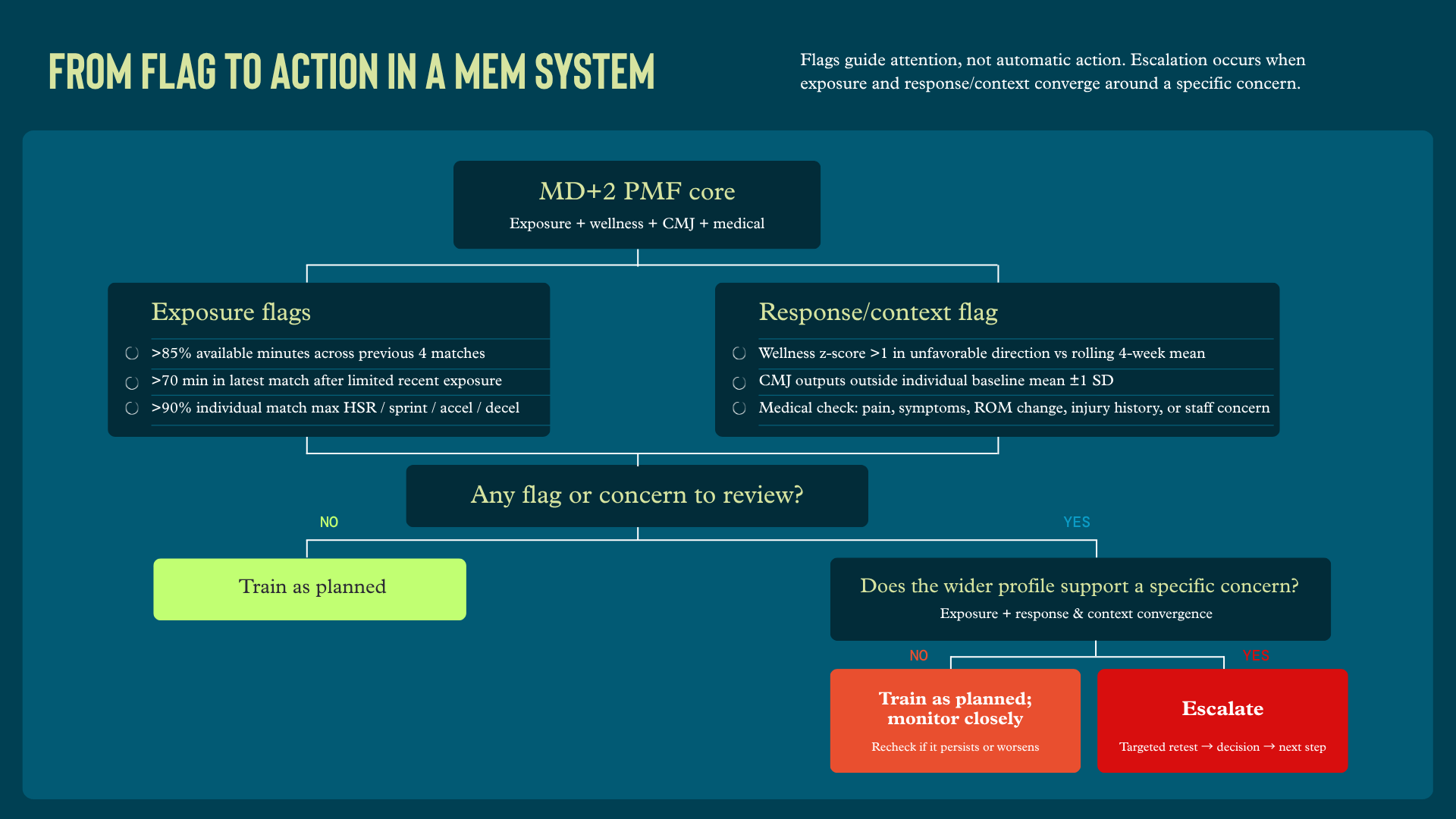
This changed the value of the system. Reporting became faster, staff discussions became shorter, and coaches received clearer recommendations. Players were asked for less, but what they provided was more likely to influence practice.
In a resource-rich but capacity-limited environment, the best monitoring system was not the one that used every tool available. It was the one that helped staff make better decisions every week without collapsing under its own weight.
Build the system you can—and will—actually use
Instead of asking “What else can we measure?”, high-performance teams should ask what they need to know to make better decisions, and how they can measure it without adding unnecessary burden.
Not every uncertainty in sport can be solved by adding another variable. Some uncertainty is part of the game, and trying to remove all of it through endless data collection often creates a false sense of control.[13]