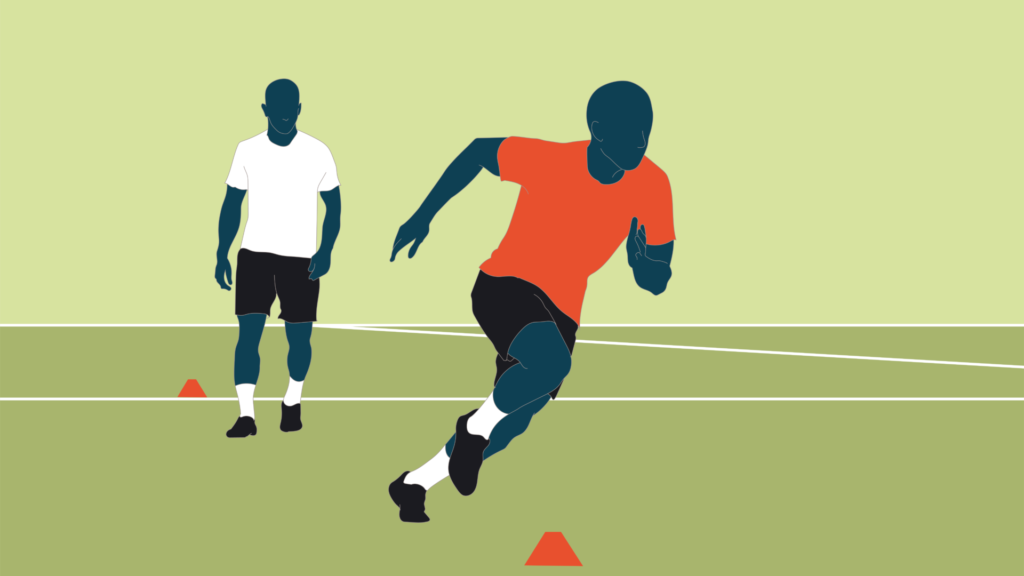


We shouldn’t need any references or in game stats to convince coaches that athletes change direction a lot, and they need to be good at it. And because training change of direction speed (CODS) is a fundamental practice, testing it should be, too.
My academic side craves validity and reliability, leading me to be overly reductionist in my thinking. I like to isolate the variable that we are measuring because I want to be all but certain that any test score represents the athlete’s capacity to perform a specific skill. Equally, I aim to be as certain as possible that I have captured the true score, so that when we test them again, I can detect and declare the tiniest of changes to be “real.”
As a coach, on the other hand, I need efficacy and efficiency. I base decisions on logistics, on time and resources, and what I can actually do with any data I generate – including whether, realistically, I will even use it. I see the athlete as a complex system, influenced by a multitude of factors, inseparable from their environment.
Appeasing these two aspects of my nature sometimes requires compromise, as we’ll see as we take an overview of testing CODS, covering the following areas: what we miss by not testing agility, the differences between CODS tests, assessing CODS as a discrete skill, and finally, its utility when layered with other tests to determine speed deficits and between limb asymmetries.
Tweet ThisWe shouldn’t need any references or in game stats to convince coaches that athletes change direction a lot, and they need to be good at it. And because training change of direction speed is a fundamental practice, testing it should be, too
@anthonyturneruk
Change of direction speed vs. agility
Change of direction speed is different to agility because COD requires no external stimulus for the athlete to respond to. CODS tests therefore do not allow athletes the opportunity to demonstrate their superior visual scanning and decision-making skills.
This is an important point because these factors often differentiate the best performers. Tim Gabbett [1] showed that elite athletes, compared to non-elite athletes, achieved faster times in an agility test involving players responding to a coach’s movements. However, there was no difference between players during a pre-planned CODS test. While this may sound like a compelling argument to include agility tests, that’s not necessarily the case for strength & conditioning (S&C) coaches.
S&C coaches build athletes that are physically capable of meeting the demands of the sport, which are dictated by the tactics of the team coach. CODS tests better reflect this role and the accountability we have within the team.
Consider that visually scanning the field for cues and trying to find patterns in play that help you determine your next action takes years of game time to develop. The athlete’s brain is constantly revising a myriad of possible scenarios based on the position of their teammates relative to their coach’s tactical instructions, where the opponents are, what they anticipate the opponents will do, and, of course, where the ball is relative to all this.
We can develop this within our S&C practice, but it complicates how we are evaluated and how we (and others) determine if we are doing a good job.
S&C coaches should be judged on whether our athlete turns up to training each week (their robustness) and, relevant to this article, has the physical capacity to do what the coach asks of them (their readiness). If an athlete makes a poor (non-fatigue related) decision on the field – a bad pass, turns the wrong way, or the team concedes a goal – that’s not on us. We should be held accountable to whether they can turn fast enough, independent of any reactive element.
Setting that argument aside, consider the time and expense required to create an agility test. One of the starkest difficulties for designing any agility test is that the stimulus must constantly change, otherwise it is essentially a closed skill test again. The stimulus must be relatively elaborate too. It can’t be a coach holding up a cone, indicating which direction the athlete should run in. Not only does that not provide a relevant stimulus, but it puts the athlete in a 50-50 situation where they may just pick a side before they set off. Contrastingly, these requirements for high test variability make it hard to determine actual changes in performance.
Tweet ThisS&C coaches build athletes that are physically capable of meeting the demands of the sport, which are dictated by the coach’s tactics. Compared to agility tests, CODS tests better reflect this role and the accountability we have within the team
@anthonyturneruk
What coaches should look for in a CODS test
There are lots of CODS tests out there and, of course, coaches are inventing them all the time. Stewart et al. [2] investigated the difference between five different CODS test: Illinois, pro agility, 5-0-5, L-run, and the T-test. Scores on these were all strongly correlated across a group of 44 sports students, meaning the tests all broadly examine the same athletic ability, i.e., how to change direction. The broader interpretation is that athletes are not inherently better at one CODS test compared to another, despite differing mechanics and differing sporting backgrounds. If you want to develop one in particular, then train it, but expect plenty of carryover to the others.
Given that, coaches should choose whichever test best replicates the movement demands of their sport. However, in the quest for sport specificity, don’t choose a test that contains so many turns that it is hard to tell what you are testing.

Can we isolate CODS?
Tests that include a skill based or decision-making challenge can confound our assessment of change of direction speed, along with our influence on the athlete’s aptitude in the different components of the test. Likewise, if we don’t want our CODS test to be a measure of speed, the turns need to be sharp (> 60°) [3] and frequent, but not so many that the test becomes a measure of anaerobic fitness. Also, the total distance should be short. We might even want to just zero in on one turn, leaving us certain of what the test is measuring, e.g., CODS while turning 180° or 90°.
Let’s use the example of the modified 5-0-5 test: starting behind timing gates, the athlete accelerates 5 m, makes a 180° turn, then accelerates back past the gates again. The test covers a total distance of 10 m, which is so short that speed and anaerobic capacity are less likely to influence the outcome.
Perhaps, however, we could reduce distance by going with a 4-0-4 or 3-0-3 design. That would increase the percentage of the test that is spent decelerating and turning.
But as the test gets shorter, the athlete would naturally have less velocity (and thus momentum) going into the turn, potentially making it a submaximal test with respect to the deceleration demands. Plus, as this type of test gets shorter, its reliability may decrease until you lose your ability to be sensitive to small changes.
How quickly tests grow
These are just possible risks. There is merit in these shortened versions, and practitioners and researchers should investigate them. But at the end of the day, if turning 180° and turning 90° are fundamental to your sport, then test both, but in separate tests so you can isolate which needs more work.
That said, when you consider we need to test the right leg and the left leg at each turn, we’re now up to four tests. Plus, we need two or three attempts at each to determine the standard deviation, which will give us thresholds for meaningful change [4].
Two tests became four tests and now the athlete is doing 12 trials. Do we have the time and the resources for this, and will the coach carve this much time out of their sessions to collect these scores? Will our athletes unreservedly engage in a multitude of fitness tests? Also, we are going to produce a lot of data here, especially if we look at speed deficits and asymmetries (more on them in the next section).
We must consider the utility of this data: will we actually use it all to inform our practice?
If the answer to all those questions is yes, then collect it all. More likely, you’ll have at least one “no,” in which case, pick a single test.
A 180° turn is a more complex skill, a greater challenge to the athlete’s braking capacity, and requires fewer timing gates, so that will probably be your best option.
How can we justify reducing two or four tests, or 12 trials, down to one?
If you train CODS, you are likely to train turns at a range of angles, hopefully in proportion to your perceived benefit of each relative to competitive performance. It stands to reason that if your athlete is improving in one, they should be improving in them all. This is the same logic we hear when testing and training strength. If you train an athlete’s back squat, you assume they have improved across all the squats (albeit not in equal measures), even if you test these improvements with an isometric mid-thigh pull, which is a movement you may not even train.
Ideally, we expect our testing data to reveal the correlations or differences between the strongest athletes and the fastest or the most powerful athletes, letting us determine the most effective exercises. But realistically, the results we observe often define relationships between the athletes who train and therefore get good scores, and those who don’t train and therefore don’t get good scores. It’s a sufficiently logical thread to follow: if you’ve been training an athlete through a range of turn angles, and they conscientiously train and test with intent, then if they improve on a 180° test, they have improved across the full spread of turn angles.
There is too much between-turn carryover for braking and propulsive forces, and athlete skill in terms of foot placement and body alignment, for these statements to not hold true.
Tweet ThisThere is merit in shortened COD tests, and they should be investigated. But at the end of the day, if turning 180° and turning 90° are fundamental to your sport, then test both, but in separate tests so you can isolate which needs more work
@anthonyturneruk
How can we get more out of our CODS test?
Should our CODS test help us determine asymmetries between left and right leg turns, and identify any speed deficits by comparing how fast the athlete would run the same distance without turns?
The change of direction deficit (CODD) provides an indication of an athlete’s CODS beyond the time to complete a test [5]. The CODD is the athlete’s traditional 5-0-5 time minus their 10 m time. A smaller value means better COD ability.
This method accounts for the athlete’s acceleration (or speed) capacity that you would otherwise struggle to evade without falling back on multiple turns, sharp turns, or shorter test distances. The CODD is thus a reflection of COD capacity, designed to ensure we are not simply running a disguised speed test, where the fastest athletes win. In support, the correlation between 10 m speed and the CODD is often close to zero [6,7], whereas there can be a significant moderate positive correlation between 10 m speed and the traditional 5-0-5 [7]. But this does also imply that a modified 5-0-5, which reduces the influence of an athlete’s speed, lessens the value of measuring CODD.

Interestingly, when splitting a group of athletes into high and low performers with respect to CODD, the fastest athletes, especially those with a high body mass and thus momentum, had the highest CODD [8]. This is logical as an athlete’s momentum largely governs their capacity to decelerate and change direction, explaining why we occasionally also note significant negative relationships between speed and CODD (i.e., as speed increases, so too does the deficit) [9,10]. This is why we have to control for speed and body mass in interpreting CODD results.
These results also underlie why we sometimes see non-significant [10] and significant negative relationships between 10m speed and the traditional 5-0-5 [11]. But another confound is that we don’t always ensure that the athlete’s approach 10 m speed in the traditional 5-0-5 is ≥ 95% of their 10 m max speed. If they don’t attain maximum speed, they are not taxing their maximum deceleration capacity (also making comparisons between athletes invalid). Placing timing gates at the start could maximize the utility of the CODD.
By way of example, each scenario below assumes the athlete achieves ≥ 95% of their 10 m velocity as they enter the 5 m deceleration zone, and that they demonstrate similar COD mechanics.
If the body mass of our group is relatively uniform (including fat free mass), then the peak approach velocity of the athlete would largely dictate the momentum that they would have to overcome to change direction. The fastest athletes could then have the highest deficits, that is, we would assess them as having less ability to change direction.
If we assume our athletes attain similar max speeds but have different body masses (as a consequence of fat mass), each athlete’s body mass will largely affect momentum and, again, underpin performance.
But when athletes have similar momentum going into the turn, despite varying body masses and approach velocities, there may not be a relationship between speed and CODD.
Presenting the data as a ratio of sprint momentum relative to turn time, similar to how you compute the reactive strength index, could be the best approach for tests that zero in on assessing an athlete’s deceleration capacity.
Body mass = 70 kg
- Peak approach velocity = 4 m/s ∴ peak approach momentum = 280 kg·m/s
- Peak approach velocity = 5 m/s ∴ peak approach momentum = 350 kg·m/s
- Peak approach velocity = 6 m/s ∴ peak approach momentum = 420 kg·m/s
Peak approach velocity = 5 m/s
- Body mass = 60 kg ∴ peak approach momentum = 300 kg·m/s
- Body mass = 80 kg ∴ peak approach momentum = 400 kg·m/s
- Body mass = 100 kg ∴ peak approach momentum = 500 kg·m/s
Peak approach momentum = 350 kg·m/s
- Peak approach velocity = 4 m/s ∴ body mass = 100 kg
- Peak approach velocity = 4.5 m/s ∴ body mass = 77.8 kg
- Peak approach velocity = 5.5 m/s ∴ body mass = 63.64 kg
This variety of correlations (+ve, -ve, and ~ 0) presented and explained above can support the case for and against testing CODD. We have to account for more than just speed or time. We have to consider body mass and momentum, and how the athlete controls approach velocity relative to their maximum capacity over that distance. Without this context, we cannot just assume that speed and CODS are significantly correlated, nor that CODD and speed are independent qualities.
Bearing in mind our starting point of a time efficient testing process, we may have just talked ourselves out of the CODD in favour of shortened distance tests such as the modified 5-0-5.
Limb asymmetries
The average inter-limb asymmetry from a traditional 5-0-5 test is too small to act on. In fact, what little difference is noted, is often within the error of the test. For example, mean scores for the traditional 5-0-5 in female youth netballers was 2.531 ± 0.089 s and 2.590 ± 0.104 s for the dominant and non-dominant side, respectively [10]. This generated a mean difference of 0.059 s and an imbalance of 2.3 ± 2.3%. In academy footballers (U16 – U23), the average scores for the left and right legs, across all squads, was 2.48 ± 0.07 s. and 2.49 ± 0.08 s, respectively, again suggesting trivial differences between limbs [12].
Given the small differences between the left and right leg (or dominant and non-dominant side), the 5-0-5 test is not appropriate to detect meaningful imbalances. In fact, it is so small that from week to week either the dominant or non-dominant leg could perform better in the 5-0-5 test, simply through chance or indirect factors such as poor diet and sleep.
Even if you did consider differences greater than the error (~ 3%) as meaningful, because the output variable is time, you cannot readily determine the root cause of the existing side to side imbalance. It could be due to a faulty motor pattern (you practice one side more than the other), a movement compensation, a reduction in force capacity during the braking or propulsive phase, or some combination of those.
Asymmetry testing like this is neither valid nor reliable. If you choose to do asymmetry testing as part of a testing battery, using the raw data (and not the percentage) from single leg jumps is likely the best option to identify any inter-limb deficiencies. Alternatively, assess the mechanics of the turn (more on this shortly).
Again, returning to our original framing, this obviates the need to run six trials to test the left leg and right leg independently over multiple angles.
Tweet ThisAverage inter-limb asymmetry from a traditional 5-0-5 test is too small to act on. In fact, it is so small that from week to week either leg could perform better in the test, simply through chance or indirect factors such as poor diet and sleep
@anthonyturneruk
5-2-180 is a valid, reliable, effective, and efficient CODS test
We’re closing in on a single CODS test that captures one type of turn but assesses both limbs, something like the pro agility test, where the athlete turns off both limbs, but with only 5 meters between turns.
The richness of the data comes from how they turn, the mechanics of their foot placement, weight distribution, body lean, and similar kinematic factors. If you have the time and resources and want to delve deeper than the total test time, set up a video camera to assess these attributes. Most cameras have a recording frequency equal to that of timing gates, so you can even explore time-based differences between sides. Not only will this provide actionable, detailed data, it won’t eat further into the coach’s and athlete’s precious training time – only your own time when you analyse the videos back in the office.
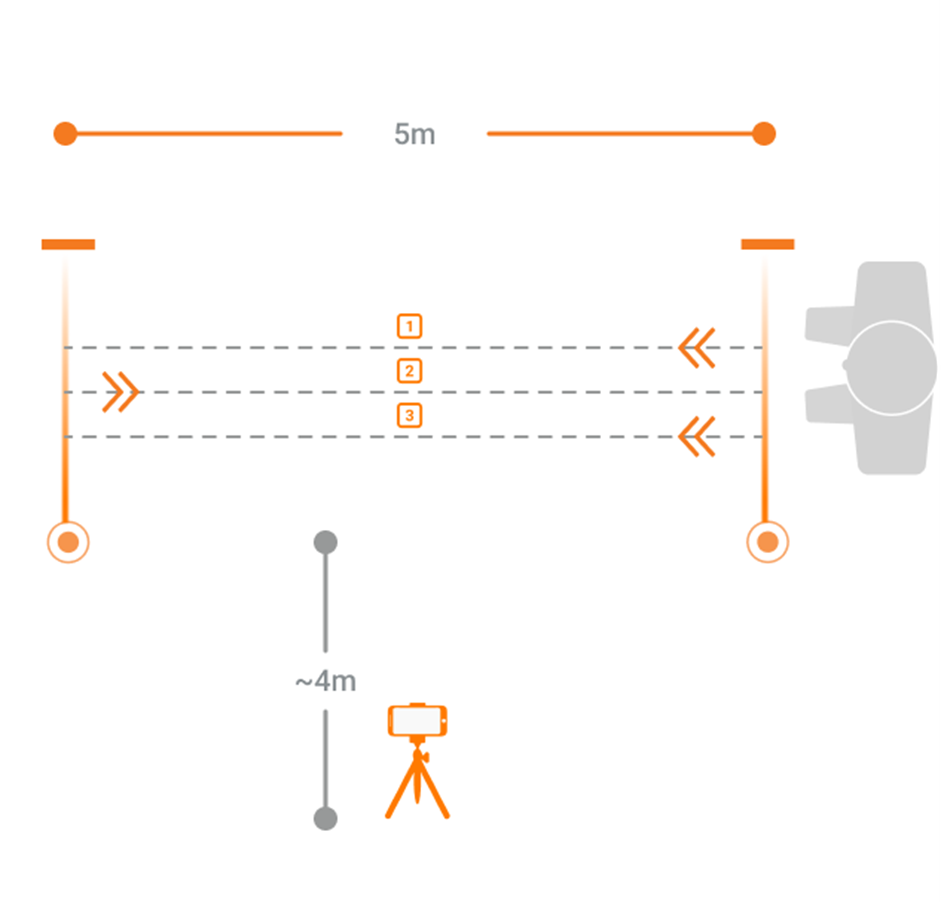
The 5-2-180 test covers 15m of total distance, with 5m between two 180° turns (Figure 2). It is both a CODS test and, by its very nature, a deceleration test.
This test uses two light gates to measure two turns. The athlete always faces the same side (and camera) when they turn, thereby turning off both legs.
The athlete starts 30 cm behind the starting gates (so as not to prematurely break the beam), sprints to the turn line 5m away, performs a 180° turn facing the camera (assuming you want to include this), sprints back to the start line, performs a final 180° turn facing the camera (thus turning using the other leg), and then sprints through the finishing gates to complete the test.
All the assumptions from above come into play. Five meters is as close to an optimal compromise as we can get to ensure the test doesn’t get skewed by the athlete’s speed and anaerobic fitness, while still requiring the athletes to slam on the brakes, and generating reliable data. We’re not putting any stock in asymmetry scores. Speed is likely an independent quality so we don’t need to measure the CODD, and we have limited time to do what we need to do.
And the big assumption: if we coach an entire COD curriculum, by detecting improved performance in one turn, the athletes are improving in all of them – especially as this test assesses the hardest one.
Tweet ThisThe 5-2-180 test covers 15m of total distance with 5m between two 180° turns. It is both a CODS test and, by its very nature, a deceleration test. Speed is likely an independent quality so we don’t need to measure the CODD
@anthonyturneruk
Visually assessing the turns in the 5-2-180
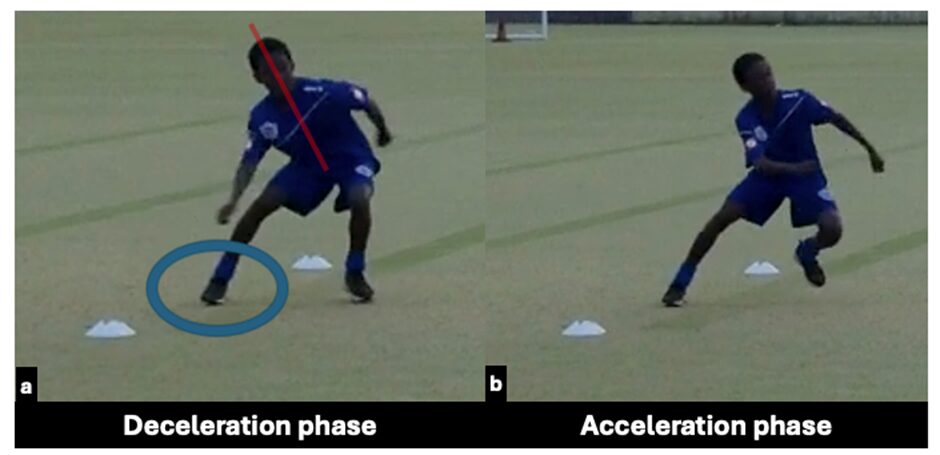
Video analysis of and feedback on the athlete’s COD mechanics will underlie the greatest improvements coming out of the 5-2-180 test. The scoring system is similar to the sprint mechanics assessment score of Bramah et al [13].
While there are many ways to change direction, including several ways to make a 180°, the example below will focus on one of the most complex forms, again on the assumption that the mechanical principles and knowledge an athlete develops from this will transfer to the others.


| Phase | Movement sequence | Left leg | Right leg | Score | |
| Deceleration | a | Distance between CoM (hips) and CoP (foot) increases as athlete “sits” | Yes ☐ No ☐ | Yes ☐ No ☐ | |
| b | Athlete re-orients themselves into a side-on position | Yes ☐ No ☐ | Yes ☐ No ☐ | ||
| c | Penultimate foot contact: inside leg performs a shallow squat to transfer energy. | Yes ☐ No ☐ | Yes ☐ No ☐ | ||
| Acceleration | d | At final foot contact: 1. Upper body and shins are aligned to direction of travel (~ 45°) 2. CoM (belly button) falls outside narrow BoS (feet); head NOT between toes 3. Outside leg “bounces” off ground | 1. Yes ☐ No ☐ 2. Yes ☐ No ☐ 3. Yes ☐ No ☐ | 1. Yes ☐ No ☐ 2. Yes ☐ No ☐ 3. Yes ☐ No ☐ | |
| e | Outside leg: 1. knee drives ~ horizontally forward 2. foot stays close to ground, and will pass ~ below opposite knee | 1. Yes ☐ No ☐ 2. Yes ☐ No ☐ | Yes ☐ No ☐ Yes ☐ No ☐ | ||
| f | Athlete achieves acceleration posture: 1. ~ 90° at ankle (dorsiflexion) 2. ~ 90° at knee 3. ~ 90° at hips 4. Shins run ~ parallel | 1. Yes ☐ No ☐ 2. Yes ☐ No ☐ 3. Yes ☐ No ☐ 4. Yes ☐ No ☐ | 1. Yes ☐ No ☐ 2. Yes ☐ No ☐ 3. Yes ☐ No ☐ 4. Yes ☐ No ☐ | ||
| Total score (out of 24, 12 points per side) | |||||
Figure 4 highlights one of the most likely candidates for an incorrect movement sequence. Here, the athlete uses the outside leg to make the 180° turn. By changing direction using the outside leg, it is hard to arrest momentum going into the turn. This generally causes the upper body to tilt away from the intended direction of travel (leaving the head between the toes). The inside leg will then have to be repositioned following its initial landing before it can usefully accelerate the athlete forward. These errors increase the time expended to change direction.
Of course, there will be plenty of occasions within a competition where the athlete will need to do this, and indeed, we should teach this (outside leg strategy) as part of a comprehensive COD curriculum. But being a closed skill test, the athlete should be able to perform it as instructed, using the inside leg.
Conclusion
Most coaches conduct fitness testing batteries that require them to measure a host of physical characteristics, and they normally aim to do this multiple times throughout the year. They want a holistic measurement of athleticism in their athletes, recognising that they can test each physical characteristic in several ways. Unless the coaches have a particular bias or the athlete has particular needs, they will base their choices on what is commonly done, what tests best represent the physical capacity in question, and what is quick and easy to administer.
The 5-2-180 is an appropriate test of CODS and deceleration. Other CODS or deceleration tests, like the traditional 5-0-5 or the horizontal acceleration-deceleration ability [14], are best reserved as “specialist” tests for delving deeper into the physical profile of an athlete. This could be justified by specific positional demands that require a more thorough analysis of a particular capacity, or as part of a comprehensive return to play test battery. For example, it may be fundamental that the turning and deceleration capacity of some athletes are tested following much higher entry velocities.
The 5-2-180 is a compromise between academic rigour and coach utility.
Tweet ThisMost coaches use testing batteries that require them to measure various physical characteristics. The 5-2-180 is an effective test for CODS and deceleration, offering a balance between academic rigor and coach utility
@anthonyturneruk