
How do you bucket your athletes to make it easier to programme and work with larger groups?
We usually do a force-velocity profile (FVP) to set a baseline and then measure change at certain points throughout year. The FVP comes from a timed or radar measured 40 meter run. Based on the timed intervals, we can see where each athlete is strongest and weakest within a run. We then place the athletes into one of three buckets: one focusing on acceleration (force), one on top end velocity, and one for athletes showing a balanced profie, which is like a mix of both groups. We can subdivide each group based on more specific needs, such as more technical work, physical work, or both.
Tweet ThisWe bucket athletes into three groups based on their force-velocity profiles: acceleration, top-end velocity, and balanced. This helps tailor training to each athlete’s strengths and weaknesses, ensuring they get the specific work they need
@_KyleBolton_
The acceleration group will spend more time on early acceleration with heavy resisted runs, early acceleration technique, and longer stretch-shortening cycle (SSC) jumps. The goal is to increase how much force they can produce at the start of a sprint. This group will still work maximum velocity, but not to the level of the top end velocity group.
That group will quickly move through the heavy resisted sprinting phase and spend more time working on late stage acceleration, max velocity, top end technique, and faster plyometric SSC exercises. Their goal is to learn how to spend less time on the ground and sustain velocity longer.
The athletes in the balanced group are neither too strong nor deficient in force or velocity. They will spend more time focusing on the later stages of each component.
These groupings extend beyond just field work, as they can help shape how we train athletes in the weight room, as well. We can keep the athletes in those groups in the weight room and program exercises that improve the specific needs for each group.

How do you use resisted sprints for technique development?
Tweet ThisExternal resistance is a great teacher. It helps athletes learn proper sprint technique through self-realization without the need for excessive coaching cues. Resistance can guide athletes to correct issues naturally
@_KyleBolton_
External resistance is a great teacher. External resistance can help teach the athletes technique through self realization, avoiding the need to overly cue them. With the help of different resistances, athletes can explore, feel, and learn how to properly apply force. In some cases, resistance can help the athlete self correct various issues.
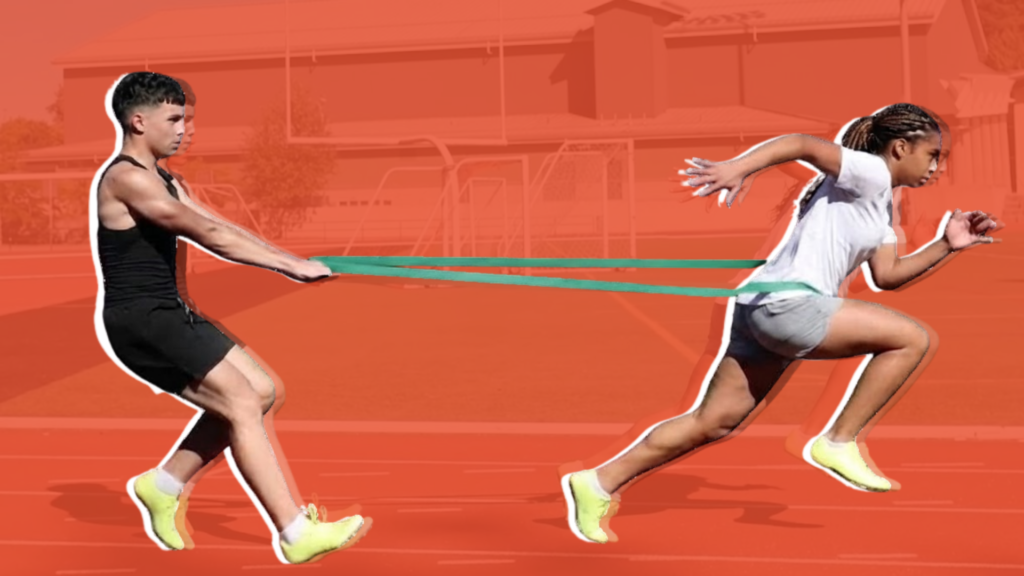
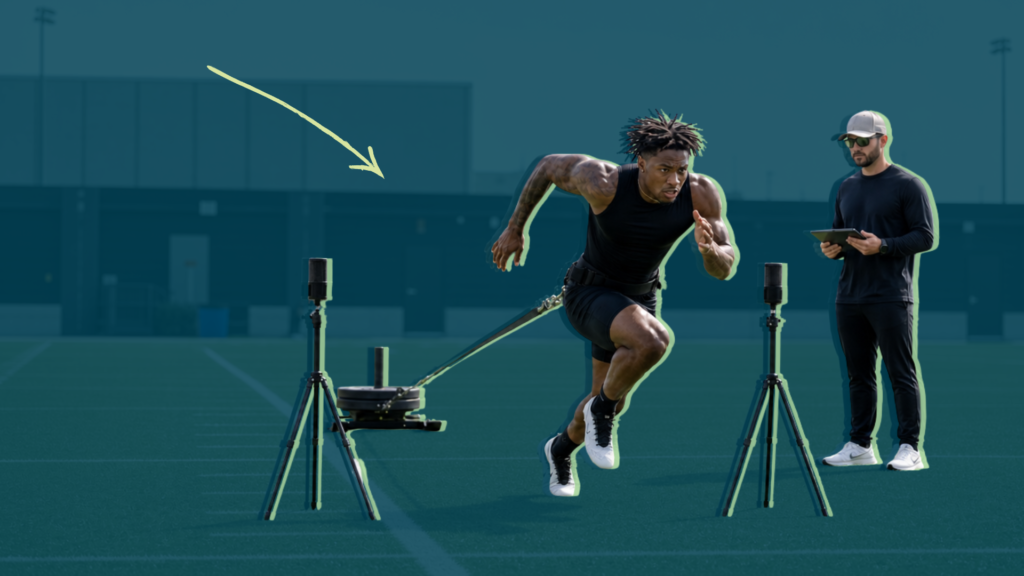
With heavier loads, we tend to work more acceleration and force production. This requires the athlete to have a steeper shin angle and body lean. Good methods for this are prowlers, dog sleds, heavy resistance bands, and decently steep hills.
Lighter resistance is optimal for top end work and upright mechanics. This ensures that we still maintain enough force to drive forward, but not so much that it requires a deep shin angle or body lean. With the weight being so light we look towards more chains, dog sleds, and, at times, lightweight vests.
There is still some debate whether too much resistance takes away from proper sprint technique. One side holds that during any stage of training 10-20% BW or velocity decrement is sufficient to elicit a training stimulus while maintaining proper running form. Technique will suffer by adding resistance, making the run less efficient.
The other side is that very heavy resistance runs are a great way to teach people how to apply and generate force during early acceleration phase, and provide a better training stimulus. Although technique may suffer some, that detriment is negilgible and acceptable due to the positive outputs.
Both views have their merits, and it ultimately comes down to your coaching style and preference.
How do you load athletes for resisted sprints? Is it based on the “buckets?”
After determining each athlete’s FVP, we develop a load-velocity profile (LVP). This entails the athlete performing 3-4 timed runs with loads at 35% BW, 50% BW, 75% BW and 100% BW. These splits show you the athlete’s theoretical maximum horizontal force, theoretical maximum velocity, maximal horizontal power output, and the optimal sled load (usually about 50% max velocity decrement).
Tweet ThisWe use load-velocity profiles to program individualized resistance for each athlete rather than applying the same load to everyone. This ensures each athlete gets the optimal training stimulus for their specific needs.
@_KyleBolton_
The LVP lets us program a more individualized resistance weight for each athlete, rather than flat loading an entire team with the same weight.
After we bucket the athletes into their groupings, we can apply the individualized weights. All athletes will begin the program at the same point, with heavy resisted sprints. As the block progresses, those who need more work on initial acceleration will continue to train with heavier resistance (more velocity decrement) for most of the training block.
Athletes in the velocity bucket will progress faster out of heavy resistance and begin to focus more on lighter resistance and no resistance to help improve their deficiencies.
What techniques have you used to run resisted sprints with large groups?
Unless you have access to a 1080 Sprint, providing each athlete in a group with their individual optimal sled load becomes a bit harder to provide. However, the bucketing process shows us which groups the athletes belong to so we can organize the groupings within the buckets. Athletes that have roughly the same optimal load can be paired together. This allows us to get closer to each athlete’s optimal load, and save time by not having to continuously change weights for every player.
The flywheel based Run Rocket (RR) is another tool to ease the burden of implementing resisted sprints in a large group. Separate your athletes based on their optimal load on the RR. For example, in lane 1 you might have four athletes that are strong and can be on level 30. Lane 3 will have athletes on level 25, and further down you may have athletes that are on level 18. This makes transitioning cleaner and saves time.
This will take time on the front end for a coach to organize and structure his grouping, but in the end it pays off significantly.
A key to remember is that when pulling a sled, the body cannot distinguish small differences in weight (5-10 lbs). Heavy is heavy. Keep this in mind and you’ll have an easier time grouping athletes in similar weighted sled runs.
After you have these groups and sled lanes sorted, you can keep the athletes in the same line for the entire workout and move as a full team down the field, with stations that match the theme of the day. These complexes help you be efficient with large groups, are easy to manage with a small group of coaches, and allows the team to stay together and see each other work.
How do you use complexes to help with managing large groups?
Tweet ThisComplexes in training involve setting up drills that flow from one to the next, matching the theme of the session. This approach keeps large groups organized and efficient, allowing seamless transitions between exercises
@_KyleBolton_
Complexes can be set up in different ways, but the most effective way I have found is by matching the themes of the training session. Start one drill at one end zone and move down the field with various other drills ending at the opposite end zone. Once you finish the entire complex, you can restart at the top and flow through it again, or move on to the next part of training – all depends on the set and rep scheme for the complex.
For example, begin with a technical drill, followed by a resisted run, move onto a free run, finally end with a plyometric.
Order the drills to help prepare or potentiate the athlete for the next one. The beauty of the complex is that it is plug and play – you can easily move the plyometric or add another drill, such as an agility or deceleration focus.
The key to complexes is setting up lanes and groupings, so that athletes can just move from one exercise to the next without having to do anything besides jog straight down the field to the next start cone. Imagine track lanes, where every 20-30 yards there is another start cone for a new drill. That is how we have made things easy on the coaches and athletes. We number the cones and let the players know which lane they are in or put it up on a video board and let the players sort themselves.
Coaches will have to put the time in on the front end to organize groupings, field lay outs, lanes, and spacing. But if you can figure this out, it becomes an amazing tool to use in a large group setting when you want to keep the team together.
The real limitations to the complex are a lack of equipment and limited space. If you are short of equipment, traditional small stations may be more feasible.
What is the most overhyped thing out there when it comes to speed training?
Tweet ThisThe biggest mistake in speed training is thinking you need the newest tech or to profile every athlete. Some of the fastest people trained with just a hill. Often, just working on sprint basics yields great results without fancy equipment
@_KyleBolton_
Making the mistake of thinking that you must do the newest training, or that you have to profile every athlete. Speed training has been around for what seems to be eternity, and some of the fastest people ever were never profiled or had fancy equipment. Some athletes and coaches had nothing more than a hill, and others not even that!
Too often we hear that we need to profile everyone to figure out where to help them. Some of the best team sport athletes at all levels still have issues with dorsiflexion in the ankles. That is low hanging fruit, and if you fixed it you could help improve their speed. Although profiling is very useful, most team sport athletes have such a low training level of proper sprinting that just working general sprint basics will yield good results.
If you are at a place that has the resources, staff, and time to profile each athlete, then sit down to examine and plan for each group, there is merit behind it. But we need to first assess the return on investment: is it worth the time and resources to go that route, or can you keep everything simple and generalized and get good results?
The more time I spend learning from others, and working with athletes and teams, the more I find that keeping everything simple is best practice.