Force-velocity profiling is becoming more and more common as practitioners want to individualise sprint training for their athletes. But using timing gates, radar or laser systems to perform the necessary assessments can be difficult in a team sport environment when time is precious. Therefore, because many athletes are already wearing GPS devices, it makes sense to use these to perform the force-velocity profiling in-situ. But is it reliable and how do you do it? To answer these key questions, we asked Data Scientist at Paris Saint Germain FC, Pauline Clavel.
Why conduct a F-v profile with team sport athletes?
Sprinting is a key physical determinant of performance in team sport, especially in soccer [2,4].
Therefore, to enable the development of more targeted training programs and improve sprint performance, it’s crucial to determine individual players’ sprint capabilities.
The macroscopic linear force-velocity (F-v) relationship delineates the mechanical capabilities to produce horizontal force during sprint running [9]. Sprinters generate both high forces and high velocities to maximize horizontal power, which is a major parameter of sprint performance [8]. At the beginning of a maximal sprint, the athlete generates high amounts of force at a low velocity to accelerate the body forwards [7]. As running velocity increases over time, the force output decreases.
Constructing an F-v profile with a team sport athlete is a great tool to assess, understand, monitor and follow individual training to optimize sprint capabilities.
What are the steps to successfully set up an F-v profile? How can we maximize data quality if using GPS?
Constructing individual F-v profiles is quite easy if you have access to a timing gate, radar or laser system. The complexity arises when practitioners have to construct individual F-v profiles for a complete team of, say, 25 players. Indeed, practitioners have to allocate a specific session in order to test player by player, and then analyze the input data one by one. Of course, in elite sport environments, time is precious and practitioners need the agreement of the technical staff, as regularly analyzing a complete team can be very time consuming.
Performing F-v profiling by using GPS devices can simplify multiple aspects. First, no set up or additional devices are needed – just the GPS, which the players already wear during training sessions. That allows us to test players one by one, in groups or all at the same time. Then the only thing to do is to download the data, split the sprints and input the data into a custom algorithm that computes the profiles automatically.
When using GPS, maximize data quality by switching on the GPS 15 minutes prior to the warm-up, outside in an open field stadium: no obstruction, clear view of the sky and without surrounding metallic structure to prevent any potential interference. We have to maximize the number of satellites (> 6) and minimize horizontal dilution of precision (between 0 and 50, ideally < 1) to be within range of good signal quality [6].
To construct a valid and reliable F-v profile, is a GPS device that collects data at 10 Hz a minimum requirement? Would data quality improve further if collected using 20 Hz?
GPS have become standard tools for determining movement patterns during training sessions and games [1]. GPS devices between 1 and 15 Hz are valid and reliable tools to measure total distance covered, but the low sample rates have limitations when determining distances covered at high speeds, accelerations over short times and speed during changes of direction [12]. Sample rates above 10 Hz manage most of these limitations, but sampling rate alone will not improve the quality of GPS data, as other factors such as chip set processor, filtering methods and data processing algorithms may come into play.
In our study, we compared a 10 Hz GPS device including a double constellation (i.e., GNSS and GPS) with the results from Nagahara et al. [10], who used 20 Hz GPS units and a single constellation. A previous study showed using a double constellation system significantly improved both positioning accuracy and integrity monitoring [3].
Optimally, the higher sampling rate (which does not rely on any interpolated data, which is not true with standard GPS sampling) and GPS device accuracy lead to a more valid F-v profile. Indeed, the observed differences between measurement systems in F0 and Pmax may be the results of the GPS having a signal frequency one-fifth of the radar’s or instantaneous signal’s.
Lacome et al [5] had similar results, supporting the reliability of GPS for F-v profiles.
Could the method of using GPS versus a radar gun be used to collect an “acceleration-speed profile”?
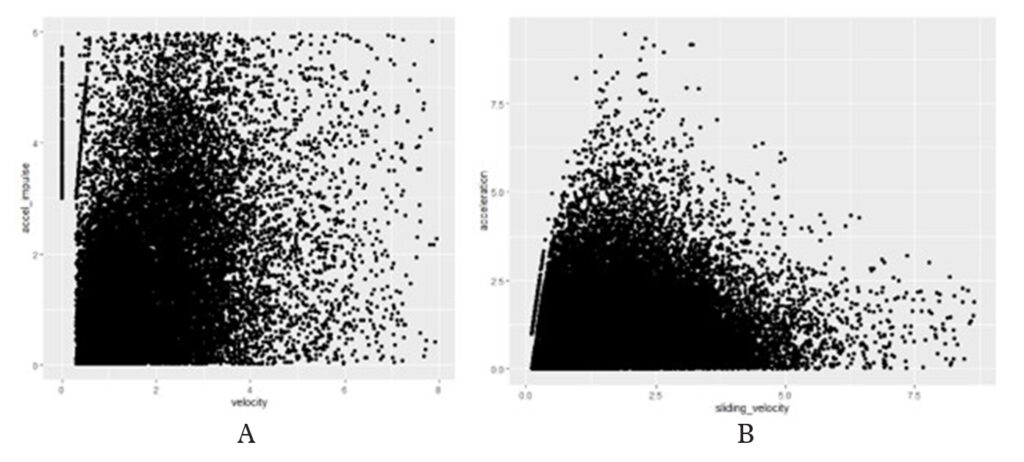
GPS devices that are valid and reliable can be used to collect running position, speed and acceleration to construct an “acceleration-speed profile.” These devices include the GPEXE Pro2, Catapult S7 or Statsports Apex units. However practitioners have to be very careful with the data involved. Depending on the manufacturer’s software, some allow practitioners to access the raw data, while others automatically interpolate and smooth data (i.e., software-derived data). To prevent some errors, JB Morin advises displaying a scatter plot of acceleration-speed data. This graphical representation makes it easy to see if the data make sense. For example, it is physiologically impossible to have high acceleration outputs at high running speeds.
To gather the sort of information needed to create a F-v profile, do we need access to the raw data or can Catapult users do this type of analysis in the manufacturer’s software? Is the raw data always available?
Most of the time raw data are available and the manufacturer keeps their software-derived data to themselves. Practitioners have to be very careful with the metrics and how to use them.
Regarding Catapult, the raw speed data are available. We used it with some data processing and filtering to construct the F-v profile.
What are the biggest mistakes you see young practitioners / clinicians make and what advice would you give them to help?
One of the biggest mistakes when using GPS devices is not checking the quality of data. Because GPS provides a high amount of data, we basically have a process and we can quickly “forget” to check whether the outputs are valid or if we are using good metrics provided by the manufacturer.
Practitioners should collect data in a good environment and set up a process to check the quality of the data, especially when not training or playing in their usual conditions: keep a close eye on the number of satellites, horizontal dilution of precision and summary values by players. On top on that, it is very important to understand why we are using a metric and how it is calculated to be sure it describes what we would like to describe, especially if the software provides the metric.
The success of F-v profiling is highly dependent on the correct collection, generation and interpretation of athletes’ mechanical outputs.