The term “game speed” has grown in popularity within the industry over recent years. Built from the foundations of general agility training, the aim to maximise transfer of training into competitive performance has resulted in more specific and contextual training.
Like most things, there is a broad range of definitions dotted around the literature. I like Tom Farrow’s statement that our goal is to “increase the likelihood that players are able to come up with a solution to the particular problem they face in any moment.” I think this process of breaking down the problem then building up the solution captures a key component of any successful game speed programme: integration.
Navigating between departments is a complex problem when we’re working to build collaboration between rugby coaches, analysts, physical performance staff and, often, players themselves.
At Gloucester Rugby, we have a rugby and analysis department that are often very open to a collaborative approach across all areas of our S&C programme, not just those aspects that touch on game speed. This is neither common practice nor a traditional approach, and I encourage any S&C coach to stimulate these inclusive discussions within their clubs. When working with coaches who tend towards a siloed approach, simply asking “What do you think the players need to improve so they can best implement your system?” goes a long way to gathering essential information.
Diving into the finer details requires continual concerted effort to maximise training effectiveness. However, it’s a necessary process to develop shared knowledge across the whole backroom team, maximising the potential of all skillsets, in turn increasing the likelihood that players will find effective solutions to performance problems.
Bobrownicki et al.[1] highlight the (often overlooked) complexities of an athlete’s decision making within professional sport.
Players face multiple layers of constraints at any given moment, including club philosophy, attacking principles, weekly tactics and each individual’s role within the current play call. These all influence decision making before the player can even react to the cues the opposition presents them.

By no means does that imply I’m against developing evasive qualities (as you’ll see later!). Every coach loves drills where the whole squad hits speed PBs when running off to celebrate with a player who’s just thrown a “left-right-left” step.
Obviously, the ultimate aim is to score tries. In Premiership rugby, teams that finish in the playoff spots (top four) typically achieve more line breaks and subsequently score more tries. The relationship between line breaks and tries is provably strong (r=0.85). Teams in the top four league positions average 8.6 line breaks per game, compared to bottom four teams averaging 5.0 line breaks /per game.
Developing the physical qualities to influence the ability to create line breaks is clearly very important to team performance.
However, different problems require different solutions. Earlier in my career, my game speed sessions involved a lot of these general evasive drills, which created a great buzz but seemingly made little difference to on field performance, where elite players play under many tactical constraints. I needed to question more and understand more.
Do they need to use footwork to create space?
Do they need to run, catch and pass square to manipulate and “fix” defenders to create space for others?
Many conversations with an array of coaches and players across rugby union and league have guided my thought process and understanding of what we are trying to influence within a game speed programme. From a physical perspective, two avenues have always presented themselves and explained the majority of a team’s linebreaks:
1) developing specific coordination to perform principles of play, enabling players to efficiently catch, pass and kick at speed within the team’s system;
2) developing evasive qualities to maximise the individual moments that occur outside of the tactical system.
These bring us face to face with the fundamental questions: do we wish to coordinatively underpin team principles or enhance individual threat? Are we building a system or looking for a superstar?
On-field tactical system sets the standards for game speed
We tend to associate game speed with agility and highlight reel moments. However, sometimes the physical solutions a player needs in tactical situations are not always about large changes of direction. In elite rugby, they are often about executing the coach’s tactical system exceptionally well with minimal physical limitations.
This may come at the expense of flashy social media posts, but coordinative overload (i.e., robust running) principles can have significant improvements on the ability to execute the team’s system. Ultimately, the tactical system is the primary driver of winning games, titles and trophies. An integrated game speed programme aims to ensure the players can perform the head coach’s system at optimal intensity.
Coaches must understand the key principle of play they are trying to influence, as tactical constraints typically drive representative drills. This often means a player knows where they are going and what skill they are required to execute. In other words, movements are pre-planned and manipulative.
“It is critical for players to understand what they are doing, where they are going and why. With such challenging time constraints, reliance on environmental information alone to plan and then execute their skills would be highly disadvantageous.” [1]
“Robust running” underpins the physical model
We explored a wealth of footage to understand trends in the movement requirements to keep pass and run options available. Maintaining a consistent technique model was essential for the patterns of movements that we wish to occur regardless of the scenario. A robust running model ticked a lot of boxes for the physical demands, with “upper and lower body separation” (also known as “chest out when rotating”) being a key driver of the desired movement strategy.
Popularised by John Pryor, robust running aims to optimise mechanics in a highly unstable and unpredictable environment. Built from Frans Bosch’s methodologies, robust running uses a coordination based approach to challenge efficient linear speed mechanics under perturbations and pressure, with the aim of developing stability, adaptability and robustness.
A key principle of robust running is upper and lower body separation.
A rugby player often has to perform a linear run at high intensity with the ball. This may seem simple. However, when rotating to communicate with their teammate on the outside, rotating and catching the ball in two hands on the inside, rapidly shifting the ball to the outside arm to free the inside arm to fend off the oncoming defender, to transferring the ball back into two hands and perform a 15 meter pass to score, all whilst travelling over 9 m/s, this simple linear run suddenly seems much more complex.
Being able to efficiently separate and rotate the upper body while minimising any disruption to running postures promotes considerable freedom to the attacking player to pass or run (“lift and hit” and “upright chest”).
Furthermore, by keeping the pelvis directed forward, the attacker displays minimal cues or signals for the read and keeps the run option available (“pass over the lead leg”). To ensure a successful integrated approach with a common language across coaching staff and players alike, we re-branded these movement principles to “pass-run-positions” to create the PRP Model. The PRP Model aims to achieve superior technical positions and running skills to achieve high pass success while maintaining a running threat.


With a system focus, we’re reverse engineering key principles of play to stress technical components and movement strategies. We categorise our game speed content into three sections: efficiency, capacity and transfer.
For example, in a high speed catch-pass action, we use the cue “pass over the lead” to encourage a rapid recovery of the swing leg and efficient frontside mechanics, two key components to effective upper limb separation. These actions allow the player to run “with speed and square” when passing. We aim to build these into stable habits (efficiency); and hope that the key landmarks from the technical model hold stable under greater velocities and time pressure (capacity), and within varying degrees of complexities or representativeness (transfer).
The complexity of these drills must continually scale up and down to match the players’ current skill level, which helps promote successful outcomes and encourages learning.
Drills that are “too complex” for the players’ current skill level causes execution rates to drop significantly enough that the drill no longer stimulates learning or technical adaptations.
Tweet ThisBeing able to efficiently separate and rotate the upper body whilst minimising any disruption to running postures promotes considerable freedom to the attacking player to pass or run
@d_grange23
Drill selection: Mind the gap between sport and S&C
It’s important to remember that we are looking to underpin the system in a simpler format, not replicate or replace it. I have previously been lost in the labyrinth of integration and representative practice, with players questioning “is this an S&C drill or is this a rugby drill?”
These experiences have led me to craft a few simple guidelines to avoid the grey area between rugby and S&C:
- Speed
- Increase entry and execution speeds vs. scenario
- Space
- Greater space between defenders to advantage attack vs. scenario
- Skill
- Pass-run focus or kick-run focus
- Signal
- Disadvantage defensive positions and hold tackle bags to reduce “long arm tags”
- Support
- Maximum of three players within the drill (ball carrier + two others)
With ecological dynamics’ rise in popularity and the increasing demand for “sport specificity,” navigating this rugby-S&C grey area has become more and more complex. Following these general guidelines has significantly aided my practice design, and subsequently the desired learning or adaptations.
Furthermore, at Gloucester Rugby we have spent a significant amount of time across the staff developing our ability to “co-coach” and collaborate within and between departments, a key pillar of an integrated team. This regularly results in S&C and rugby staff coaching within a drill. However, this does not come at the expense of clarity about what the drill should achieve.
Rotate leadership based on the needs of the moment
A key part of our coaching model is absolute understanding and agreement on what principle(s) the exercise, drill, game or session is developing, because that determines who the “head coach” is at that moment. If the development focus is a “physical” principle, the S&C coach is the head coach, regardless of how specific the drill may be. All other staff (other S&C, rugby coaches, analysts, physios etc.) are subsequently co-coaching that desired principle, restraining from diverting any player’s attention – not even towards their specific area of expertise. This division of labor alongside unity of focus captures the players’ attention, maximises the learning opportunity, and often creates that “buzz” that every coach strives for.

The above graph shows the results of a five week period targeting specific coordination to “keep pass-run options available.” Players were graded on pass accuracy and the technical landmarks of pass-run positions.
Initially, low percentages of pass-run positions suggested that the upper limb’s rotation when making a pass was largely distributed across the running cycle. An open pelvis (facing the touchline) was common, minimising any run option and failing to adhere to the principle of “keep pass and run options available.”
Following a five week training period, stats showed our players demonstrating more pass-run positions. This would suggest that our players are now frequently passing over the lead leg with high trunk control (chest out), resulting in minimal disruption from the running cycle. From a tactical standpoint, they are conveying minimal signals or cues, creating uncertainty and “freezing” defenders, coupled with the attacker’s technical ability to run or pass.
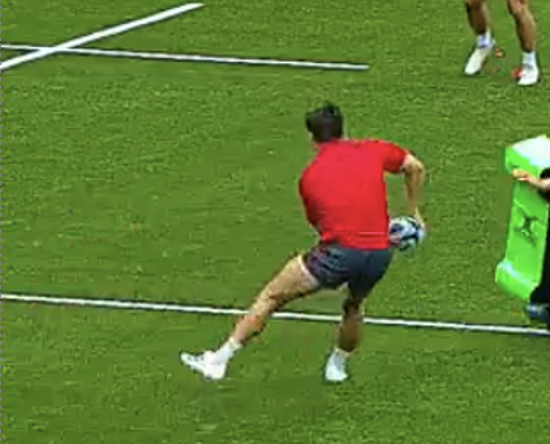
Strong systems create space for superstar moments
Elite rugby is not simply a chaotic, evasive free-for-all, despite what the introduction of research articles may tell you. Multiple levels of tactical constraints act upon a player at nearly all moments.
However, as Bobrownicki et al. [1] and Young et al. [2] discuss, when in possession, the player has an opportunity to analyse the situation and decide whether to continue with tactical play or break from the system and take on the defender(s) if the specific cues present themselves. We have to ensure they possess the ability and confidence to do both.
To reiterate, our aim of game speed is to increase the likelihood that our players will create line breaks and turn them into tries, however that happens.
System, meet superstar.
This video shows many different COD strategies and line breaks. Sometimes the space is created by others within the system, sometimes it is created by the individual, and sometimes it just presents itself and you hope the player has the qualities to take it.
To optimise training, we must identify what COD strategies we seek to develop. Young et al. [2] provides a great in depth analysis of an array of attacking evasive strategies. From an ecological dynamics perspective, we acknowledge that each player will self organise and perform one of many strategies to optimally find a solution to the given problem within evasive moments. However, we aimed to narrow our focus to provide basic rules and stability within a few key COD strategies. Young tells us that that certain strategies would be “more optimal” within certain spaces, therefore we can categorise strategies based upon space available.[2]
This guided us towards four key COD strategies. Two strategies bias small to moderate space that are best suited to “break the defensive line,” where deception and creating separation are the big factors in success. The other two “optimal” strategies operate in larger spaces, like those when attacking the back field (post line break), where “taking the space” and opportunity is key.
Progressing the decision-making demands on players
Our approach to training these qualities attempts to teach and train both sides of the perception-action cycle. To maximise development, we must ensure that our training model captures the what and how of COD speed combined with the when and why of perceptual speed and decision-making.

In “Level 1,” we seek to build movement efficiency. Our primary aim is to develop movement quality within a closed, predictable environment.
We need technical models in place for key patterns of movement that we want to emerge regardless of the scenario. These models are equally as important for coaches as they are to players. They direct our coaching eye and subsequently guide our coaching cues. We continually educate our players on the key drivers of each cutting strategy (e.g., “hide the hit,” “lift and hit,” “rip and rotate”) in pre-session presentations, targeted cueing during sessions or feedback post-session.
Consistent exposure and common language hopefully drives a deep level of understanding and creates basic rules to refer to when the perceptual challenge rises.

For example, in the triangle cut, we use the cue “hide the hit” to influence the player to keep their hips and shoulders square to the defender with their feet underneath their centre of mass prior to the plant step. In our terminology, this is the “lift and hit.” This minimises any visual cues afforded to the defender, thereby maximising deception.
We educate the players on this position, but we need the players to feel what is effective. To do this we often get their teammates to stand in front and provide feedback to the attacker about how they’d feel defending that side step. Did they hide the hit? Would it be hard to defend? What can they do differently?
They have the experience defending these actions, not us. Player-to-player feedback can drive curiosity, stimulate some great conversations and significantly influence learning.
Once a solid, stable technical foundation has been built, we often “race and chase.” We want to challenge the expression of the COD strategy under time and competitive pressures. This not only stimulates output but provides us with a good understanding of a player’s individual nuances that emerge among additional pressure. This information is invaluable when heading into Levels 2, 3 and 4.
In Level 2, our aim is to develop their ability to see and subsequently couple the cue with the movement action.
Navigating the theory behind decision making and perceptual skills can be a messy road. Research suggests that there are three inherently different viewpoints; two stem from information processing (information processing and naturalistic decision making) and the other is ecologically driven (ecological dynamics).
We do highly simplistic drills, where players can deliberately process and extract cues (information processing); and we do highly complex drills where behaviour may emerge based on the affordances offered by the environment.
However, it hopefully is becoming apparent that we see a lot of value in giving our players basic rules and principles to anchor onto. As a result, we developed a look-see-know process for decision making.
Simply put, we encourage players to “look” (visual scanning), we educate on what to “see” (pattern recognition) and we expose them to scenarios so they “know” what to do (situational knowledge). In our environment, three key cues are generally present: shape, speed and space. As you can see in the videos above, in Level 2, we seek to develop drills to teach the ability to see these three cues.
This does not mean we’re always intervening. Often within higher level drills the best cue is “don’t think, just beat them.” However, that is built upon the foundations of extensive technical development and conscious, deliberate decision making in lower level drills. In Levels 3 and 4, our coaching shifts to an intensity driven, outcome focused approach. We might be developing efficiency and teaching decision making behind the scenes, but when in a Level 3 and 4 drill, we’re letting them loose and pushing them to explore.
In Level 3, our aim is to see the expression of the COD strategy within a live scenario. Sometime this is as simple as a 1v1. However, we often couple passive (Level 2) and live together, a part-whole method.
Below is an example of a passive (Level 2) break focusing on seeing the speed and shape of the defender, coupled with “take the space” in the backfield to overload the demand of beating the second defender.
Level 4 contains our most complex scenarios. We ensure the individual has progressed up through all levels prior to introducing significantly greater complexities, such as increasing the demand of beating two live defenders or layering in additional supporting players.
The level structure above is simply our road map. We identify whether our focus is to develop our ability to break the line or take the space post-line break. We then determine which COD strategies we seek to develop, then increase the perceptual and decision making demands through each level.
Tweet ThisIt is essential we have technical models in place for key patterns of movement that we aim to emerge regardless of the scenario. These models are equally as important for us as coaches, as they are to players
@d_grange23
Game speed programmes live in the context of the overall performance programme
Both of these programmes are built upon the foundations of our linear speed, strength and power and general efficiency programmes. We continually spend significant amounts of time working on acceleration, deceleration, maximum velocity and general change of direction, as well as the underpinning qualities such as ankle stiffness, trunk integrity, hip locks, switching and dribbles. The concentration of each element within our global training plan is continually changing throughout the season.
At our club, the staff shares the decision-making process about where the group or individual is at any given point and where we should direct training for the next block.
Tweet ThisOnce a solid stable technical foundation has been built, we often “race and chase”. We want to challenge the expression of the COD strategy under time and competitive pressures
@d_grange23