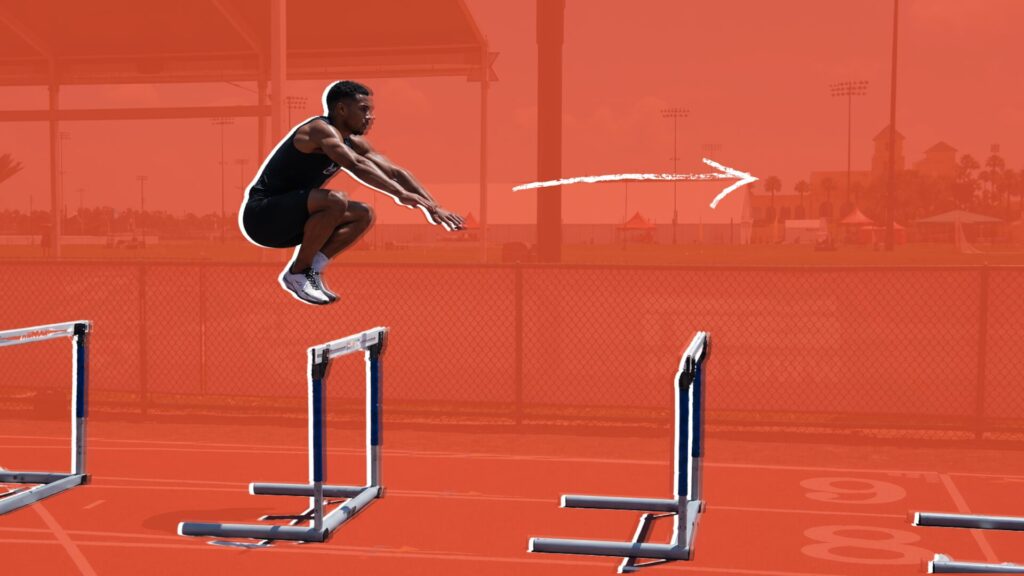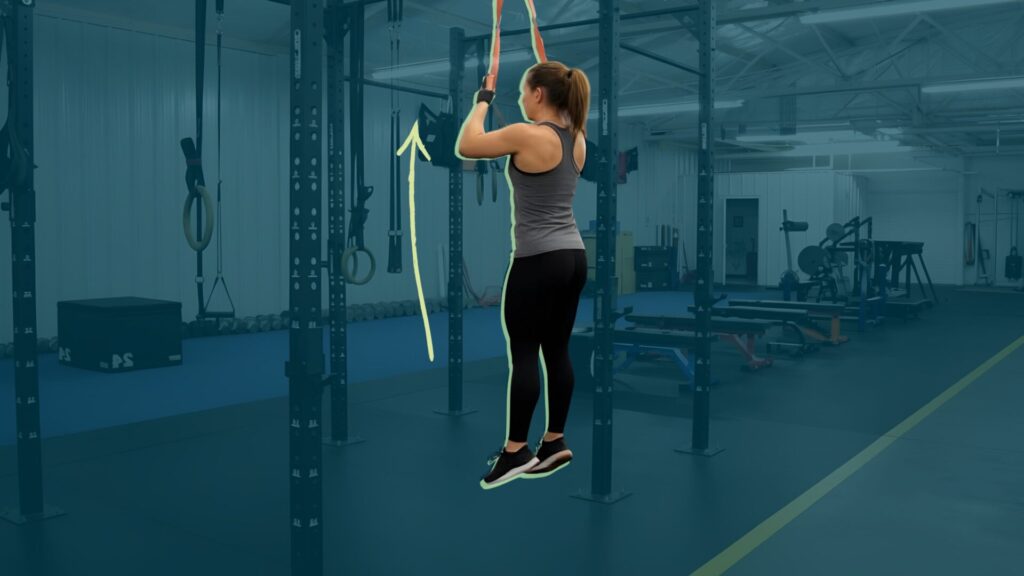

The principle of specificity would lead us to think that horizontal jumping exercises transfer to horizontally oriented tasks such as acceleration, while vertical jumping exercises transfer to vertically oriented tasks such as CMJs and max velocity sprinting. Is this the case?
It is largely the case, but what we consider to be an appropriately specific training activity to enhance performance in a given athletic task may not be as specific as we think.
That means we may be prescribing the wrong type of training.
Horizontal jumping exercises do transfer to horizontally oriented tasks such as a 10 metre sprint; and vertical jumping tasks transfer to vertically oriented tasks such as countermovement jumps. However, jumps that we consider horizontal also have a vertical component. An athlete who is executing a standing long jump for distance needs to jump up (vertically) as well as out (horizontally). Compare that to an athlete who is performing a conventional countermovement jump – they only have to move vertically. The so-called “horizontal jump” is more complex and multidimensional than the vertical jump.
As a result, and in line with the findings of our meta-analysis, horizontal jumping is superior to vertical jumping at enhancing horizontally oriented performance. And it is just as good as vertical jumping at enhancing vertically oriented performance.
Horizontal jumps don’t have any magical properties in light of these results. It’s simply that what we often classify as horizontal movement is not purely horizontal. Like in the standing long jump, they often have a vertical component.
This has implications for programming. Concentrating on horizontally oriented jumps might be advantageous, particularly in environments where time constraints preclude the coaches from including all types of jumps in a programme.
What is it about horizontal jumping exercises that give them additional benefits over vertical jumping exercises?
It appears to be the fact that horizontal jumps have both a horizontal and vertical component, therefore requiring the athlete to travel upwards and outwards. Vertical jumps, by contrast, demand only an upward movement.
More research in this area is required to clarify fully whether this is the case. But based on the results of our meta-analysis and some supporting evidence from the literature, it appears to hold in practice.
We’ve calculated both between- and within-group effect sizes for all available studies, and also examined the effect of horizontal jumps on vertical performance and vice versa. It isn’t that vertical jump training is ineffective at enhancing horizontal and vertical performance. We see moderate effects on measures such as countermovement jumps and short sprints. Horizontal jumps are more effective than vertical jumps.
Based on the results, a strength & conditioning coach could expose one group of athletes to horizontal jump training only and another to vertical jump training only. If they were to measure the effects of the respective training programmes on countermovement jump as an outcome, they might well find that both programmes were equally effective.
This is a negative for vertical jump training, which has essentially been “beaten at its own game,” so to speak.
Tweet ThisThe so-called “horizontal jump” is more complex and multidimensional in nature than the vertical jump because it requires movement both upwards and outwards as opposed to just upwards
Jason Moran
Does this change if the jump, either horizontal or vertical, is unilateral versus bilateral?
It is difficult to say for sure because there are very few, if any, studies that examined the effect of unilateral-only protocols in the context of vertical and horizontal outcomes, as in the meta-analysis. That is why the subgroup analysis only compared bilateral against bilateral combined with unilateral. It’s an interesting avenue for researchers to follow within the context of plyometric training. Indeed, this is something our research group is looking at right now and we currently have some work in review on this exact issue.
To answer the question more directly, there doesn’t appear to be any reason why the pattern of results we reported in this work would differ between unilateral and bilateral jumping formats. However, for uninjured athletes, a comprehensive approach that includes both unilateral and bilateral jumps in a multidirectional format is still recommended because of the independent adaptations from each type of training.
Is there a difference in adaptation time for vertical vs. horizontal jumping exercises? If so, why is it the case?
Yes, time appears to be a factor, but the reasons are not necessarily apparent.
Over the longer term (>7 weeks), horizontal plyometrics appear more effective than vertical at improving a test such as a short linear sprinting. Vertical plyometrics also appear inferior over the shorter term, though effectiveness increases over longer programmes. Even so, there is no difference between horizontal and vertical training methods for outcomes like a vertical jump, and that holds true whether the programme is long or short.
The “take home point” is that longer duration programmes of horizontal plyometrics should be more effective than mainly vertical programmes at making an athlete sprint faster; and they are equally effective at making athletes jump higher, regardless of the length of the programme.
But then one should ask themselves if training only one mode of plyometrics is a wise choice.
Meta-analyses are excellent tools to obtain an overview of how effective a particular training method is. But a narrow body of literature in a niche area such as plyometric exercise can lead to incomplete or erroneous conclusions, so it is important to tread carefully on such ground.
If there is a differential in time adaptation, it may be no more complicated than the fact that many coaches possess a bias towards the selection of vertically oriented exercises in their S&C programmes. If this is the case, athletes who repeatedly train in the vertical plane could have a relatively lower potential for adaptation in response to vertically oriented plyometrics than they do to horizontally oriented plyos.
We can conclude, then, that horizontal plyometrics yield greater benefit in the short term and even greater benefit in the long term.
Tweet ThisIt appears that a concentration on horizontally-orientated jumps might be advantageous particularly in time-constrained environments
Jason Moran
How does age and maturation affect the impact of horizontal and vertical jumping interventions?
Maturational progression during childhood and adolescence, as well as the amount of training an individual has performed, can have both positive and negative implications for performance. The speed and nature of changes in physical development, hormonal levels and neuromuscular coordination can all affect force output and movement quality, either directly or indirectly.
It is not really clear if the individual’s maturational status would change how they respond to vertical vs. horizontal training. But on a broader level, the factors mentioned above appear to have an effect on performance, regardless of training type.
While horizontal training appears to be more effective than vertical training for enhancing sport specific performance, coaches should conform to a number of guiding principles when programming for individuals younger than 18 years old. For example, coaches must prioritise technique and technical competency for this group, remaining conscious that they may not have learned or performed this type of training before. Coaches should also consider the difficulty level of different jump types, such as vertical vs. horizontal jumps or bilateral vs. unilateral jumps, when selecting certain exercises. The additional stability of a bilateral jump compared to a unilateral jump could mean that a countermovement jump might be an effective exercise for an individual who struggles to move competently. Accordingly, despite the apparent superiority of horizontal training over vertical training, coaches should first choose exercises that the athlete can actually execute properly, and add further layers of complexity as their skill proficiency improves.
What are the biggest mistakes you see young practitioners/ researchers make and what advice would you give them to help?
In research terms, this is a very simple question to answer. Much of the strength & conditioning research that I read suffers from two primary issues. The first is that as researchers make genuine attempts to move the field forward, they appear to be focusing on increasingly trivial minutiae, which may or may not have an impact on how coaches do their jobs. The research community and the practitioners’ community seem to have diverged when, in the age of unlimited access to knowledge online, this gap should be closing.
This is related to the second issue, which is that much research seems to be written by researchers, for researchers. Though important, that ignores the place of the coach in all of this. The coach is the “end user” of the new knowledge that researchers are generating, but I’m not sure if coaches are availing themselves of as much of the research as they might, simply because much of what is written appears to alienate them from the process.
Research must be actionable. But in the current environment, I don’t believe that it is.
In terms of coaching, I think young coaches have a tendency to overcomplicate their approaches, when the simplicity of the approach is truly important.
The literature on periodisation is an excellent example of this. In my experience, young coaches take these principles far too literally and try to construct elaborate long term plans that are dogmatic and have no flexibility. A more effective approach would be to use the governing principles of periodisation as a set of guidelines that inform the planning of training, rather than dictate it.
This is just one example, but it could be applied in many other areas of strength & conditioning, which is a field that is in need of simplification and consolidation rather than divergence and complexity.
Tweet ThisOver the longer term (> 7 weeks), horizontal plyometrics appear more effective than vertical at improving a test such as a short linear sprinting
Jason Moran