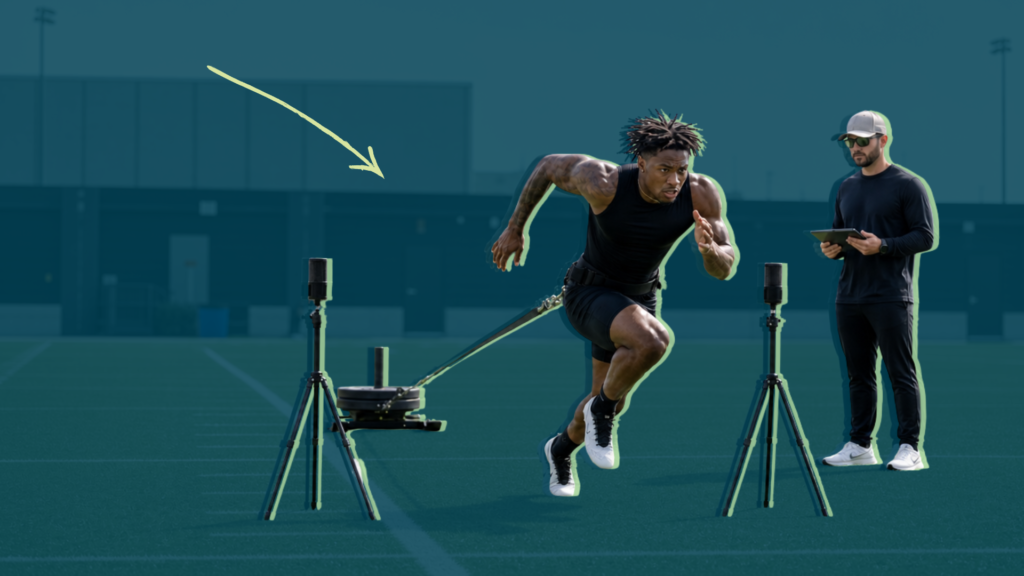
John Harry recently published a paper which spoke about an alternative way to programme for ballistic exercises. Those familiar with velocity based training may have used velocity loss to manage volume but this could be leading to inappropriate loads for a up to 25% of athletes. We asked John six questions to explain more.
What problems exist when prescribing load to ballistic exercises based on velocity data?
Broadly, velocity data are quite powerful for load prescription during resistance training[1]. We know this because of research demonstrating positive performance adaptations[2]. The problem with prescribing ballistic exercise loads with velocity data is the highly individualized relationship between velocity and the relatively light loads (i.e., 30% of the 1-repetition maximum) used in ballistic training[3]. This means that the typical velocity-based recommendations for ballistic training[4] are unlikely to be applicable to diverse groups of athletes, even when training for the same goal.
Our recent work demonstrated this, as recommended velocity ranges did not apply to barbell jump squats[5] with 15%, 30%, 45% and 60% 1RM squat loads.
Velocity data are unlikely to reveal the ideal training load, producing what I think are inferior, albeit still positive, adaptations to training.
Velocity loss seems to be a simple formula for prescribing volume, and it’s a method many coaches use. But what problems arise when using it?
Our data[5] suggests the common 10% and 20% velocity loss thresholds are more applicable than blanket velocity ranges when identifying jump squat training loads. I think that applies to other ballistic exercises.
This is great for coaches, because velocity loss thresholds are quite simple to obtain when athletes are instructed to move as much weight as possible until their velocity decreases below the chosen threshold. Unfortunately, only ~40% of athletes perform jump squats without decreasing velocity by more than 10% relative to their unloaded jump’s velocity. The 20% threshold seems more appropriate, as loads 15-30% 1RM are appropriate for ~75% of trainees.
While it seems like 20% velocity loss is a good threshold to use when prescribing loads, it neglects about a quarter of athletes[5] who’ll likely end up training with an inappropriate load.
What is system momentum, and why does this metric allow us to better prescribe loads?
System momentum is the quantity of motion the athlete-load system creates, since the athlete and load are “connected” to create a single system. I am a proponent of system momentum for ballistic exercise because ballistic exercises are performed with maximum effort or volition: maximum force output within the shortest possible time at a given load to create the largest quantity of motion.
Based on the impulse-momentum relationship (ΣFΔt = mΔv; force*time = mass*velocity), athletes’ overall effort relates to the impulse (left side of the equation), and that effort is equal to the momentum (right side of the equation), or the resulting quantity of created motion.
Thus, prescribing a load associated with greatest system momentum ensures that the athlete is properly stimulated and putting forth the most overall mechanical effort during the exercise. Table 1 is from our recent article[5] and shows that loads with the greatest system momentum an athlete can produce ranges between 15-60%.

Sometimes it’s easy to lose sight of the fact that the most fundamental training concept is that athletes need to be overloaded by predominantly stimulating loads[6]. This does not mean the heaviest load will stimulate the greatest effort from an athlete.
Training should focus on athletes’ ability to create the maximum quantity of motion. That relates to overall mechanical output, not peak force production or an athlete’s perception of the “difficulty” of one load vs another.
Tweet ThisPrescribing a load associated with greatest system momentum ensures that the athlete is properly stimulated and putting forth the most overall mechanical effort during the exercise
@johnharry76
How can we calculate system momentum and track it over time to ensure that we are getting “real” improvements?
System momentum is the product of mass (athlete, load, or athlete plus load) and movement velocity. This makes it a very easy to use metric requiring very little adaptation among coaches and practitioners currently using some form of velocity monitoring.
Coaches and practitioners should incorporate system momentum by recording the average or maximum velocity athletes achieve during the repetitions of each set, and then multiply the chosen velocity metric by the athlete’s mass plus the load mass.
For example, an 80 kg athlete lifting 100 kg at 2.2 m/s has a system momentum of 180 kg * 2.2 m/s = 396 kg*m / s.
Given the simplicity of the system momentum calculation and the fact that ballistic exercises are performed with relatively light loads, it is more than reasonable to prescribe an ideal training load during each training session. For example, each session could involve progressively loaded sets of a jump exercise. The practitioner should determine the initial load for momentum calculations, but should start recording velocity somewhere around 15% of the 1RM for the most closely related strength exercises if necessary. For jump squats, for example, this would be 15% of the squat 1RM).
Because progressive load increases should be between 2.5% – 10%[7], practitioners can determine the athlete’s peak system momentum by continually progressing the load until they reach a set where system momentum stops increasing. They can then perform working sets at the load with the greatest system momentum, with the previous loads being the warm-up sets.
Where else can system momentum be used? And where would you not advise it to be used?
System momentum can be used with all exercise types (strength, power, etc.) when the objective is ballistic. The vast majority of strength coaches would agree that relatively heavy back squats lead to improved vertical jump performance, even though the squat is a strength exercise and jumping is ballistic. Research supports this, as squats performed twice a week for six weeks with an average load of ~76% 1RM led to jump performance gains, even though the loads were not in the typical “power” or “explosive” range. I speculate that the common training loads for the squat are likely increasing the system momentum an athlete can create with respect to the momentum they create during jumping.
The only exercises for which I would not recommend system momentum are those where the athlete and the load do not move in the same direction with the same objective. For example, during the push jerk exercise, the barbell’s peak upward velocity occurs when the athlete is moving downward to appropriately position the body and receive the load in a stable position. In this case, barbell momentum would be more appropriate because the goal is to maximize the quantity of upward motion created for the barbell.
Simply, if the barbell is not continually in contact with the athlete at the same location throughout the repetition, do not use barbell momentum.
What are the biggest mistakes you see young practitioners/clinicians make and what advice would you give them to help?
The biggest piece of advice I can give young practitioners or clinicians is to check their ego at the door and never become satisfied with how much they “know.”
Practitioners have to demonstrate credibility for their athletes to buy in and trust in the process, but that should happen through demonstration of knowledge. Thanks to Andy Galpin, I learned to live by and promote the training motto “Methods are many, but concepts are few.”
Sure, there are lots of sexy looking programming methods seasoned practitioners use (e.g., momentum- and velocity-based training, 5-3-1, TriPhasic training, etc.) that young practitioners then set out to use. But the concepts of all programming methods relates to my previous point about using stimulating loads in the right way for a specific objective. This is easy to forget early on because the concepts aren’t as sexy as the methods. I’ve been lucky enough to collaborate with some exceptional practitioners who constantly adapt to their surroundings and evolve their training practices. But some have shown a lack of interest in saying “I don’t know” or a resistance to others’ ideas or constructive criticism. I encourage young practitioners to constantly evaluate their approach to ensure that they can thoroughly explain both the methods and concepts of their training programs to their athletes and fellow practitioners.