
In part I of this two-part article, I discussed ways to help determine which technical features of team sport athletes we may want to change. Although there are numerous factors to consider in making this decision, it is not always an easy one to make and whilst a criterion model can be useful to compare an athlete against, we should also consider their individual qualities and the unique movement styles that may be suited to athletes at the individual level. I also covered the importance of considering barriers which may prevent coaches or other practitioners from eliciting robust technical changes in the athletes they work with, before outlining potential opportunities in the week where specific work can be conducted with athletes to help make these technical changes, using an example in-season training week of a rugby player. In the current article (part II), I move on to explore a number of methods which can be used by coaches and other practitioners to help with their technical interventions.
Methods to facilitate technical changes during sprint acceleration
Now that we have identified any potential barriers to making technical change, and we have established what opportunities exist in the week to work on these qualities, we now need to consider methods that can be used to help facilitate the desired technical changes. This is likely to need a dovetailed approach of spending time sprint training with or without technical focus, whilst also addressing modifiable constraints relating to the new strategy to help facilitate this change. I like to use the analogy of walking through the jungle. Moving towards a new strategy is like trying to carve a path through a jungle. At first, it might be challenging, and you’ll need a machete to hack your way through. As you walk the path repeatedly over time it becomes more like a dirt track – a bit bumpy – but easier to navigate before a well-trodden and smooth path emerges. By this stage the old path has overgrown and it’s not possible to go back. So, if we want to make shifts in an athlete’s sprint acceleration strategy, we need to have a degree of confidence (based on sound reasoning) that it is achievable and consider what it needs to take to get there.
There is a lot to be said for setting up the training environment and training tasks in order to alter the physical constraints of the athlete and let change emerge gradually over time when the athlete is allowed to sprint freely. However, for the purpose of this article we will now explore some coaching methods which can be used to help provide a more direct approach to apply technical interventions during training. It’s important to note here that we should be careful with the way in which information is delivered to the athlete and whilst I feel there is certainly a place for internal based cues or discussions with athletes, I would tend to favour a more externally directed approach, and to call upon the use of analogies and/or holistic cues which are ‘self-generated’ by the athlete where possible.

Amplification of error method
Tweet ThisThe amplification of error method works well when you want to change a potential ‘movement issue’ of an athlete when they are not aware that it is taking place
@wildy_jj
Whilst her contact length is long (achieved by accessing almost ‘too much’ leg extension), it simply takes her ‘too long’ to achieve this length and therefore her acceleration suffers as a result. By exaggerating the movement issue (i.e., exaggerating the ‘push’ and achieving an even longer step length) in the video, she becomes aware of the sensation associated with this movement feature. By amplifying this issue, it triggers a positive search strategy by the athlete, providing them with information about the consequences of this movement issue. From a coaching perspective, it is now easier to converse with the athlete about the identified issue and communicate effectively with them to ‘bring them back’ from this over-pushing habit, since they now have a feel for the exaggeration of their movement issue.
Video 2
Drawing attention to potential movement-based issues can be achieved in other ways. Consider the athlete in the video below. During the profiling process for this athlete, it was identified that her 10m times were worse when her step rate peaked from the very first step. Typically, when she starts with a slightly longer step length and when her step rate gradually increases over the first three steps, her 10m times were better. Whilst I am not against a relatively high foot recovery action in the initial steps, there was no change in the height of her recovery foot from the outset of her sprinting efforts, which seemed to correspond with her step rate peaking from the first step. In the following video (video 3) you can see first the natural sprinting action for the athlete in real time followed by the same sprint in slow motion. After this, you can see sprint efforts (first in real time and then again in slow motion) where she has balloons strapped to her posterior thighs. She was asked to sprint ‘normally’ again, and you can see how having the balloons strapped to her posterior thighs interferes with her natural sprinting action as she ends up kicking the balloons from the very first step.
After this, the athlete was then instructed to ‘miss the balloons’ in her first couple of steps and you can then see in her final sprint effort in the video how this results in a gradual increase in the height of her recovery foot and a longer step length from the outset, with a gradual increase in her step rate over the first 4 steps (all confirmed through two-dimensional kinematic analysis). This now enables the athlete to ‘latch on’ to the feel of this coordinative movement sequence and can be used as a reference point for her during her sprint-based sessions. As an aside, this is an overly elaborate approach (using balloons), but it is certainly something that will stick in her mind!
Video 3
Old way, new way approach
Once the athlete has an understanding and a feel for the movement feature that we want to manipulate, the ‘old way, new way’ approach can be a useful method for changing an automatised movement skill [4]. I’m a big fan of this approach and is where I spend a lot of my coaching time when looking to make subtle, but permanent, changes in the sprint acceleration strategies of team sport athletes. The ‘old way, new way’ approach is a method by which you contrast the existing strategy (‘old way’) of the athlete, with the new potentially more favourable technique for that individual (‘new way’).
To help gain an understanding of how this approach works, clasp your hands together (Figure 3). Now, switch your hands over so that the other thumb is now on top. This should now feel less familiar and a bit strange compared to how you originally clasped your hands. Next, keep alternating between how you clasped your hands originally and when you swapped over so that the other thumb is on top. Change the speed at which you do this too – try faster and slower switch overs. At times hold the unfamiliar clasped position for longer also. Over time you should start to feel the contrast between the two lessens whereby the more unfamiliar way starts to feel less ‘awkward’.
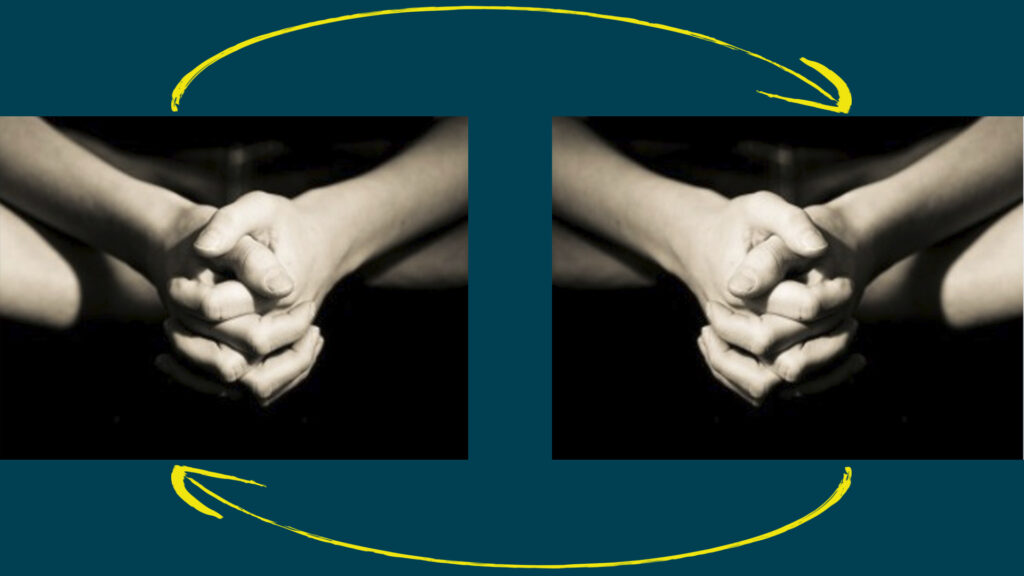
Now that may not be the best example of how the old way new way method feels and works, but the way in which you clasped your hands originally is an example of something interwoven and deep set within your neural architecture. In other words that’s probably how you have always clasped your hands over the years and is second nature – it feels like the norm. By contrasting an existing strategy with a slightly altered one by using the ‘old way, new way’ method is thought to tackle what is known as an interference problem. This interference problem is where the well-established habitual movement patterns interfere with the to-be-learned (i.e., new way) or adapted movements required. There are set stages to the method [5] but, for the purpose of brevity, repetition of the ‘old way’ is followed by the ‘new way’, which is then followed by reflecting on the difference between the two ways (the use of video feedback with the athlete can be useful here).
The video below was taken from a speed session where the ‘old way, new way’ method was being used with rugby players. During the profiling process it was identified that there was a clear relationship between the athlete’s step length and their 10m times. That is, they were running fastest when their step lengths were longer. In this video we were alternating between the athlete’s normal (‘old’) way (top) and then their adapted (‘new’) way (bottom). The athlete had previously undertaken a practice session in which we used parts of the ‘amplification of error’ method (i.e., exaggerated the player’s step rate) and also explored a full continuum of faster step rate to longer step length sprint trials. The athlete had developed a feel for what a slightly longer step length felt like to them and understood the rationale behind why we were exploring this slight shift in strategy. As you can see in the video, in his second sprint acceleration (bottom) he is accessing slightly more leg extension and covering greater distance with each step when in contact with the ground and during the flight phase. Over time the ‘new way’ begins to feel like the ‘old way’ – a more natural strategy.
Video 4
Directed forgetting method and performing under pressure
Once an athlete is able to discriminate between the ‘old way’ and the ‘new way’ and that the ‘new way’ is now feeling more natural, the ratio of time spent on the ‘old way’ versus the ‘new way’ should start to decrease, to a point where the ‘old way’ is no longer practiced. This is where directed forgetting comes in to play [6]. Essentially, at some stage we need to remove the interference from the technique we are trying to modify. Directed forgetting is where the athlete literally tries to ‘forget’ the previous action of the skill to focus on the new one. Over time with the right kind of interventions this will emerge as a natural consequence of the athlete self-organising in response to the constraints imposed on them. However, directed forgetting can help facilitate this process too and is a logical follow on from the ‘old way, new way’ method.
Tweet ThisAs a general rule of thumb, concentrating on the basics of speed training – sprinting, jumping and moving a variety of loads explosively will cater for the majority of speed requirements in team sport training setting.
In some cases where no barriers are preventing the athlete making a technical change and where there is a high degree of confidence that the change in strategy being sought will likely result in superior performance (based on sound reasoning and actionable information provided from a profiling process), then success can sometimes be gleaned from jumping straight to this approach. An example in practice of this can be seen in the following two videos. In video 5a the athlete’s natural strategy can be seen. During the profiling process it was identified that they were achieving significantly better (i.e., lower) 10m sprint acceleration times when their step rate was faster. We then applied a directed forgetting approach whereby the athlete practiced a faster step rate during speed sessions (5b) and during warm-up opportunities in training. We were able to get early success with this athlete using this approach from the outset.
However, for athletes who do not possess good coordinative ability, those who have a narrow movement repertoire, and /or have physical constraints acting as barriers to access the new movement strategy, this approach will not be effective if used at the start of the technical change process.
Video 5a
Video 5b
Finally, to ‘put a lid on it’ the adapted technique needs to stand up and be tested under pressure. As already explained, this needs to be subconscious. There is certainly scope at times for the athlete to apply their technical focus in competitive settings in training when the outcome of their performance doesn’t matter (i.e., during competitive contextual speed training), but over time the technical changes required ought to manifest naturally when the athlete is under pressure in training and match situations. An example of some contextual speed training can be seen in the simulated ‘interception’ video below.
Video 6
Final words
Changing the acceleration technique strategies of team sport athletes is not always straightforward. Sometimes, just leaving them to it is a good approach to take. As a general rule of thumb, concentrating on the basics of speed training – sprinting, jumping and moving a variety of loads explosively will cater for the majority of speed requirements in team sport training setting. However, from time to time it may be necessary to explore making subtle changes in an athlete’s sprinting strategy to help take them to a higher level in terms of their speed capabilities. There IS time within the training week of a team sport athlete to do this and, as highlighted, this doesn’t need to take up a lot of coaching time.
What is important though is that the decision to make any kind of technical change is based on well-founded reasoning which has not been formed on a ‘snapshot’ decision or simply because we have seen other (faster) athletes sprint in a particular way. Overall, technical change is a huge topic, one that is often misunderstood, and one that is hard to do justice to with a word limit! Hopefully, though, this article has provided some food for thought, an insight into some of my thoughts on the area, and may be of use to coaches interested in exploring the technical changes of team sport athletes during sprint acceleration.