Rehabilitation in elite football (soccer, for our American and Australian friends) has vastly changed over the years. We no longer simply “rehab an injury” or “get the player back in.” Where that was previously the norm, we now recognize that a performance rehabilitation approach should work beyond focusing solely on the injury, instead preparing the player to return to sport and mitigating re-injury risk.
From a physical perspective in an Academy, athletic development is the main focus. Within the Academy model that aims to develop potential first team players, our role is to develop the required physical qualities. That stays true during rehab.
An Academy player’s injury may be the first which requires actual rehab. Delving in to an Academy structure, this may depend on player age/phase: foundation (FP: U9 to U11), youth development (YDP: U12 to U16 ) or professional development (PDP: U17 to U23). In the FP, players lack “body awareness” and do not know what constitutes an injury, especially the first time it happens. At the YDP and PDP, players generally have a better understanding of their bodies, with more efficient injury reporting. Here, injury incidence is more frequent and severe [5], with increased training and match demands placing greater stress on muscular, tendinous and ligamentous structures [10]. Within the PDP, injuries allow for focused physical development for a sustained period of time. But the consequences of losing the developmental opportunities of practices and matches during such a crucial part of their early career are potentially detrimental to their technical and tactical development.
Tweet This“A performance rehabilitation approach should work beyond focusing solely on the injury, instead preparing the player to return to sport and mitigating re-injury risk”
@JasonOkeefe10
Regardless of developmental stage, rehab aims to prepare the player for the demands of the sport. As with team training, a performance rehab structure follows a periodized model to attain the desired physical state [8], even as the player trains in the presence of an injury.
To enhance this process, we implement a pitch-based rehab plan outlining weekly progressions in running loads from the introduction of pitch-based running through return-to-training (RTT). In this article I will focus on the pitch-based long-term rehab process of the PDP Academy footballer, outlining:
- The planning process for pitch-based rehab running loads;
- Session design for pitch-based rehab, within the constraints of the planned running loads;
- Contextual factors to consider during rehab.

Planning the load progression for pitch-basedrehab running
For a successful RTT, pitch-based rehab must progressively replicate the physical demands of the sport. I view an Academy player sustaining an injury as a window of opportunity for physical development. The end goal for pitch-based rehab is for the player to return to or, where appropriate, surpass pre-injury chronic running loads prior to RTT. This ensures the player is capable of handling the physical demands of team training upon their return.
Key considerations for the planning process are:
- Location, type, severity, potential implications and re-injury rate of the injury. This requires a medically-led multi-disciplinary team approach to inform key stakeholders.
- The main question from a coach will be: “When are they going to be back?” While a vague question, as it often “depends” and rehab is based more on criteria than time, knowing approximately how long you will have with the player for pitch-based rehab aids planning.
- Awareness of pre-injury chronic running loads. Ensure the player is capable of achieving these loads prior to RTT.
In the rehab loading plan, I focus on five main metrics covering three areas to quantify player running loads. This keeps the rehab program in line with loading reports used throughout the club. 4.0m.s-2
| Measure | Metric | Description |
| Volume measure | Total distance (m) | Total distance covered in the session/drill |
| Extensive measure | High-speed running (m) | Distance at ≥ 55% of the player’s maximum velocity |
| Sprint distance (m) | Distance at ≥ 70% of the player’s maximum velocity | |
| Intensive measure | Explosive distance (m) | Distance accelerating and decelerating ≥ 2.0m.s-2 |
| High intensity accelerations and decelerations | Total number of accelerations and decelerations ≥ 4.0m.s-2 |
Once we identify the planned duration and targeted running loads of pitch-based rehab, we outline the number of on-pitch days per week and what type of session (general / technical / intensive / extensive) to prescribe on specific days. Progressing through the early to late stages of rehab, there is a shift in momentum from high control to high chaos in order to replicate the sport-specific demands ahead of RTT [6].
Tweet This“I view an Academy player sustaining an injury as a window of opportunity for physical development”
@JasonOkeefe10
During early-stage rehab (figure 1), players complete 3-4 pitch sessions per week. Sessions are more generic and limited in running loads, with a focus on aerobic system development.

During mid-stage rehab (figure 2), players complete four pitch sessions per week, with increasing sport specificity and running load demands.
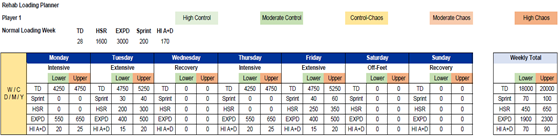
During late-stage rehab (figure 3), players complete 4-5 pitch sessions per week, with positional specificity a key focus and running loads approaching pre-injury levels.

Case study: Rehab running for a youth midfielder with a hamstring injury
For long term injuries, we plan out the whole pitch-based rehab program from session 1 through RTT.
In this example, we will explore the rehab of a central midfielder suffering a hamstring injury. For those less familiar with football, a central midfielder occupies central areas of the pitch and is involved in all aspects of the game, covering more total distance than other positions.
Injury type
The player suffered a tendinous hamstring injury requiring surgical repair. These injuries slightly prolong the player’s rehabilitation process, with the player’s initial RTT post-injury a key period in reducing re-injury risk [2].
Timeframe
The expected time to RTT is 4 months. Following brief periods of non- and partial weight-bearing, the plan includes an eight-week period of gym-based loading, including three weeks of progressive Alter-G loading prior to commencing pitch-based rehab. Pitch-based rehab is planned to last eight weeks, progressing from highly controlled general sessions during early-stage rehab to late-stage rehab where sessions will be highly position-specific with increased running loads to prepare for RTT.
Pre-injury running loads
| Metric | Average weekly load |
| Total distance (km) | 32 |
| High speed running (m) | 2000 |
| Sprint distance (m) | 350 |
| Explosive distance (m) | 3200 |
| High intensity A + D | 180 |

Programming rehab running loads
Note the lower and upper limits for running load metrics in the rehab plan (figure 4). Their inclusion allows for flexibility in sessions during the week. Despite aiming for the upper limit, the lower limit guarantees a maintenance of or small progression in running loads from the previous week. During late-stage rehab, attempting to replicate training / match demands with position-specific drills can be challenging, particularly when it comes to controlling within-drill running loads. Drills are designed to achieve targeted running loads, yet the player can easily manipulate key attributes such as exposures to high-intensity accelerations and decelerations.
These limits also serve as a session guide. Generally, my delivery of pitch-based rehab is limited to mid- to late stages, with the medical team leading the early stages to ensure the player is capable of progressing to more football-specific training. For a physio, the awareness of running loads in relation to drill content may not be common knowledge, so we need to provide the necessary guidance and communication.
When planning rehab running loads we need to understand the gap between the ”fit” player, who has a higher chronic load through consistent training exposure, and the injured player, who effectively has no chronic load due to a lack of training. Models such as the acute:chronic workload ratio [3] are ineffective during the rehab process because of that divergence. Because the model revolves around a ratio, an injured player would constantly report high acute loads, given the weekly increases in running loads. But if we’re delivering a progressive RTT process, these weekly increases are necessary.
Likewise, percentage increases in running loads cannot be uniform across players or injuries. We have to work for the specific case of this individual athlete and this specific injury. We would not progress HSR and SPR exposure at the same rate for a hamstring vs. an ankle injury, for example. A hamstring injury may require a slower progression in HSR/SPR volumes and percentage of maximum velocity (%Vmax) exposure to ensure tissue tolerance to these changes in loads [7], where an ankle injury may require consideration of the frequency and intensity of acceleration and deceleration demands.
In our hamstring case, high-speed running (>55% max speed) commenced in week 2 and running at sprint distance (>70% max speed) started in week 3. Early exposure to both at threshold level during these weeks allows for more progressive loading for 6-7 weeks, ensuring the player can reach pre-injury running loads prior to returning to team training. Note how the weekly increases are not uniform (figure 5). The player’s individual responses to the week and what we as a staff feel is a suitable progression determine how much we increase the volume.
Tweet This“Percentage increases in running loads cannot be uniform across players or injuries. We have to work for the specific case of this individual athlete and this specific injury”
@JasonOkeefe10

Rehabbing the player for his future, not his past
While there are running load criteria to meet during rehab, it is important sessions are not completely dictated by a number. We want to build high chronic running loads that serve as numerical targets, but we must also restore and develop the physical capacity required to perform in training and matches [4].
During early-stage rehab, session content remains general, keeping “high control” with limited football-specific training [6]. Late-stage rehab involves more chaotic elements, incorporating football-specific movements periodized similarly to team training with intensive and extensive splits. Where the team’s intensive sessions incorporate small-sided games (SSG’s) and possession drills, intensive rehab sessions focus on pass & move drills and patterns of play in reduced areas to expose the player to the acceleration and deceleration demands of SSG’s [11]. Alternatively, where team-based extensive sessions involve large sided games (11v11 / 10v10) or waves of attack, extensive rehab sessions focus on large area patterns of play and focused conditioning drills to expose the player to the higher total and sprint distances that occur during team sessions. When establishing pitch-based running load parameters, we must consider several contextual factors via a multi-disciplinary team approach to ensure all decision makers are on the same page (figure 6).

Player Position
The positional demands of academy football differ along similar lines as in the first team [1]. From personal experience, on a double game week central midfielders can cover 40-45 km total distance, where a forward may complete 35-40 km. Likewise, a fullback can complete 2,500 m HSR / 700 m SPR, where a centre back may complete < 1000 m HSR / < 200 m SPR (for those less familiar with football/soccer, a positional overview is provided below).

Coaches must be aware of the movement demands of each position when planning a player’s rehab. Our injured player was a central midfielder, although central midfielder roles vary greatly. Through the Academy system, the player played as a #6 (defensive central midfielder), #8 (box to box midfielder) and #10 (attacking midfielder). Following discussions with key stakeholders, the player’s prospective position with the first team was a box to box midfielder (#8).
Player position has a significant influence on running loads, so we must ensure the player is prepared for their positional demands. Drills must be position-specific in order to develop the necessary physical capacities. Figure 8 outlines areas of the pitch covered by a box to box midfielder, which we must consider in rehab drills.

Team Shape/Tactics
Academy teams often play the same formation and tactics as the first team as a means of developing potential first team players. Team shape affects positional characteristics, altering the running load demands on the players [9]. Although team shape may change based on the opposition or player availability in an Academy setting, generally there is consistency game to game.
With our player and his planned position (#8), he would likely return to a team playing a 4-3-3 formation (see the team shape highlighted darker in figure 7), a team shape consisting of 4 defenders, 3 midfielders and 3 attackers (combination of wingers and forwards). In this system, the player will likely cover greater total distance and high metabolic load distance (HMLD = HSR + EXPD) compared to if he was playing, for example, central midfield in a 4-4-2 formation (the lighter shaded team in figure 7) [9].
Video clips provided by the performance analysis department highlight the positional demands required in this formation to guide drill design.
Position in the Team
In the PDP, we are more likely to see a first team approach of “picking the best team to win.” We see a mixture of regular starters, substitutes / squad players and those left out of the squad.
Squad position is likely to affect the degree to which we push player running loads during rehab. Regular starters will likely return to the starting lineup soon after RTT. They will need a higher running load exposure to prepare for this. With a non-involved player, we may have additional time within the RTT period to develop their chronic load to a higher level.
Our player was a regular starter for the U23’s. He also had one of the highest game running loads in the team, producing both high total distances and extensive running loads. Since he would start every game, his pre-injury chronic running loads were relatively high, making this the target during his rehab.
Projections for the player’s future
What level of football are we preparing the player to return to? If he is returning to the same group as before the injury, pre-injury chronic running loads are a suitable loading target. However, if the player is a “high potential asset” with experience of “training up” a level, we may target higher chronic loads, preparing him for the increased game exposure and resulting running load demands of the first team. Additionally, PDP players are preparing for a loan to gain first team experience in the Football League, where teams often play twice per week. There, running loads are predominantly game-based with limited training time. Where our current rehab model generally focuses on intensive / extensive splits, a player who has the potential to leave on loan soon after RTT may require a combination of intensive and extensive workloads within each session to prepare for match-specific demands.
We had several considerations with our player. Given his expected RTT, there would be a sustained period of team training prior to a potential loan move. That gave us two options: RTT with the U23’s and gradually build up “chronic” running load exposure, or immediately “train up” with the first team. The player had previously trained up. However, given the injury duration and first team managerial change during the rehab, the player would initially return to training with the U23’s. This would allow the player to meet pre-injury running loads during late-stage rehab before maintaining or increasing these during team training.
These contextual factors add to the importance of an MDT approach. Without the relevant pathway plans for the returning player, we could deliver a well-progressed rehabilitation programme that would not sufficiently prepare the player for what he is retuning to.
Pitch-based rehab drills to connect physical and technical development
Taking these factors into account, I have provided examples of drills we programmed for this player’s late-stage rehab.
Figure 9 outlines an intensive drill the player completed, with contextual factors such as position and team shape / tactics incorporated. Passes are played between the player, a rebound board and staff member in a “midfield 3,” providing different angles for him to receive and pass (1). The player then steps in fast with the ball and passes into the ”forward” (mini goal) before accelerating back to the starting position (2). He collects another ball, with further passes between him, the rebound board and staff member (3), before playing a pass off the staff member to play out to the “winger” (mini goal) (4) and jogging back into position.
For this type of drill, our players will typically work for 2-3 minutes, with 60-90 seconds rest between reps, completing 4-6 reps.

This is the main working drill of the session, with a session-specific warm-up and technical drills completed beforehand. Here, warm-ups consist of acceleration and deceleration mechanics (video 1), often leading to change of direction or further acceleration and deceleration specific drills. Technical drills take typically cover smaller distances and incorporate more accelerations, decelerations and changes of direction (video 2).
Figure 10 outlines an extensive drill the player performed. The physical stimulus here comes in the form of speed-endurance, where the player works for 15s and has 45s rest between reps (1:3 work:rest ratio), completing 2×6 reps. The player begins in a deeper position inside his own half and plays a pass off a rebound board (1). On receiving the ball back, the player turns and plays a long switch of play out wide to the staff member (2). The player makes a high-speed run to the edge of the penalty area, where the staff member crosses the ball in towards the player to shoot at goal (3) before a high-speed recovery run is completed back to the starting position (4).

Similar to the drill provided for an intensive session, this is the main working drill of the session, with a session-specific warm-up and technical drills beforehand. In some instances, there will also be additional conditioning. Warm-ups consist of running mechanic drills, building up to high-speed running and sprinting (video 3), while technical drills take place in larger areas to increase distances covered (video 4).
Minimizing the disruption of injury and rehab on player development
Practitioners must recognize that the planning and delivery of a player’s rehab will always be specific to that individual case. Where first team football requires us to consider more external factors (e.g., pressure to win and the manager’s rehab philosophies), the rehab of an Academy player, utilising a more developmental approach, affords both the player and practitioner time to return in the best possible condition.
The longitudinal planning and consideration of contextual factors in agreement with key stakeholders improves the quality and individualisation of rehab to the player and their injury. An injury has the potential for detrimental effects on technical and tactical development due to sustained time away from the main programme. This approach may allow for continued development within these areas, as well as the physical areas that are key determinants in a player’s pathway to the first team. The performance rehab approach keeps our eyes on the bigger picture to continue enhancing a player’s development.