

It’s no secret soft tissue injuries are an enormous burden in high volume, high intensity, intermittent running sports, such as Australian Rules Football (AFL) [1-3]. Rehabilitation can be a complex, pressurised environment with practitioners required to navigate the complications inherent to various injury types, psychological stress of the athlete, time pressure and multiple stakeholder expectations.
The overlapping demands of rehabbing athletes in an integrated sports performance environment makes it critical for those leading the rehabilitation of athletes, regardless of their profession, to have a system or series of guiding principles to steer the rehab process following soft tissue injury.
A plethora of literature exists on identifying potential risk factors for soft tissue injury [2, 4-8]. Using hamstring strain injuries as an example, there is an abundance of evidence to conclude that, prior to return to play, rehab must address factors [9-14] such as strength qualities, lumbopelvic control and a graded return to the running or locomotor demands of the sport, in particular high speed running and sprinting.
As practitioners and clinicians, we understand the importance of progressively returning to high speed running and sprinting following soft tissue injury. However, there is limited practical information specifying guidelines for how running and locomotor activities might be planned and progressed during the return to play process. We can improve rehabilitation outcomes by establishing a clear operational framework that includes: a sound understanding of sport demands; a structured system for rehab running progression; and utilisation of past experiences to inform future decisions and refine our approach.
In this article, rather than describe all components of the rehab process, I will focus on the progression of running and locomotor activities using the following outline:
- A framework for rehab running
- Guidelines for rehab running progression from time of injury to return to sport following soft tissue injuries
- Results of an analysis into rehab running prescription in an AFL team
- An example of how I’ve implemented this framework to rehabilitate soft tissue injuries
The analysis underlying the rehab running progression addresses many of the most common questions around the rehab and return-to-play pathway: expected days until return to run following different soft tissue injuries; expected number of rehab running sessions before return to training; expected number of days until return to full training; content guidelines for individual running sessions; guidelines for progression of %max velocity; and guidelines for progression of volumes.
While the information presented below is specific to a single AFL team, I believe the framework and guidelines transfer to any sport, allowing practitioners to adapt and implement to their own circumstances.

Rehab running framework
Rehab running is the process of returning to running activities following injury. It encompasses the reintroduction, progression and reconditioning of all running-related activities relevant to the individual’s sport/activity.
A framework to navigate the rehabilitation process – in particular, a return to running activities – provides a foundation upon which to plan, program and individualise. Key benefits are:
- consistent delivery of rehab running approach
- minimised risk of negative reloading response
- flexibility to allow for individualisation based on injury specifics and how the individual is responding
- adapting for different rates of progress related to the nature of injury; training and injury history of athlete; and individual response to increasing training intensities
- planning and programming structure for progression back to normal sport/activity, which helps with athlete and coach buy-in and understanding of the rehabilitation process.
The consequences of negative reloading (exacerbation of symptoms or injury recurrence) during rehabilitation of soft tissue injuries necessitate the need for a structured rehab running framework. While the specific goals of rehabilitation will vary from sport to sport, injury to injury and individual to individual, the rehab running process ultimately needs to achieve two objectives:
- re-establish competency to perform a range of running and locomotor activities,
- recondition to tolerate these running activities to the volume and intensity of sport requirements.
Tweet ThisThe rehab running process needs to achieve two things; re-establish competency in locomotion, and recondition to tolerate the volume and intensity of the sport
@harries_simon
To assist in developing a structured and coherent framework, running related activities can be broken down into five key areas:
- running gait at varied velocities (i.e. jog, run, stride, sprint)
- max velocity
- acceleration and deceleration
- change of direction and evasion skills
- sport specific actions and skills

Figure 1 – Rehab running framework
Once this framework is established, appropriate activity types within each of these five areas can then be aligned to the various stages of rehabilitation, respecting the loads placed on the healing tissue and scaffolding a progressive increase in intensity of running activities. Typically, I use a hierarchical approach based on my own understandings of exercise/drill intensity or complexity to fit activities into a continuum within each of these five areas.

Figure 2 – Running rehab framework with example exercises and drills
Guidelines for rehab running progression
With a broad scaffold in place providing a foundation to plan, program and individualise prescription of rehab running. I’ve been able add a further layer to this framework by developing a range of guidelines for progressing rehab running sessions following soft tissue injury. Whilst not without limitations, the basis of these guidelines come from my experiences and the results of the analysis detailed below.
In turn, it should assist practitioners and clinicians to facilitate more efficient planning and provide a foundation upon which to adapt and individualise to their own specific environments.

Figure 3 – Rehab running framework – Grade 2 soft tissue injuries

Figure 4 – Rehab running framework – Grade 2 soft tissue injuries
Basis for rehab running guidelines
Analysis of rehab running prescription
Over three consecutive seasons the senior rehab physiotherapist and I were responsible for planning and delivering all rehab running programs to injured players. We used the rehab running framework to guide our approach. To explore if any patterns exist to help guide future rehab running programming, I’ve conducted a retrospective analysis of all soft tissue injuries between January 2019 and May 2021, and the respective GPS data from each running session leading up until return to full training.
The purpose of this analysis is to report on the rehab running prescription and to identify guidelines for progression that others may use in their own practice. It was not intended to provide a thorough injury analysis across these three seasons. With that in mind and to protect the confidentiality of this data, I have not reported the exact number of injuries sustained. However, to give the reader confidence in the depth of information reported I have only provided analysis where there were five or more injuries of the same diagnosis.
The following variables of interest were analysed: days until RTR (return to run); number of sessions prior to RTT (return to full training); days until RTT; and %max velocity (highest velocity achieved in session / individual’s highest recorded velocity). Further, total distance, very high intensity running (>23 km/h), and accelerations (>2.5 m/s2) as a percentage of each individuals’ game average were also analysed.
Importantly, we chose the date of return to full training, instead of return to play, as the “end point” for each rehabilitation to enable inclusion of both in-season and preseason injuries. For this analysis, the first full training session the athlete completed post-injury is the final rehab session. The reader should take this into account and understand that, in most instances, the athlete would complete further sessions prior to return to play.
Calf and hamstring strains were the most common soft tissue injuries. General rehabilitation timeframes including days until return to run (RTR), number of rehab run sessions pre return to full training (RTT) and days until RT are in the tables below. The recurrence rate of all soft tissue injuries sustained over this time period, including those not in this analysis, was 11.8%. This indicates the approach to rehabilitation was neither overly conservative nor aggressive [2, 3, 15].
| Severity | ||
| Diagnosis | Grade 1 | Grade 2 |
| Acute adductor strain (n) | >5 | – |
| Calf strain (n) | >5 | >5 |
| Hamstring strain (n) | >5 | >5 |
| Quadriceps strain (n) | >5 | – |
Table 1 – Count of soft tissue
| Injury grade | Date until RTR | # Sessions pre RTT | Days until RTT | |
| Adductor strain | Grade 1 | 4 ± 1.5 | 4.5 ± 1.9 | 16.1 ± 3.5 |
| Calf strain (no tendon involvement | Grade 1 Grade 2 | 6.7 ± 2.5 8.8 ± 6.1 | 5.4 ± 3.1 6.0 ± 3.0 | 16.3 ± 14.0 33.3 ± 12.8 |
| Hamstring strain | Grade 1 Grade 2 | 4.1 ± 0.9 7.1 ± 1.9 | 5.5 ± 3.0 6.5 ± 3.3 | 23.5 ± 10.3 28.8 ± 6.6 |
| Quadriceps strain | Grade 1 | 4.2 ± 2.3 | 4.75 ± 1.9 | 22.0 ± 6.8 |
Table 2 – Timelines for rehabilitation
Overall, the analysis showed a high degree of variability of individual case progression across rehab running sessions, which provides some insight into the highly individual nature of rehab and potentially the limits that athletes and practitioners can push in certain circumstances. Similarly, the average rates of progression provide insight into what we can expect the progression might be (See Figures 5-12).
Max velocity progression during rehab running
We observed a number of key results when analysing the progression of %max velocity:
- %max velocity generally increased more aggressively for grade 1 injuries compared to grade 2 injuries.
- A progressive increase in %max velocity across the four initial running sessions for injuries of both grades, after which average session intensities were similar. This is likely due to a number of factors: an increased variance in %max velocity from session 5 onwards; varying rates of individual progression; and, once an individual had achieved >85% max velocity (typically by session 4 or 5), I was more judicious in the sequencing of subsequent sessions, with a general rule of only two sessions >85% max velocity within a week.
- During the first two sessions, a slightly more conservative progression of %max velocity for grade 1 hamstring and quadriceps injuries compared to grade 1 adductor and calf injuries.
- Conversely, we progressed grade 2 calf injuries more conservatively than grade 2 hamstring injuries.
- Compared to adductor and hamstring injuries, calf and quadriceps injuries showed a higher variability between individual cases in progression of %max velocity. This potentially indicates a larger variance in the individual athletes’ levels of apprehension during these initial running sessions.
Tweet ThisCompared to adductor and hamstring injuries, calf and quadriceps injuries showed a higher variability between individual cases in progression of %max velocity
@harries_simon
Large variances in %max velocity across sessions may also be attributed to substantial errors in team sport players ability to accurately run at submaximal speeds [16].
% Game loads
While these results are a valuable guide, practitioners should exercise a degree of caution when translating or extrapolating these results to other environments. They should consider the fundamental differences between the athletes and sport involved in this analysis, and their own unique situation. Our results come from a relatively narrow sample, yet still reveal high levels of variability in the % game loads during rehab between injury types and between individual cases. The differences between injury types during the initial running sessions are likely explained by our programming bias. This is based on personal experiences regarding the tolerance of different injury types to early reloading, and also to our knowledge of the differences in regional muscle group contribution to the production and absorption of forces in running. For example, taking a more conservative approach to progressing total distance in calf injuries compared to hamstring injuries is based on acknowledging the large amount of work performed by the plantar flexors compared to the hip extensors during running at slower velocities [17].
Tweet ThisI take a more conservative approach to progressing total distance in calf injuries vs hamstring injuries due to the large amount of work performed by the plantar flexors vs the hip extensors during slower running
@harries_simon
Nonetheless, several trends emerged:
- Similar to % max velocity, the average rates of progressions in total distance, VHIR (>23 km/h), and accelerations (> 2.5m/s2) increased more aggressively in grade 1 injuries compared to grade 2 injuries. This difference was itself more pronounced in the progression of very high intensity running and accelerations.
- More conservative total distance increases for calf injuries during initial 3-4 sessions.
- More conservative VHIR increases for hamstring injuries during initial 3-4 sessions.
- Accelerations increased at a similar rate regardless of injury site location.
- More aggressive progression across all variables, particularly very high intensity running and accelerations, for grade 1 injuries compared to grade 2 during initial 4-5 sessions
To highlight several key trends, Figures 5-12 illustrate the typical progression for grade 1 calf and hamstring injuries.

Figure 5 – % max velocity progression – grade 1 calf vs hamstring

Figure 6 – Total distance (% of game average) – grade 1 calf vs hamstring
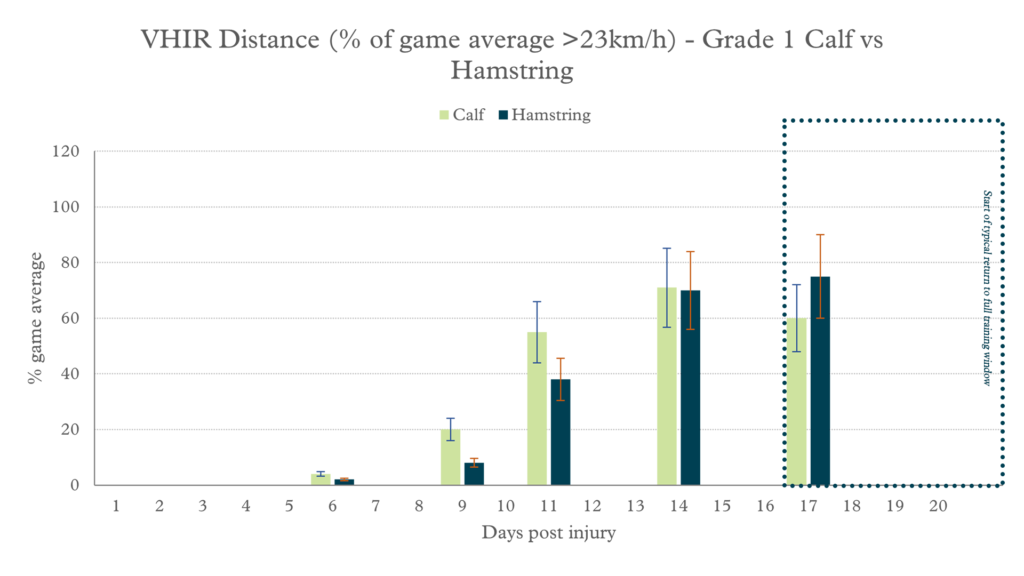
Figure 7 – VHIR distance (% of game average >23km/h) – grade 1 calf vs hamstring

Figure 8 – Accelerations (% of game average) – grade 1 calf vs hamstring

Figure 9 – Average rates of % max velocity progression for grade 1 (adductor, calf, hamstring, quadriceps) and grade 2 (calf, hamstring) soft tissue injuries

Figure 10 – Average rates of total distance progression for grade 1 (adductor, calf, hamstring, quadriceps) and grade 2 (calf, hamstring) soft tissue injuries

Figure 11 – Average rates of VHIR progression for grade 1 (adductor, calf, hamstring, quadriceps) and grade 2 (calf, hamstring) soft tissue injuries

Figure 12 – Average rates of acceleration progression for grade 1 (adductor, calf, hamstring, quadriceps) and grade 2 (calf, hamstring) soft tissue injuries
Example of a rehab running prescription
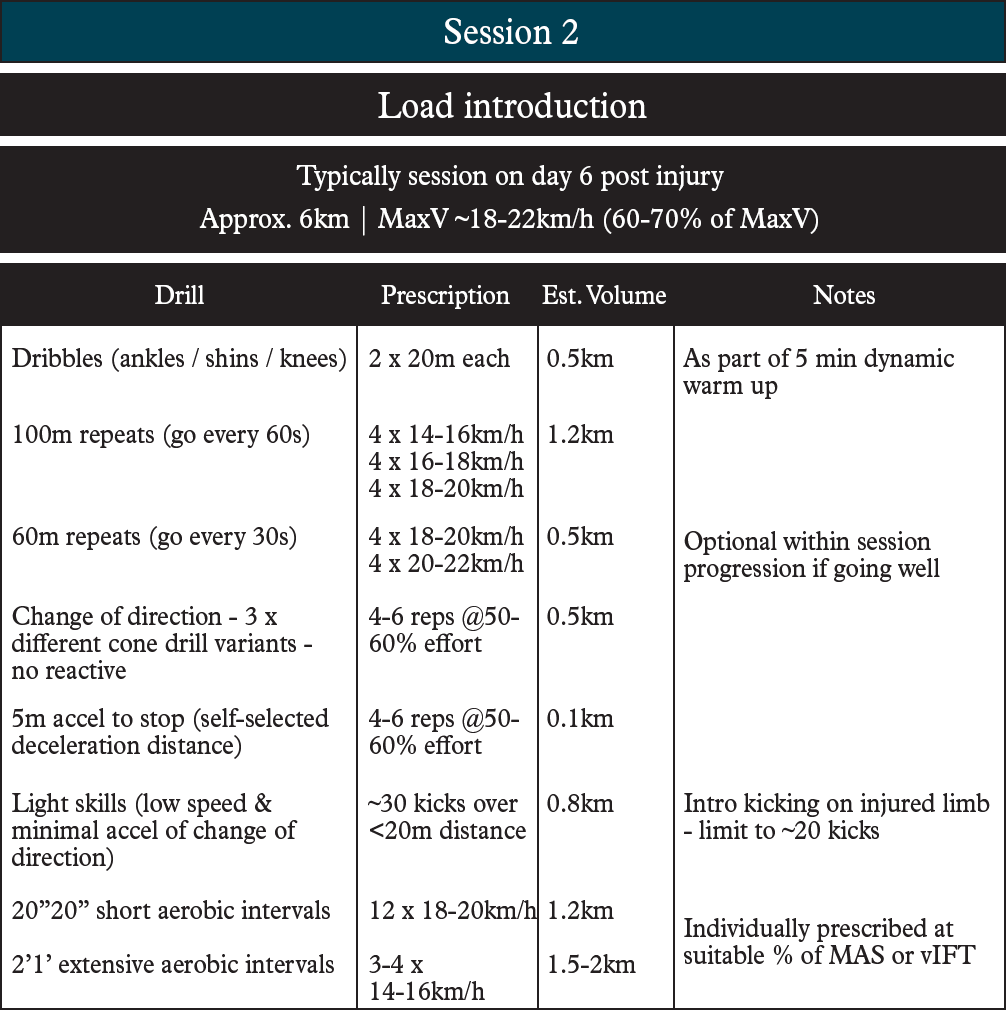
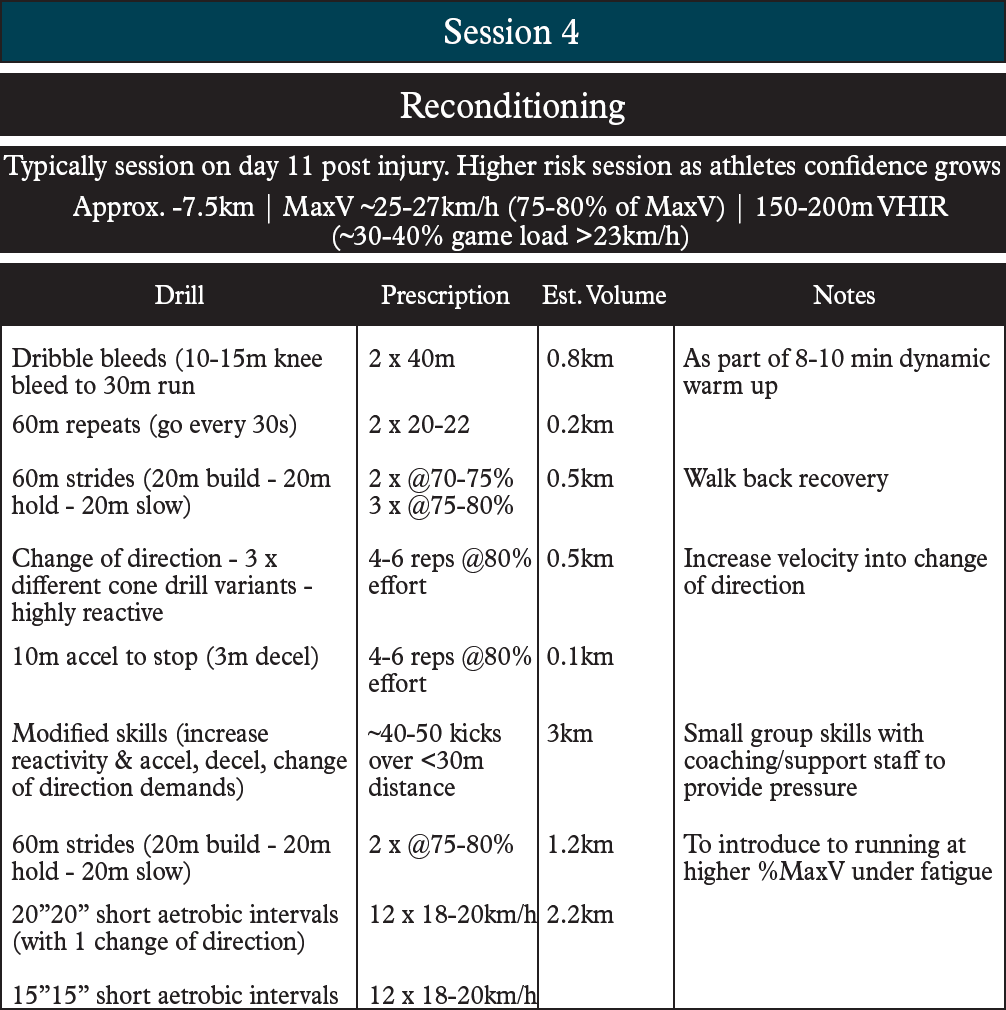
Below are six sequential rehab running sessions I’ve typically implemented for a grade 1 hamstring strain as part of a progression to return to full training, all of which I based on this framework and the guidelines.
I start by implementing a very structured approach, prescribing specific time intervals to complete a set distance that corresponds to an average velocity throughout each running effort. For example, 22 seconds to complete 100 meter effort = average speed of 4.5 m/s or 16.5 km/h. Then, I prescribe systematic progressions of running speed until the athlete has returned to approximately 75% max velocity.
| Drill | Time interval | Average velocity (km/h) | Peak velocity (km/h) | % max velocity** |
| 100m | 26 24 22 20 | 13.8 15.0 16.4 18.0 | ~15-16km/h ~16-17km/h ~18-19km/h ~19-20km/h | 47-50% 50-53% 56-59% 59-63% |
| 60m repeats | 12 11 10 9.5 9 | 18.0 19.6 21.6 22.7 24.0 | ~19-20km/h ~21-22km/h ~22-23km/h ~23-24km/h ~24-25km/h | 59-63% 66-69% 69-72% 72-75% 75-78% |
| Building strides | – – – | – – – | 24-26km/h 26-27km/h 27-28km/h | 75-80% 80-85% 85-88% |
| Building flys | – – – | – – – | 28-29km/h 29-30km/h 30-32km/h | 88-90% 90-95% >95% |
I find this approach delivers several key benefits and adaptations. First, it improves the accuracy of matching the athlete’s running speed to the prescribed running speed. To avoid negative reloading response, this is very important particularly during the early rehab running sessions.
Second, progressively increasing the athlete’s efforts to produce higher running speed helps the athlete build confidence and work through varying levels of apprehension, while developing the kinaesthetic awareness to self-regulate submaximal running speeds. That improved self-regulation supports the communication process between coach and athlete, especially going into the transition to running at >75% max velocity.




The rehab running framework, guidelines and analysis presented are by no means a perfect solution, nor is it the only way to organize and progress running during rehabilitation.
However, combined with the practitioner’s or clinician’s expertise and experience, I believe this scaffold can inform more precise planning to optimise outcomes, deliver a consistent service to our athletes and minimise risk of a negative reloading response during the progression of running and locomotor activities.