“Movement variability” is one of those terms that you see and hear but maybe aren’t 100% clear what it is and how it links to performance and injury. Jake Cowin from the Tasmanian Institute of Sport teamed up with Sophia Nimphius and others for a scoping review (open access) on this topic. So we asked Jake to answer 6 questions so coaches can better understand this topic.
What is movement variability and why has this common term not got a firm definition?
Movement variability is defined as the “the normal variations that occur in performance across multiple repetitions of a task” [1]. Even when you try to complete the same task in the exact same way, there are small changes in the way the task is performed, this concept is considered “repetition without repetition” [2]. Within sport, this relates to all skills or actions performed and can be measured in a range of different ways (e.g., joint angles, forces, electromyography, goal accuracy, etc.)
An issue with the term movement variability exists as it is used both to explain a theoretical construct and as an operational measure [3]. These two uses are conflicting as the theoretical construct of movement variability must be intentionally general so that it can be applied broadly but use as an operational measure requires high specificity and accuracy [4]. This presents a large gap between general and specific use of the term which can result in erroneous comparisons and difficulty drawing conclusions from the literature.
In our recent paper [5] we provided a framework outlining three types of movement variability which occur within sporting tasks (Figure 1). These emerged from the literature and help to add clarity to specific use of the term movement variability without dismissing the history of the term or the research surrounding how best to measure and analyse it [6,7]. The three types of movement variability we proposed are:
- Strategic variability describes the different approaches or methods of movement used to complete a task.
- Execution variability describes the intentional and unintentional adjustments of the body between repetitions within the same strategy.
- Outcome variability describes the differences in the result or product of a movement.

Why is movement variability essential for performance?
Movement variability is vital to performance as it allows an individual to change their movements, often this is in response to constraints such as time, presence of defenders, positioning, etc [8]. For example, movement variability is what allows a basketball athlete to adjust their shot to get around or over defenders and still achieve a successful outcome. Movement variability allows for more consistent outcomes to be achieved suggesting that having lots of movement options available in each situation is an important aspect of performance [9].
Tweet ThisMovement variability is vital to performance as it allows an individual to change their movements, often this is in response to constraints such as time, presence of defenders, positioning, etc
@JCOWIN9
Individuals with low movement variability will perform quite consistent, repetitive movements that are resistant to change. As a result, these movements are highly predictable allowing for the opposition to anticipate what will happen next and exploit this. For example, consider a baseball pitcher throwing the same pitch to the same location at the same speed repeatedly. This is highly predictable and can be exploited by the opposition batters.
Is there a link between movement variability and injury risk?
There is a theoretical goldilocks relationship between movement variability and injury risk [10]. Low movement variability is associated with overuse injury risk, as the tissues of the body are repeatedly stressed in the same manner over time resulting in progressive breakdown of these structures [11]. High movement variability is associated with acute injury risk, as it suggests that the individual is moving erratically in a way that the body is ill-prepared and unfamiliar with [10]. These movement are believed to put the body in risky positions for acute injury scenarios.
Consequently, this suggests an individual needs adequate variability to both distribute stress and maintain performance flexibility whilst avoiding excessive variability which heightens the risk of acute injury. Undoubtedly the question is now – how much movement variability is too much or too little? Unfortunately, we still don’t quite know the answer, however, taking a nonlinear approach to data is helping to answer these questions by looking at how the data is structured.
Adequate variability shows a ‘chaotic’ structure which has some underlying patterns and repetition but also elements of randomness. Deviations away from this structure suggest the variability is too low (periodic) or too high (random) for a healthy system. Data from individuals with ACL injuries (prior to reconstruction) showed that they exhibit low execution variability in the knee during walking compared to their non-involved limb [12]. Similarly other studies have shown reduced movement variability across all types when injured [13]. This suggests movement variability should be considered in rehabilitation to ensure the athlete is able to return to a healthy, adaptable state of movement and reduce future injury risks.
Can we measure an athlete’s movement variability (strategic, execution and outcome variability) within a given sporting task? If so, how?
Just as there are lots of different ways movement can be variable, there are lots of different ways movement variability can be measured. The choice of measurement should reflect the type/s of movement variability that are of interest and should represent the task and environment you wish to understand the results in. Given the many factors that can influence movement variability the majority of studies have been conducted in laboratory settings, but it is also understood that people move differently in these environments then they do in competition [14]. However, with growing accessibility to technology such as force platforms, inertial-measurement units and optic based tracking systems the ability to assess individuals in their sporting environments is growing.
Once you know what you are assessing, how to calculate variability and analyse it is another important consideration. Some analysis techniques consider only the magnitude of variability whilst others consider the structure of the data. Research is mainly focused on measurements and analysis involving continuous, discrete and nonlinear analysis methods [1,3,6,7].
We will have more work to share in this space soon particularly regarding how execution variability can be monitored over time.
Do you have any recommendations for practitioners designing practices when looking to enhance movement variability qualities?
The research suggests taking a nonlinear pedagogical approach to develop movement variability [15,16]. This involves embracing movement variability in training using tools such as constraints to promote new ways of moving. This is in line with the concept of showing someone where to look but not specifically what to look for.
In the gym I utilise force plates to understand how my athletes like to move and ensure I am putting the appropriate constraints around their exercise selection to help create the capacity for more movement options. For example, an athlete who performs a countermovement jump with high eccentric forces will be constrained by a seated start box jump and forced to find a suitable concentric movement option. This constraint causes the athlete to find a new way to move / develop the capacity to move in a new way if required.
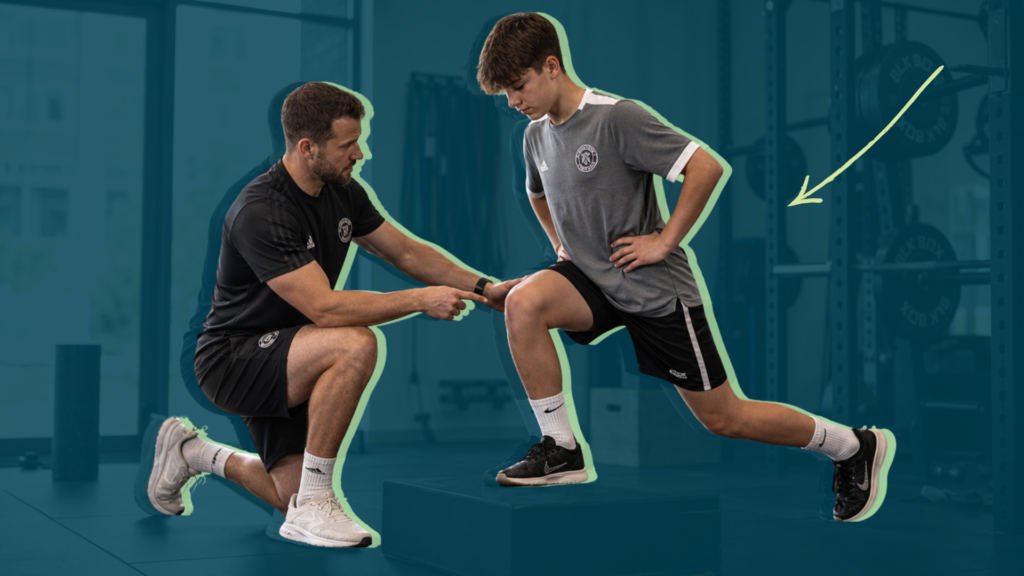
I also utilise exploratory style movements especially as a warm-up activity. These movements are all about the concept of “do it again, but different”. For example, I have athletes perform lunges where the constraint is that “no two lunges can be the same” – this encourages the athlete to move in multiple directions and take ownership of their movement and purpose. In order to develop strategic and execution variability I have used hopping circuits where the athlete has to hop onto and off of different surfaces, in multiple directions, and onto or over obstacles, I have particularly found this useful post-injury to help athletes develop and restore any possible lost movement variability.
Tweet ThisI utilise exploratory style movements especially as a warm-up activity. These movements are all about the concept of “do it again, but different”
@JCOWIN9
On field I regularly discuss with coaches and ensure that drills have a good variation in what constraints athletes are being exposed to. This simulates the chaotic nature of sport and ensures that drills transfer to competition. This can be as simple as suggesting different starting positions, or where the ball starts to create a different stimulus. Similarly, I plan conditioning drills with a focus on exposing athletes to a variety of situations during a session. I refer back to the STEP (space, time, equipment, people) framework for modifying constraints and ensure we are meeting the goals of the sessions whilst also varying these elements.
What are the biggest mistakes you see young practitioners/clinicians make and what advice would you give them to help?
The biggest mistakes I see are people taking a top-down approach to problems as opposed to a bottom up. Considering movement variability in your training can help improve athlete performance but it relies on a strong understanding of the athlete and how they move. Once you know this it is much easier to design your programs and understand how you want to challenge the athlete. Good program design and appropriate exercise selection are the crux of what we do and something that we can all continue to develop.