

Recently, there has been a flare of discussion about whether sports practitioners should use the word “prevention” to describe the quest of minimizing injuries among their players. Avoiding all injuries may be an unrealistic goal – there are often far too many uncontrollable factors. As a result, the term “injury risk reduction” is growing in favour because it less absolute.
Part of our choice of terms is who we are talking to. If an executive from the front office queries the sports performance and sports medicine staff “How many ACL injuries will we get this season?” my experience leads me towards a response like “Hopefully we will have none, and we are putting in place strategies to reduce the risk of them happening.” But if you want to discuss Nordic hamstring exercises with the coaching / technical staff, an audience-appropriate response is more pragmatic and targeted, along the lines of “I think that this exercise will be good at reducing the risk of hamstring injury if we can get the players to do it.” We have strategy X to reduce the risk the of Y.
Overall, my approach is to conceive of prevention as the philosophy and risk reduction as the strategy. Administrators, national sporting organisations and public health officials are more likely to accept “prevention” and recognize that the target is “some” rather than “all” injuries. Coaches, players, parents and colleagues, for their part, may better tolerate the realities of risk and will forthrightly acknowledge that some injuries will occur.
This article will expand on the BJSM education review by Phil Coles[1] (Figure 1) and highlight ways to implement strategies in both elite and sub-elite sporting settings. While football (soccer) will be used as the example in this article, the overarching concepts and philosophy are relevant for all athletes and sports.

Outlining the injury prevention strategy
“Injury” can mean many different things to many people, from the minimal “any physical complaint” in the injury research literature through a minor niggle or tightness to a season ending injury.[2] Early injury models presented injury incidence as a recursive, mostly linear concept. An athlete possesses some number of intrinsic risk factors (age, previous injury, strength, fitness) and encounters an external risk factor or stimulus (match or training), affecting his susceptibility to injury. More recent models observe that not all risk factors impact the athlete equally, and their individual and combined contributions vary during different time frames.[5] Training load, for one, may have a positive or negative impact on the athlete.[6] Understanding the athlete and the event is an important step in developing an injury prevention system.
Injury surveillance
Injury surveillance is a monitoring and assessment program for your injury prevention efforts. If you want to know if what you are doing works, you need to know what injuries are occurring and how they are happening over an extended period of time. By using a standardised system and process, such as those from the International Olympic Committee[8] or a sport-specific institution[2], practitioners and teams can collect consistent and robust injury information over a long period. This helps ensure validity and – crucially for player health – continuity, even if there is a change of sports performance staff.
Tweet ThisInjury surveillance is the foundation of any injury prevention system, and is a vital first step as it will guide what injuries you need to target
@FigtreePhysio
Injury surveillance takes in information from medical staff and the players themselves. There is an increasing body of evidence showing a much greater capture of injury information with self-reported surveillance tools such as the Oslo Sports Trauma Research Centre Questionnaire on Health Problems (OSTRC-H).[9] However, third party information is necessary for a more detailed and diagnostic outlook.[10] This requires significant buy-in from all involved.
Injury surveillance is the foundation of any injury prevention system, and is a vital first step as it will guide what injuries you need to target.
Identifying the risks from the sport and the individual
Evidence is accumulating in the football (soccer) literature about the sport-specific situations where injuries occur. For example, the four main mechanisms of ACL injury in football were pressing and tackling, being tackled, regaining balance after kicking and landing from a jump.[13] A similar study using video analysis to determine the pattern of hamstring injuries found that the main mechanisms for injury were stretch-related (lunging, kicking or landing), and sprinting.[14]
This type of sport-specific mechanistic information allows sports practitioners and technical staff to target reducing the risk for players who perform these actions. Clearly, we cannot remove players from these events, but we can implement strategies that progressively increase athlete safety in these situations.
Tweet ThisThe four main mechanisms of ACL injury in football were pressing and tackling, being tackled, regaining balance after kicking and landing from a jump
@figtreephysio
All injury models include intrinsic risk as predisposing the athlete to injury.[4,5,6] Some of these risk factors are modifiable (e.g. strength and fitness), but many like age and previous injury are not. Figure 2 summarizes the potential factors that can contribute to an individual athlete’s risk profile at any one time, breaking them into four key elements: context specific, internal vs. external, individual specific and non-modifiable vs. modifiable.

The complexity of prevention
Once you know what injuries you are trying to prevent, you can start creating your plan. Injury prevention is multi-levelled (Figure 3). The injury prevention continuum includes athletes that do not currently have any issues (primary); those with a minor physical complaint like hamstring tightness, which may not stop participation (secondary); and those who currently have a problem that we don’t want to exacerbate (tertiary).

Comprehensive injury prevention model for a youth footballer
John Smith is a 14-year-old striker who is new to your club this season. His previous club identified him as a highly talented prospect and placed him on the extended monitoring list for his national football organisation.
He had no injuries that resulted in missing a match in the previous season, but occasionally has knee and groin tightness after a match. Two seasons ago, he missed four weeks with a bilateral heel pain consistent with Severs Disease. John is 177 cm (5’ 10”) tall and 71 kg, and reports that he grew 5 cm in the last six months. A maturation assessment places him at the peak height velocity growth stage, that is, he is at the age at which he is likely to be growing the fastest..
His new academy trains three times per week for approximately 90 minutes per session and plays one match per week. Last season he played at a lower level academy that trained twice each week. He has never done specific strength exercises. He also trains twice per week with a school team in the morning and occasionally plays in school tournaments.
Primary prevention: Incorporating the individual into the team
Primary prevention is always a challenge because nothing has happened yet, and if it works, nothing will happen!
Primary prevention strategies are usually designed at the level of a population. For example, the Football Australia Perform+ (the 2021 updated version of the FIFA11+/11+) (Figure 4) is designed for all players: male and female, youth and adult. Injury incidence drops by 40% when teams employ this program 2-3 each week.[17]
These programs have specific exercises and drills that aim to address known risk factors for injury in the sport. For example, the Perform+ and 11+ include exercises that target hamstring, quadriceps, calf, ankle and knee injuries, and now hip / groin injuries with the addition of the Copenhagen adductor exercise in the Perform+. Given the nature of these programs, they tend to be aimed at the community level athlete and can be delivered by coaches or parents.
Additional primary prevention strategies include:
- Adequate training load, high speed and maximum velocity running and technical competency may reduce injury risk in uninjured players.[15]
- Training technique, e.g. kicking, striking, tackling, deceleration.
- Ensuring adequate cardiovascular fitness and loading for the sport.
- Correct protective equipment and adherence to laws of the sport.
- Adequate skill level to perform desired task.
- Landing and proprioceptive drills.
- Correct footwear for the surface involved in the sport.
- Appropriate player recovery and training programming.
Implementation
- Physical capacity assessment to determine an individual’s physical status relative to the rest of the squad, and to set his baseline. An example is the 30-15 Intermittent Fitness Test, which also facilitates individualized conditioning.
- Consideration of load application. With John progressing from two to three sessions per week, he may need some time to get used to the extra physical load. Additionally, the new academy training level may entail a higher training intensity. In combination with physical capacity testing, the technical staff may gradually increase his exposure to high speed and high intensity running and repeated efforts. Importantly, the coaches should exclude him from drills but should progress him to the level of the other players, for example, by performing five sprints instead of 10 for the first few weeks.
- Pre-training and warm-up should include movements and exercises like those in the 11+/Perform+. These should include non-contact and contact landing and balance exercises; acceleration and deceleration; and change of direction drills. Exercise variations and doing some with the ball may be added once the coaching and performance staffs are happy with John’s movement quality on the foundation exercises.
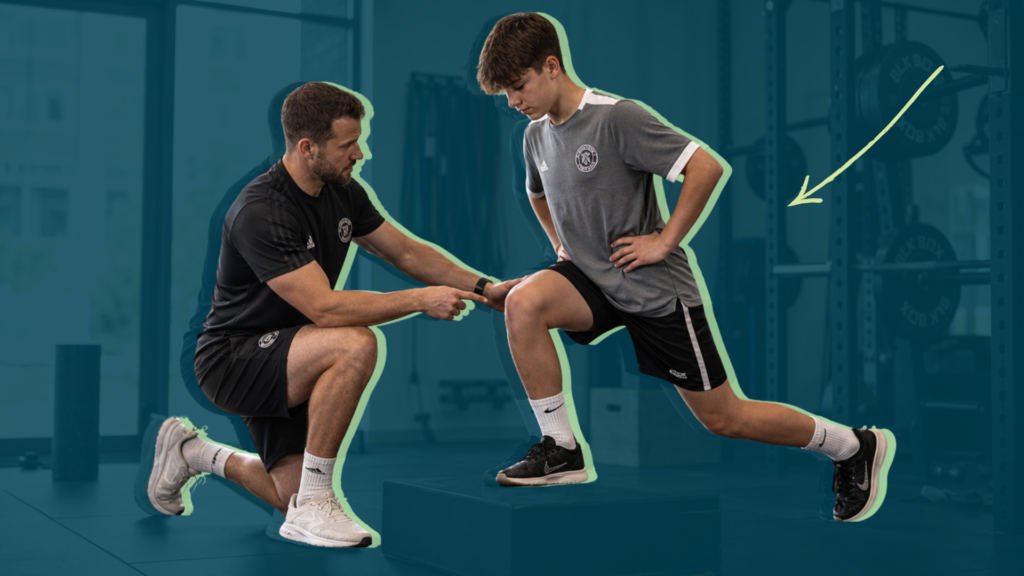
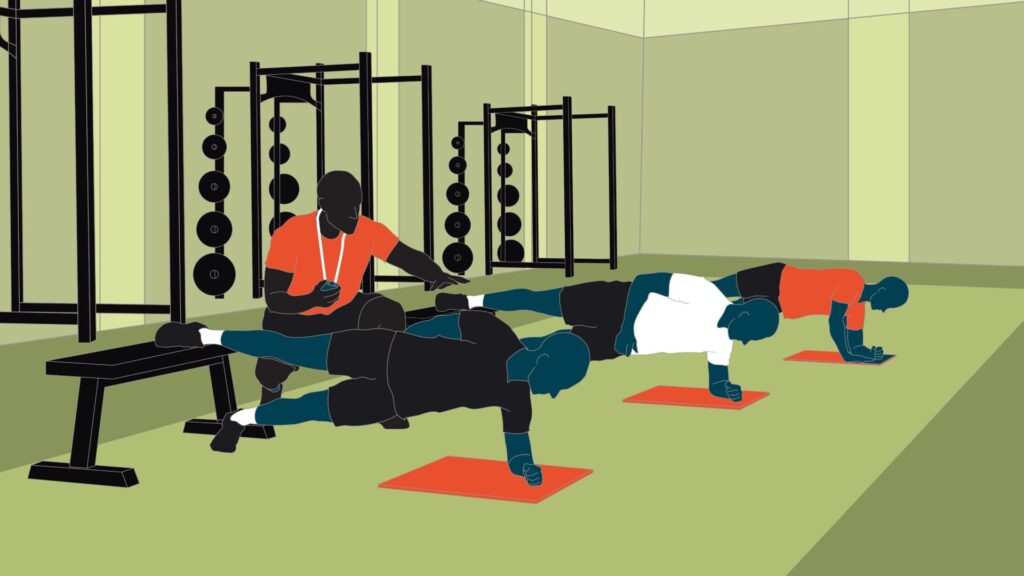
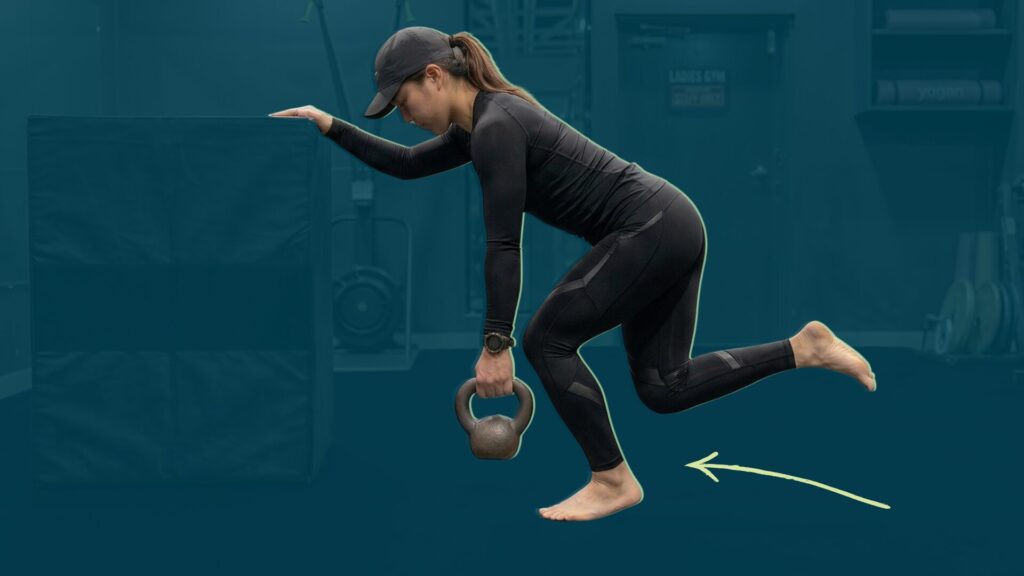
- Capacity building. Schedule strength-based exercise programs three times per week. Strength exercises contained in the 11+/Perform+ including Nordic hamstring exercises; Copenhagen adductor exercises; front and side planks; squats to calf raises; and plyometrics. If the players have access to a gym, practitioners can safely introduce technique-based strength programs. Conditioning strategies may include running drills based on 30-15 IFT results, on top of in-session conditioning to ensure John is well prepared for the demands of the match.
- Equipment review. John will need to comply with the academy policy and wear shin pads for all sessions. As the players often train and play on artificial grass surfaces, he will also be provided with an Artificial Grass version of his preferred natural grass boot brand.
- Stakeholder support. Communication across all stakeholders – player, coach, sports performance and sport medicine staff, parents, school, club, administration – is very important. The staff should explain the results of John’s screening and the prevention plan to his parents, being sure to include tips for how they can support the process. Encourage John to be open and honest so the club can best support him, and his parents play an important role in facilitating this.

Secondary prevention: Targeted to the individual
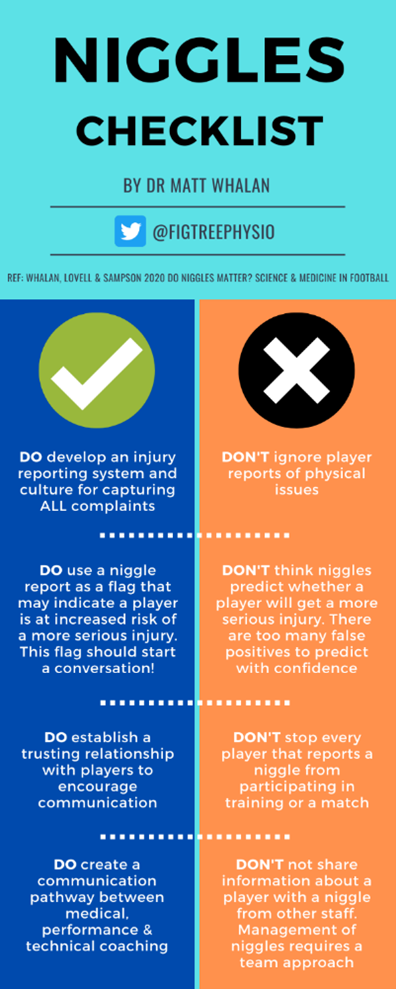
Once you understand the sport and individual specific risk factors, you can develop secondary prevention strategies. A secondary prevention matrix is one way to visualize these risk factors and how they may affect players differently (Figure 5). For instance, we can use a player reporting a “niggle” as a flag for increased risk of a more significant injury. Recent research showed that the report of a minor physical complaint is not only associated with a 3-6x greater risk of a more serious injury, but 68% of more significant injuries were preceded by a minor physical complaint that didn’t affect participation.[10] Furthermore, 90% of all hamstring injuries that caused a loss in training or match time were preceded by a an athlete complaint in the same location.[10] Obviously, increased risk is not the same as predicting that an injury will occur.
Communication and trust between sports practitioners, players, parents and coaches is vital for setting up a secondary prevention system. While maintaining participation in training should always be the goal, modifying training and including treatment interventions may be necessary as a result of an injury risk “flag” and that requires support from all stakeholders (Figure 6).

Implementation
- Physical monitoring. Isometric adductor strength is measured at 45 degrees of hip flexion with a dynanometer prior to each training session and compared to John’s “normal” results. This test is logistically convenient: it is easy, fast, reasonably reproducible and can be performed with a range of devices, from a sphygmomanometer to a more expensive and accurate handheld device.
- If you have more time, you can take more measurements. As John does not have an injury at present, our goal here is to quickly capture a snapshot of muscle performance but also create an opportunity to have a conversation with him.
- In the event of a change in his score on the test, e.g. a 20% decrease in strength but no pain or discomfort, the staff may order a more detailed physical assessment and choose to modify his training. This would include reducing his volume of high speed actions, including shooting and crossing.
- Subjective. During the physical screening, we will talk to John about how he is feeling that day. That conversation will cover his physical readiness for the session, what he did physically the day prior to training, any physical complaints or any other issues. As we develop a relationship with him, we will also be better able to determine changes in mood and happiness.
- Teams can also use an app to collect sleep, mood and soreness self-reports. Significant changes in these factors can be another risk flag to review with John prior to training.
- In the event he reports an issue, a medical professional will assess his complaint and the staff can evaluate his participation in training and whether he needs a treatment intervention. For example, if he reports general hamstring tightness, the team physiotherapist may perform manual therapy to reduce tightness, prescribe mobility exercises prior to training and brief the coach to ensure John does not shoot or sprint during the session.
- Consideration of growth stage. Measure John’s seated and standing height every three months to identify high periods of growth. This information will add context to subjective and objective findings, and may assist in understanding physical complaint reporting and load sensitivity.
- Given John’s age and school commitments, we will obtain a schedule of when he has school exams and school football commitments. Depending on his physical and subjective presentation during this time, we may adjust higher intensity and volume activities during these periods.
Tertiary prevention: Managing the injured athlete
This is probably what physiotherapists are most commonly associated with: working with a player after something has already happened. Importantly, treating practitioners have a key role in promoting safe and efficient return to play and performance. Effective communication with coaches and athletes is vital. For example, for a football player with a chondral lesion in the knee, the goal is reducing the risk of further damage to the knee while continuing to facilitate participation and performance. In this case, the player may have a specific set of extra or alternative exercises during the week, or they may avoid prolonged exposure to high risk events.
Implementation
Unfortunately, despite the Primary and Secondary strategies, John was kicked in his ankle during a match. The team physiotherapist assessed him and cleared him for training participation and on-field rehabilitation, subject to the restrictions of non-contact ball work and a maximum running speed of 50% of his maximum.
- Squad Integration. Review the training components for the session and discuss with the coaching staff the elements that John can participate in. In this case, he can do the warm-up and passing practice. He can also stay on the outside of a small sided game as a non-contact passer. When the squad moves to a larger game, he can shift to an individual program.
- Individual Program. The rehabilitation program has on- and off-field components. The on-field portion consists of closed skills such as juggling, passing and dribbling drills with the ball. These can be modified to become a conditioning drill by adjusting intensity, duration and rest periods. As John progresses, the drills will become more complex and include opposition players, contact and finishing a drill with a high intensity action such as a shot.
- Conditioning. In John’s first session back, he may perform light running to assess response to load. As he progresses, he will build back to pre-injury running intensity and volume. For example, he may start with two repetitions of 3-minute continuous running set at an easy pace. This may progress to six repetitions of 150m of higher speed running, with 30 seconds “on” and 30 seconds rest. Additional conditioning will be off-field via cycling, swimming and the cross trainer.
- Continue primary and secondary risk minimization strategies. Ensure John completes his strengthening and performance program as outlined. Even when fully back to play and performance, he will continue to be monitored closely in the weeks following his return.

Selling it to coaches
Unfortunately, barriers continue to exist to implementing a systemic injury risk reduction program. These include beliefs that injury prevention programs are too long, coaches lacking awareness, and concerns about doing some exercises, like the Nordic hamstring exercise, before training (or at all).[18] These and other pitfalls have led to poor implementation of injury prevention strategies.
Another potential reason is that the term “injury prevention” medicalises the process and disempowers coaches from actively driving the process. There are a number of potential ways to improve adherence and compliance.
Prevention is performance enhancing
When athletes are more available for training[19] and matches,[20] they are more likely to be successful. Furthermore, most exercises and strategies that reduce injury risk (such as Nordic hamstring exercises and sprinting) also increase physical performance.[21]
Learn to speak coach
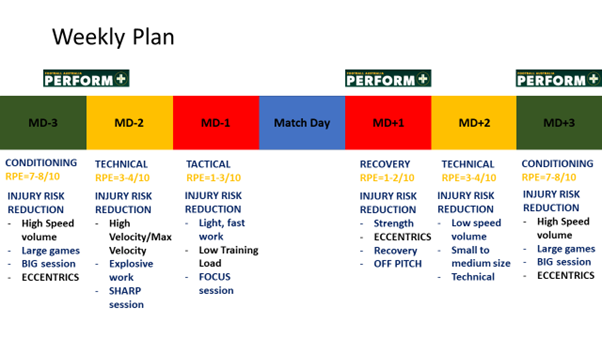
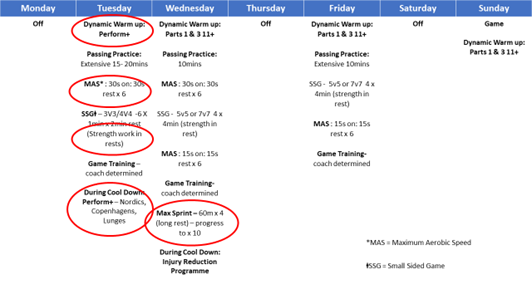
Often sports science and sports medicine staff are good at prescribing but poor at coaching. Understanding how coaches plan their session, week and season will allow the practitioners to work out ways to fit in the key elements. Figure 8 is an example of a week-long micro-cycle built around match day (MD). Figure 9 is an example of a training session and where you can slide elements into a normal session.
Helping the coaches coach: Promote flexibility, variation and efficiency
Coaches are key to injury prevention strategy implementation. Incorporating injury prevention strategies into normal coaching practice is vital. In Australia, the Perform+ has been de-medicalized and included in the strength & conditioning modules, and is now a standard component of all coaching education.
Tweet ThisCoaches are key to injury prevention strategy implementation. Incorporating injury prevention strategies into normal coaching practice is vital
@figtreephysio
Allowing coaches to modify the exercises or drills in a way that adds variation but maintains the theme of the original exercise may be useful: for example, including the ball into the warm-up drills. However, this should only happen once players are competent and able to perform the original drills well. This removes the barrier about program duration. For example, the Perform+ encourages coaches to spread strength exercises throughout the session or at the end of training. This rescheduling of strength work improves compliance with the exercises, saves time in the session and reduces injury incidence.[22] Getting players to do exercise at home is also a great idea and is equally effective in improving strength and performance.[23]
Female players
While the difference in ACL injury incidence between male and female players is well documented,[24] ensure you consider gendered social factors such as access to resources, training age, quality of facilities and attitude towards rehabilitation when designing an injury prevention system for the female player.[25]
Much more work needs to be done in the female athlete space. However, moving away from a deficit model – the idea that a player is injury prone because she is female – is an important step forward. Working on the persistent gaps may significantly help reduce injury risk for female players.