There has been a lot of discussion / controversy about force-velocity profiling recently on social media. Can you briefly explain the debate?
The discussion surrounding F-v profiling specifically relates to the methodology put forward by Samozino et al. [5, 6]. This approach is based on simple “field methods” using a macroscopic biomechanical model and inverse dynamics, which I’ll refer to as the “SAM method.”
Without getting into the nitty gritty of the model (see references below), the SAM method brings the laboratory to the field, thereby allowing strength & conditioning coaches and sport scientists to quantify the mechanical characteristics of jumping and sprinting performance using only basic body measures such as body mass, standing stature, lower limb length, jump height and velocity-time (or position-time) data, without the need for laboratory grade technology.
The controversy on F-v profiling [1, 3, 4, 8] has typically been in relation to:
1. what the profile does and does not represent,
2. the mechanical assumptions evident in the biomechanical modelling,
3. potential misconceptions regarding mechanical terminology, and
4) the utility of F-v variables to inform performance.
It is important for practitioners to critically analyze and critique these concerns, and make an informed judgement of whether this methodology is useful in their sporting context.
Many of the concerns above have been addressed in a recent commentary from Samozino et al. [7] that largely focusses on the methodological rigor with which the data has been collected. It challenges the opponents in reference to potential pilot studies, measurement error and familiarization of procedures.
Despite these examples, there are also several studies endorsing the validity, reliability and application of F-v profiling, highlighting the use of the SAM method to improve coaching practice.
In the interests of disclousre, my thesis is focussed on F-v profiling, and we have raised limitations of the SAM methodology within various chapters. Yet we have also identified and demonstrated the utility and effectiveness of using F-v profiling within individual and team sport populations. Link to ResearchGate.
Why would a coach take the time to conduct a force-velocity profile and how do you do it, both for horizontal and vertical movements?
From a biomechanist’s perspective, if coaches want to understand what is driving performance, rather than just using an outcome measure such as jump height or sprint time, F-v profiling provides quantitative data to describe the athlete’s movement expression across the force-velocity continuum. Although many athletes will achieve great performances without performing this assessment, F-v profiling gives coaches with a better starting point than just using performance outcomes and their “coaching eye.” It essentially creates a mechanical roadmap of how coaches can further understand and develop the mechanical components underpinning jumping and sprinting actions using biomechanical data.
Unlike typical fitness batteries or other resistance training methods where strength is assumed to be the dominant factor driving performance, force-velocity profiling enables data driven decisions to inform interventions. That allows coaches to optimize and individualize various aspects of training to enhance performance on the track, basketball court or football field.
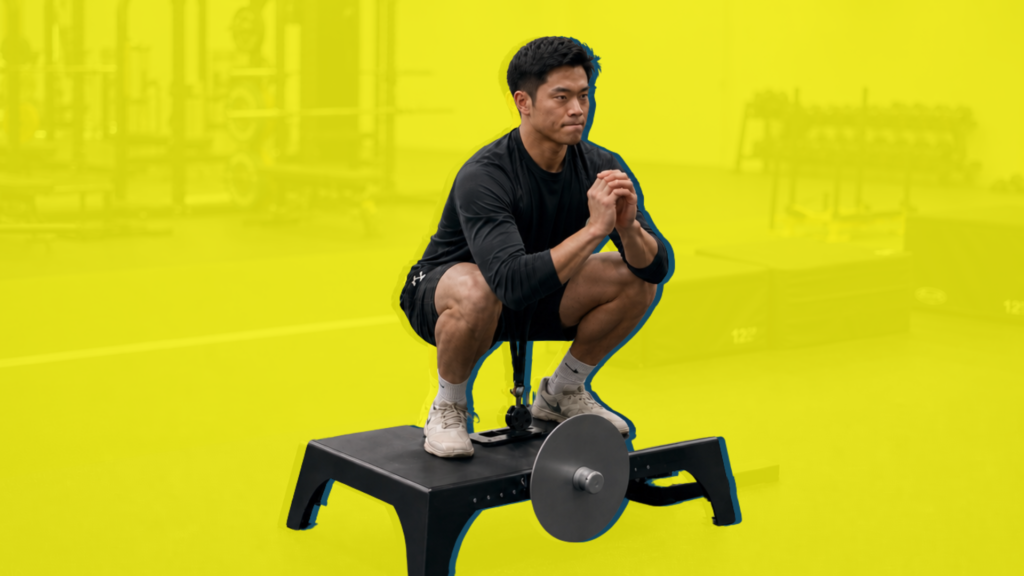
Vertical force-velocity profiles are determined by performing squat jumps or countermovement jumps in a Smith machine or with free weights (e.g., barbell, hexbar) against a series of external loads that span the F-v spectrum. A standard protocol will put the athlete through 2-5 loads, from 1-2x bodyweight, recording jump height at each load.
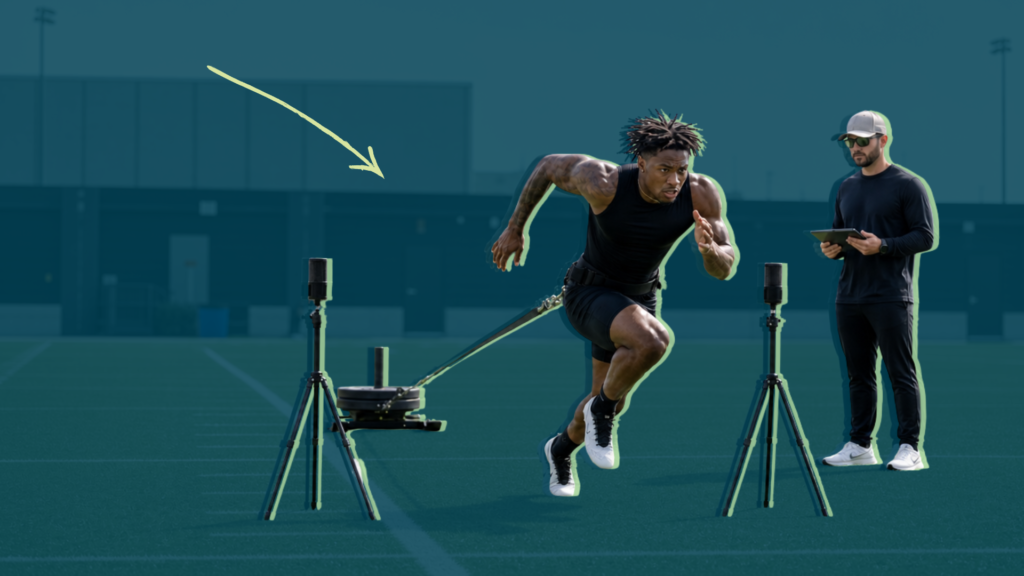
Horizontal force-velocity profiles are determined by performing 20-40m maximal sprint efforts. The practitioner collects position-time data with timing gates or GPS; or velocity-time data via radar / optical laser or a motorized pulley device such as the 1080Sprint or DynaSpeed.
From this data, practitioners can derive all F-v variables for further analysis in Microsoft Excel spreadsheets designed and made freely available by J-B Morin and Pierre Samozino.
Tweet ThisForce-velocity profiling essentially creates a mechanical roadmap of how coaches can further understand and develop the mechanical components underpinning jumping and sprinting actions using biomechanical data
@dylhicks
How can force-velocity profiles help coaches make programming decisions? Do you have any examples?
For the jump F-v profile, mechanical variables will provide indicators of whether force production at low velocity (i.e., high load) or high velocity (low load) during the propulsive phase of the jump is a limiting factor in maximal expression of external power and, therefore, jump height. This may be linked to either a biomechanical (force, velocity and power) or technical (segmental dynamics) weakness / mechanical imbalance, or both. This type of F-v data can then inform training and programming decisions.
Without describing all jump related F-v variables, if we analyze two different sets of vertical F-v profiles from field hockey players (Att = attackers, Def = defenders; Profile A = male players, Profile B = female players), significant differences are apparent between position groups and sex within the same sport.
For example, male attackers display a more velocity oriented F-v profile compared to defenders, whereas female attackers display a more force-oriented profile compared to defenders. This information likely reflects differences in game demands between sexes, but also provides strength & conditioning coaches with key information about how to prescribe position specific gym and field-based sessions.
Differences in training interventions for male players in attacking positions should include an emphasis on high velocity movements in both force orientations: plyometrics such as speed bounding and depth jumps, band assisted jumps, sprinting and, for advanced athletes, assisted sprinting. Female attackers, on the other hand, may need to emphasise high force movements at low velocity, such as traditional strength exercises like back squats and hexbar deadlifts, along with horizontally loaded movements such as resisted sprint training.
Paired with appropriate on field hockey training, coaches can address the mechanical characteristics of players at specific positions on the field from a more holistic perspective.

Similarly, mechanical characteristics displayed during sprint F-v profiling can also assist practitioners when designing short and long term training programmes.
The profiles below identify two national level 100m athletes (Athlete A, PB: 10.47, Athlete B, PB: 10.81) and their mean F-v characteristics across the competitive season. If we exclude the track workouts (physiological and neuromuscular stimulus) and focus specifically on the mechanical characteristics, it is clear Athlete A has an overall more enhanced F-v profile, with greater F0, v0 and PMAX, which has influenced performance outcomes.
To improve Athlete B’s performance outcomes, the coach must then decide which aspects of the programme, either a biomechanical or technical focus, will elicit positive adaptations.
The slopes of both athletes’ F-v profiles are similar, yet Athlete B has lower values. This may suggest that coaches can enhance maximal power expressed in the horizontal direction by improving both ends of the F-v spectrum. That may require contrasting training methods, from heavy resisted sprint training to assisted sprint training, which may have different adaptation rates and timelines before we see enhanced sprint outcomes.

There was a time when those pushing the force-vector theory were telling us that vertically oriented training was optimal for vertically oriented tasks and horizontally oriented training was optimal for horizontally oriented tasks. Can your work help debunk this as “vertical and horizontal profiles explain similar mechanical characteristics irrespective of force orientation?”
Yes, the force-vector theory suggests greater transfer should occur in sprint actions if we perform horizontally loaded movements (i.e., resisted sprint training, hip thrust), and vice versa for jumping actions and vertically oriented movements (i.e., back squat, deadlift).
Our recent study contradicted this finding and showed significant relationships between matched mechanical variables in both the vertical and horizontal orientation, suggesting they explain the same lower limb neuromuscular characteristics. This implies one F-v profile will predict performance in the other.
I would not say our work “debunks” the force-vector theory. But in the population we studied, club level field hockey players, we found F-v profiles could be used interchangeably to infer mechanical characteristics and performance in the other orientation. Therefore, only one assessment was necessary.
These findings may not be the case with all population groups; however, I suspect they may be representative of field sport players from similar competition levels. This has implications for strength & conditioning coaches when making decisions on whether they should prescribe vertically or horizontally loaded exercises, or ensure a mix of both types to surf the force-velocity curve.
Tweet ThisUnlike typical fitness batteries or other resistance training methods where strength is assumed to be the dominant factor driving performance, force-velocity profiling enables data driven decisions to inform interventions
@dylhicks
Despite this, is there still a place for coaches to do both? If so, why?
Yes! Other literature in the field of mechanical profiling suggests the athlete’s competitive level, training age, sex, body mass, lower limb neuromuscular properties and resistance training background all influence relationships between matched variables.
It should also depend on the sporting context you are working in. For example, jump profiling may be more relevant to basketball players, whereas those playing field sports may find more relevance in a sprint profile.
Also, the type of assessment you perform may be based on the experience of the practitioner; and the technology you have access to may also sway the decision, although this is becoming less of an issue with the use of smartphone applications such as MyJump and MySprint.
Another consideration when determining whether both assessments are necessary is the technical component of applying more horizontally directed force when sprinting, i.e., mechanical effectiveness, compared to applying force almost completely vertically during vertical jump actions. Observing how athletes apply force in both force vectors may be a key performance indicator for some practitioners, so they should assess both F-v profiles.
What are the biggest mistakes you see young practitioners/clinicians make and what advice would you give them to help?
Currently, my main coaching occurs in youth athletic development within a school setting and track & field (100-400m state and national level athletes). Here are some mistakes I see too often, some of which I made myself as I was developing my craft – a process still underway.
Too much variety in training. Changing the inputs of the training programme too often make it near impossible to determine which aspect of training is causing the performance change, whether that be positive or negative (see Bondarchuk). I often see younger or less experienced coaches manipulating too many training principles at once or changing exercises too readily.
This limits skill acquisition In a youth setting, as not enough time is spent refining the movement pattern before moving to the next one.
Within track & field, athletes and coaches need to observe changes on the “clock” during baseline track workouts to understand physiological and neuromuscular adaptations rates. Changing the type of workouts performed on a weekly basis makes it difficult to determine the efficacy of the programme.
Keep the main thing, the main thing. Basketball players must make buckets. Australian Football players must kick goals. Sprinters must sprint. It seems common sense, but I feel too many strength & conditioning coaches want to convince athletes that they should place equal emphasis and training time on the field / court and weightroom. The actual sport task – tactical and technical – will always have the greater transfer to the performance.
I am not at all saying strength & conditioning is not important. It is, and performance staff play a role in the process and influence sport outcomes. But the focus should always be to address the demands of the sport, starting with the field of play
Listen to older coaches. I have made this error, as I am sure many younger coaches have. Find the coaches in your field or domain who have been successful and listen to them.
As they say, success leaves clues. They have likely been doing the job for more years than you have been alive and would have been there and done that. They may not have always done things the right way, but they would have likely made every mistake you are about to make, so do not discount the advice they give and be proactive in seeking it.
More recently, I would suggest there is a greater disconnect between the younger and older generation of coaches due to the impact of sport science. Nonetheless, high performance sport is still based on training principles and training methods that have been around for almost a century (see A. V. Hill & K. Furusawa), so there is nothing new. Older and experienced coaches know that no one is getting to the top of the podium without putting in the work, regardless of the HRV score that morning.
Tweet ThisIt is important for practitioners to critically analyse and critique the concerns with F-v profiling, and make an informed judgement of whether this methodology is useful in their sporting context
@dylhicks