For most of the history of sprint or change of direction (COD) training in football, sports practitioners and scientists assumed these actions must have purely linear or rectilinear trajectories. Reality is different, though. Approximately 85% of the maximum velocity maneuvers in a professional football league consist of curvilinear sprints [1]. Sprinting during football matches is rarely linear [2]. Treating footballers’ sprints as “Pac-Man” displacements is one of the biggest misconceptions in this area of sports performance.
Different elements have shaped this persistent lapse. First, practitioners may simply think that since the shortest distance between two points is a straight line, if we intend to train athletes to move as quickly as possible from one point to another, we should train them to move as quickly as possible along that straight line.
However, this is a simplistic and reductionist analysis, disconnected from our sporting context. Football is football, not Pac-Man. Displacement trajectories in football are not purely rectilinear movements. The presence of opponents and teammates, and technical-tactical elements such as attacking movements for receiving the ball or attacking the free space, all introduce nonlinear movement needs and patterns. When football players sprint, they are frequently changing their trajectories, constantly readjusting routes and sometimes doing this without a clear braking maneuver (e.g. cutting) to maintain speed.

Just because the shortest distance between two points is a straight line doesn’t mean that’s the optimal route in game play. Sometimes it is better to sprint more distance and not brake (as commonly observed with change of direction actions) to get into a game situation sooner or avoid an offside position.
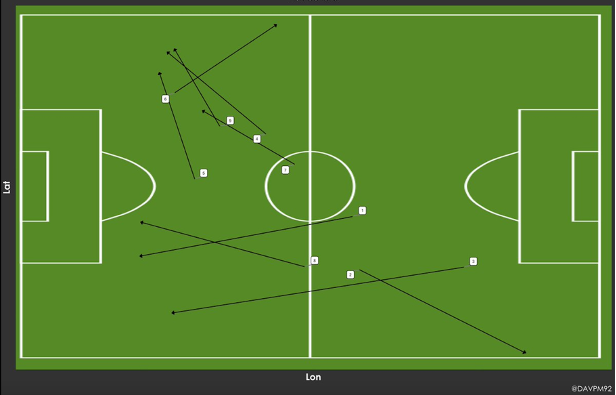
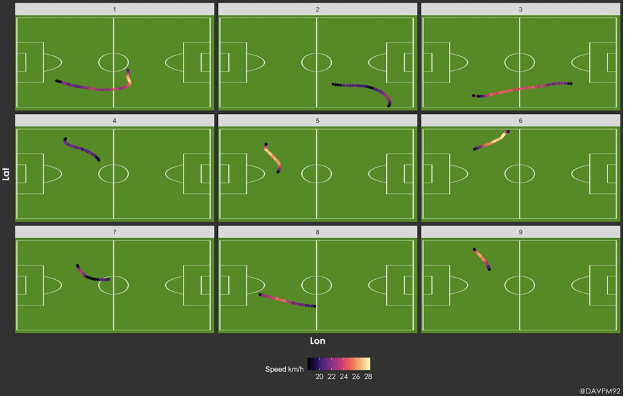
Second, sometimes the tracking systems – particularly GPS – report sprint distances, locations and frequencies by taking the start and end point of the sprint, and simply drawing a straight line between those points (Figure 1). The computation assumes linearity. But if we analyze the raw tracking data, we can see how the trajectories are not purely rectilinear, but curvilinear (Figure 2).
Understandably, we often try to simplify some actions in sports training. Some practitioners train basketball players, track athletes and football players. This may lead them to simplifying or unifying actions from the different sports and implementing general movement patterns across the training group, neglecting the details of each sport or each position. Hence, straight sprints, purely vertical jumps or extremely standardized and decontextualized actions on the assumption that they are suitable for all athletes and guarantee reliability due to athlete familiarity.
Nevertheless, sprint actions are not the same in football as they are in futsal or basketball, so they should not be trained as if they were.
Is there a “curved sprinting deficit” in team sport athletes?
It is logical to expect that players are faster over a 17 meter straight sprint than a 17 meter curvilinear sprint, similar to the change of direction deficit. However, our data shows equal, or even better, performance in the curved sprint compared to a linear sprint [3-5]. Three potential explanations for this observation are:
- The distance was not long enough to show clear differences. Amongst track athletes and sprinters, for example, over [6,7].
- Specificity: Our subjects were football players, who are more familiar with curvilinear than purely rectilinear sprints. This leads to a smaller difference between the actions.
- Radius of the curve sprint test: The 9.15 meter radius did not require the players to perform “cutting” or “braking” maneuvers.
As a result, the deficit concept does not make sense in the curvilinear-linear sprint comparison using our test in team sports. Perhaps the differences would favor linear sprinting if we decreased the turning radius or increased the total distance of the test. But then the test’s degree of specificity would be lower. Nevertheless, other authors studying track and field athletes did not report differences between curved and straight sprinting [8].
Emerging research supports the unique demands of curvilinear sprinting
When I started my thesis project a few years ago, there was nothing in the literature about the curvilinear sprint in football. Some studies about curve running in athletes, but not in football. Since our first study at FSI (Football Science Institute) Research Lab in 2019, papers and skills related to curve sprinting have multiplied. Except for our published papers, though, there is still limited published research on this topic, although many projects are investigating curve sprinting in football.
The first question that came to our minds was whether there is a relationship between curved and linear sprinting. Our studies show a wide range of correlations between linear and curvilinear sprinting [4,9-12].
In general, we found a moderate-to-large relationship between these outputs, with the relationships depending on age and skill / competitive level [11]. We found a stronger relationship in young people than in highly experienced adults. We interpret these results to suggest that when athletes reach physical maturation and proficient experience, skills that seemed similar (e.g., linear and curvilinear sprinting) manifest as independent skills. But that relationship is not very relevant for us: if we had to choose between curved vs. linear running, we would choose the most representative sprint in football.
One of the main differences between curved and linear running is the role of each leg. While in the linear sprint both legs have the same behavior (kinematic, kinetic and spatio-temporal), each leg has a different role in curvilinear sprinting. In our second study, we showed that the inside leg had longer ground contact times than the outside leg [5]. Indeed, the inside leg was more affected by the change from linear to curvilinear sprinting, per the their contact times. The outside leg, in fact, was not affected.
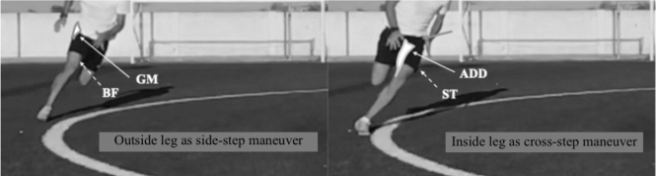
EMG results confirmed that each leg had a different activation pattern. The gluteus medius and semitendinosus of the outer leg were more activated, while the semimembranosus and adductor of the inner leg were more active in curved running (Figure 3).
Given that each leg has a different role in curved sprinting, we should train them in those conditions.
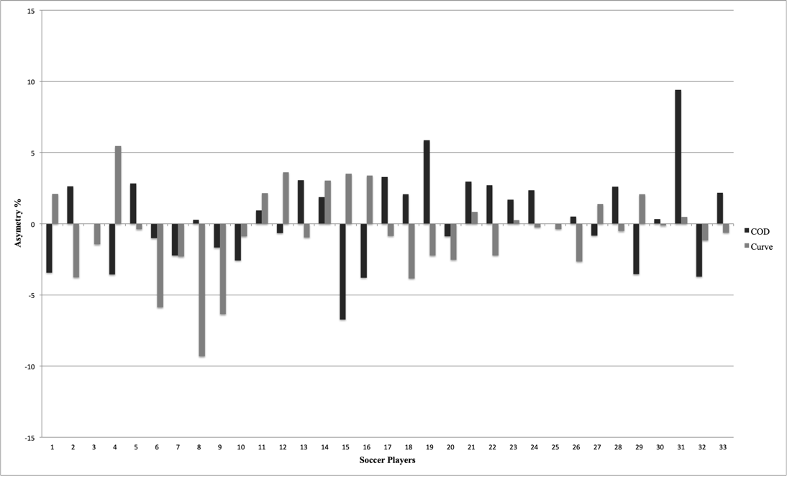
The curved sprint is not a change of direction. Our research shows a limited association between single 90º COD speed and curvilinear sprint tests, with a shared variance of ~11% [4]. The main difference between the two is that the curved sprint does not have a deceleration phase – it is a gradual change of trajectory that aims to avoid “cutting” actions. In fact, in our study we found that ~70% of football players (22/33) who had asymmetries for one side in the COD test presented asymmetries in the opposite direction in the curve sprint test (Figure 4). The differing roles of each leg during each skill likely explains these differences. While the outside leg has a greater contribution during COD tasks, in the curved sprint the inside leg plays a more prominent role in forward propulsion.
Tweet ThisThe curved sprint is not a change of direction. Our research shows a limited association between single 90º COD speed and curvilinear sprint tests, with a shared variance of ~11%
@AlbertoFilter

Assessing curvilinear sprinting in the field
Our goal in planning the first study was to develop a simple assessment for curvilinear sprinting that had broad, almost universal application.
Unlike the straight sprint, players in a curved sprint test need a reference line to follow while accelerating. Sprinting to one side or the other of the line changes both the distance and the centrifugal force. Thus, we had to find a standardized line to assess the curvilinear sprint in the field.
Fortunately, football fields marked to FIFA dimensions offer a curved line that meets the criteria of the standard sprint in football. The arc of the area is 17 meters long and a degree of curvature (9.15m radius from penalty spot) that is within the range of the standard curvilinear sprint in football (Figure 5). The other option was the central circle of the football field, with the same degree of curvature but an excessively long distance even if you use only half of the circle. In fact, unlike the linear sprint tests, the preparation for the curve sprint test does not require a measuring tape to assess the sprint distance between timing gates, avoiding measurement errors or maladjustment.
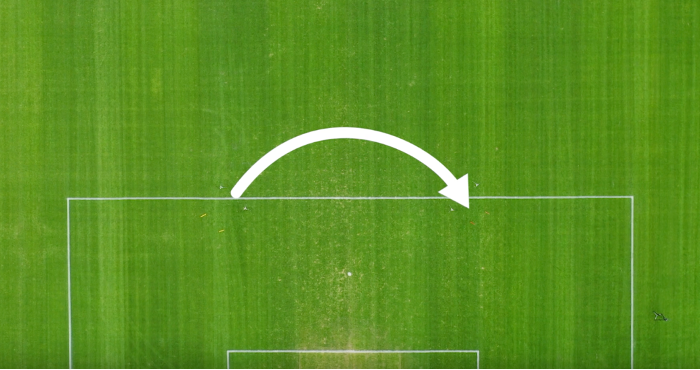
Curve sprint testing only requires two timing gates, placed perpendicular to and at the beginning and end of the arc of the area (Figure 6), with the starting line 1 meter from the first timing gate. Optionally, you can place timing gates in the middle of the arc (8.5m) to have a more complete understanding. Practitioners must not forget to perform the curve sprint test for both sides in order to measure the “weak” and the “good” side. For more details regarding this protocol, see our first paper in the Journal of Sports Sciences [9] or this video by FSI, where we provide details about the test.
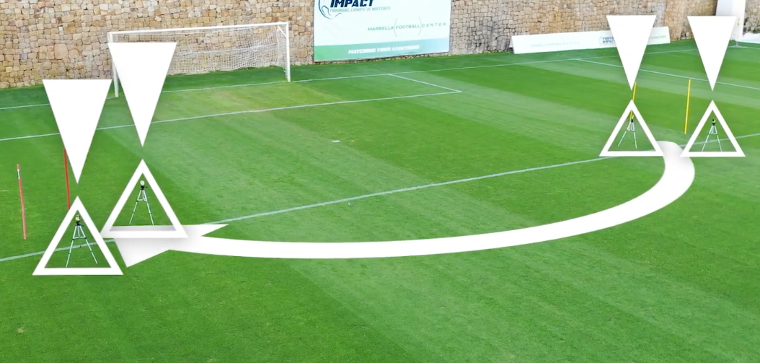
For those practitioners or researchers without specialized timing equipment, mobile phones are a valid and reliable method. By recording from the penalty spot (Figure 7) you can generate frame-by-frame analysis of player performance and learn their “good” and “weak” side. Our experience suggests that using video is not only good for timing data, it provides you with data for kinematic analysis.

Knowing how to interpret the data is just as important as obtaining it. The FSI lab measured more than 600 highly experienced players from a wide spectrum of ages and clubs. That broad sample indicates the importance of considering variables such as age (e.g., maturational stage), position and level (elite vs. non-elite). Based on my observations (and not a rigorous analysis), useful categories for a senior player could be:
- Poor: ≥ 2.9s
- Okay: 2.89 – 2.6s
- Good: < 2.6s
Evidence-based drills for training curvilinear sprinting on the field
There are still no longitudinal studies demonstrating beneficial training effects for curvilinear sprinting, Therefore, all the information below is based on experience and trial-and-error.
To train curve sprinting we must understand that centrifugal force affects curve trajectories, implying adjustments in whole body posture and between both legs to avoid going to the outer side of the curve.
Centrifugal Force = (Mass ·* Velocity2) / Radius
The best exercise to improve curve sprinting is curve sprinting itself. We should still complement it with other drills, but curve sprinting and its varieties should be the central axis of any training program.
Modifying the radius of the curve can increase or decrease its load. Joint stabilization in the frontal plane becomes increasingly important with smaller radii, and sprint speed may become increasingly limited by the ability of a group of joint stabilizer muscles to generate force [13] (Figure 8). Therefore, if we increase the length of the radius we decrease the centrifugal force, causing smaller kinematic and kinetic adjustments.
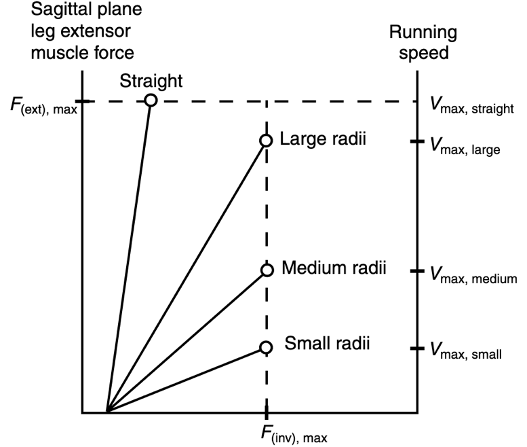
At the outset of introducing curve sprinting into your training programs, we recommend larger radii / smaller turning angles. Using the arc of the area as a reference, we can manage this metric easily. The video below shows a curved sprint with a lower load of centrifugal force. In this first exercise we intend to familiarize the player with the curvilinear sprint, offering different radii and prioritizing acceleration without going off the curve.
If, on the other hand, we want to increase the centrifugal force load, we can decrease the radius by going beyond the arc of the area (Video 2).
The inside leg increases ground contact times meaningfully from linear to curved sprint. Training the inside leg in isolation could contribute to improving the application of force. Hop jumps with the inside leg trying to progress as far as possible and with low contact times (“the floor is lava”) favors the rate of force development in this leg, making it an appropriate drill to develop it (Video 3).
The third drill increases the degree of specificity, being closer to what the player performs during a match. We have two options to increase the load of the curved sprint: decrease the radius or increase the mass.
Increasing mass means increasing centrifugal force. In these drills (Video 4), we increase the mass using a weight vest. This compels a body adjustment (i.e., greater lateral lean) to avoid braking or cutting actions. Although the weighted vest does not make sense for straight sprints, one of the limiting factors in curve sprinting is the action of the stabilizer muscles to keep the body in the frontal plane [13] (Figure 8). If we place more mass on the trunk with the weighted vest, we will increase the load and the stabilizing contribution of the muscles (lateral forces), in order to avoid losing development of force in the sagittal plane.
For an even more contextualized approach that increases sports specificity and transfer to a football game, we mimic what the player performs during the match. Sprinting in football is not just curve sprinting from a stationary, forward facing start. Sprinting in football often starts from rolling acceleration, a ball-related task, an external focus of attention (ball) or a rotated trunk; and could include deceleration and decision-making (i.e., agility). This task sets out to mimic an acceleration scenario that occurs during the competition, increasing centrifugal force with a weight vest.
“Contextualized sprint” implies the individualization of these activities. However, this concept is still not widely implemented. During youth development, we must provide a wide range of movement patterns. Then, as the overall levels of specialization increase, the specificity of the stimuli should increase, incorporating the movement patterns closest to the game into each training / testing session.
In order to adapt the sprint to each sport or position, we must consider multiple aspects that can modify the sprint scenario. For example, accelerating from a side-step maneuver is not the same as accelerating from a front start position. The variables that move towards more sport-specific sprinting scenarios include:
a) Starting position the player uses to accelerate during the competition. Accelerating from a frontal or lateral position are two different tasks. We can classify starting positions according to Paul Caldbeck’s thesis [1] as rear, frontal and lateral (Figure 9).
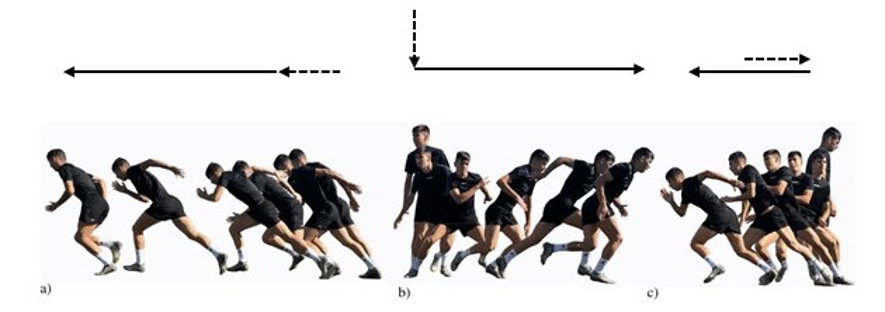
b) Starting velocity: We should train athletes to go into curvilinear sprints from different contexts. Some players have a more explosive initial acceleration (i.e., when the initial speed close to 0 m/s), but most in-game actions in football are “rolling accelerations,” where the athlete is already moving at 5–6 km/h [1.4-1.7 m/s] [1,14] Video 4 shows a “rolling acceleration” with the ball.
c) Trajectory: The route the player takes during the sprint. The curved sprint is more frequent than the straight one. The training programs must adapt to each player, providing a representative trajectory of the angle of curvature and distance the player will run during the competition.
d) Focus of attention: Where the player looks when accelerating. It seems insignificant, but the focus of the player’s attention implies a certain position during acceleration. For example, as Video 4 highlights, the player has an external focus of attention – he’s watching the ball – which implies a rotation of the trunk. This situation is frequent on the field. If the tactical purpose is to attack the free space, the player must look towards the teammate with the ball.
e) End of sprint: The end of the sprint is usually an element of motivation and impetus for the player. Therefore, including a ball at the end of the sprint could generate better performance during acceleration. The technical action can be varied: attack a ball into free space, perform a duel with the ball or, as shown in Video 4, include a deceleration and an “offensive agility” scenario (e.g., attack the opposite side of the defender).
Tweet ThisVariables that move towards more sport-specific sprinting scenarios include starting position, starting velocity, trajectory, focus of attention and end of sprint (motivation of impetus for the player)
@albertofilter
Developing the physical qualities for curved sprinting in the weight room
Those are all on-field training ideas. However, the weight room can provide resources to improve kinetic (strength development) and kinematic (body placement) aspects. The main physical quality to improve is the optimal development of the forces in that specific context, that is, force projection. The latest research on sprinting shows how rate of force development is not only important in its own right, but so is its projection: where is the force “going” as the athlete developments it?
In curve sprinting, unlike in the straight sprint, the lateral force (in frontal plane) throughout the route is constantly redirecting our body to avoid braking or “cutting” actions. This leads to body lateral lean during a curved sprint, and greater peak hip adduction, peak hip internal rotation and peak ankle eversion in inside leg (Figure 10) [15].
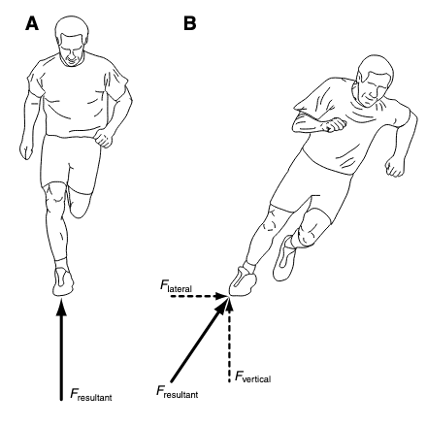
Coaches should design movements to produce force while the body is leaning laterally to enable better body placement to apply force with both legs, especially the inside leg.
Landmine variations can help mimic the direction of force development during curve sprinting, creating vertical and lateral resistance at the same time. These exercises (Video 5) focus on the leg that limits performance in the curved sprint, the inside leg. The landmine simulates the position of the inclined body that we reach with the curvilinear sprint. Going even deeper, the foot of the inside leg during curved sprinting requires greater ankle external rotation and eversion [15]. Together with the landmine, we can use a “slant board” with a low angle to favor a greater range of movem in the ankle of the inside leg.
Curved sprinting is a new component within the training and testing programs of team sports. Our research demonstrates a cost-effective and easy-to-use way to test and train curvilinear sprints on all football fields. Within the context of acceleration and sprinting, curvilinear sprinting is one step closer to the specificity of the sport, and therefore should take priority for training and testing. Strength & conditioning programmes should target the hip, ankle and foot in the non-sagittal planes.