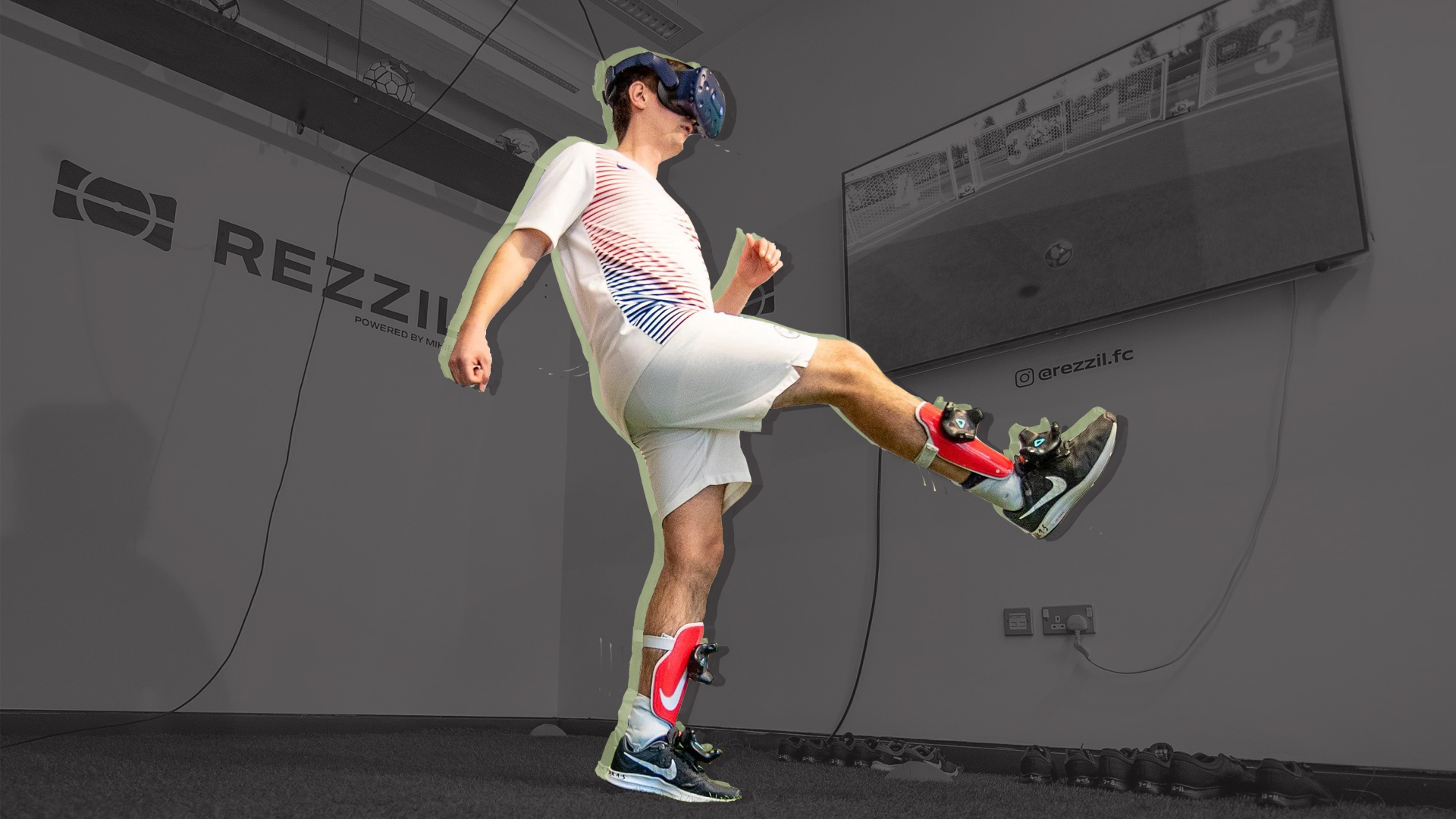
Jonny King is 1st team rehabilitation physiotherapist at Leicester City Football Club. He has a particular interested in ACL rehabilitation and has recently started integrating the use of virtual reality in rehabilitation. So we asked him 6 questions about this…
Virtual reality is getting a lot of press and we know that you like to integrate it into your athletes’ rehabilitation programmes. But how did you first come about to using it?
I initially came across it during the first COVID-19 lockdown. There were some videos flying around various social platforms of players using virtual reality headsets at home as a means of having some form of football simulation whilst not being able to train with their club as normal.
At the time, we didn’t know whether sport-specific virtual reality training had a crossover effect onto the football pitch in terms of skill acquisition and skill development. There was a limited evidence base, with only small case studies being published. However, I remember thinking at the time that this tech could have a niche role in “training the brain” specific to an athlete’s sport and rehabilitation.
Visual motor training has been used to target adaptations to the central nervous system and to drive sensorimotor and neuroplastic adaptation. Eyes open/eyes closed, blinking and the use of strobe glasses have been traditional strategies used by clinicians to manipulate visual stimuli to challenge the sensorimotor system. The VR system takes this a step further by providing a highly immersive environment where visual training can be manipulated to assist or challenge movement and motor planning.
Tweet ThisVirtual reality systems take challenging the sensorimotor system a step further by providing a highly immersive environment where visual training can be manipulated to assist or challenge movement and motor planning
@Jonny_King_PT
By no means is it the solution to all our current questions surrounding return to sport outcomes in professional football, but it adds another, novel dimension to our programming.
You have utilised the VR system most readily throughout ACL rehab. Can you talk about how you do this in a bit more detail?
Okay, well let’s take the ACL injury scenario to start with, which Dustin Groom eloquently describes as;
“An inability to maintain lower limb neuromuscular control while attending to an external focus of attention, involving highly complex dynamic visual stimuli, variable surfaces, movement planning, rapid decision making, variable player positions and environment interactions.”
The need to integrate intense neurocognitive demands with complex multidirectional movements is an essential part of ACL rehabilitation. VR systems allow us to bridge this gap by creating progressively challenging football drills, where ball speed, angle of pass, pressure speed from opponents and time for decision making can all be manipulated.
In the early phases of rehabilitation, we prescribe very basic drills as early as two weeks post-op to challenge cognitive and perceptual capacities with very little dynamic movement or joint load. In the later stages of rehab, we can have players passing to fast moving targets in a 360-degree arena with opponent pressure, requiring multi directional movement. This follows the principles of Matt Taberner’s ‘Control Chaos’ continuum, but starting much earlier, prior to the player returning to the grass. The realism of the environment and the physical inability to look at your knee / foot position put a constraint on the training to avoid an internal focus for motor planning. This, therefore, enables an external focus of attention, which we know is a key component for motor re-learning.
Another big benefit of implementing VR is increased athlete engagement. What benefits have you seen from that increased engagement?
There are lots of novel elements to the system, which can make rehabilitation fun as well as productive. Foot golf and darts are two of the more popular games. They give athletes a break from the monotony of the gym environment, which is invaluable in keeping them engaged in what can be long spells on the sidelines.
We know that engagement and compliance go hand in hand. VR offers us a tool to maintain interest, even when it may not always be the most effective training tool. It can offer a neat trade-off to obtain athlete buy-in, which may give us in roads into the athlete completing other aspects of their rehab they perceive as less enjoyable.
Tweet ThisNovel games within VR systems give athletes a break from the monotony of the gym environment, which is invaluable in keeping them engaged in what can be long spells on the sidelines
@Jonny_King_PT
Our software generates a leader board of players around the world, based on accuracy, execution and decision-making ability in specified drills. This brings an element of competitiveness to the rehab, which is always healthy to drive level of application and also standards / quality of movement and execution.
How do you effectively design drills to get the desired response from a VR session?
As I mentioned previously, there is a huge range of variables we can manipulate, based on the stage of rehabilitation. First, from an injury and tissue healing perspective, we can manipulate tasks and drills to protect injured tissues. For example, early in an MCL injury, we may limit tasks to the sagittal plane. As we increase degrees of freedom, this opens up to include the frontal and transverse planes.
Second, we can manipulate each drill to ascertain certain metabolic responses. We modify duration, rest and intensity of drills to target differing energy systems based on the theme and stage of rehab.
Again, people ask, well, why don’t you just use the field for this? We do! You cannot rationalise using the VR over the field for physical training. Of course not. However, for neurocognitive training, it is a useful adjunct to complement field rehabilitation, where we can add in multiple teammates and opponents to drills to provide an extra layer and complexity to decision making. Sometimes this is not possible when working one-on-one with a player outside.
What do you think is the future of VR?
The software company we work with, Rezzil, is continuously evolving. They are now creating virtual replicas of athletes’ home stadiums and training grounds for them to train in. Does the degree of realism influence skill transfer and decision-making capacity? We don’t know yet, but it seems logical that more realistic and immersive environments encourage better skill transfer.
Having worked with Rezzil from early on in their journey, we are constantly speaking around research and innovation. How can we quantify the effectiveness of this system so it is not just perceived as a toy or a game.
Like with other visual or motor control training in a rehabilitation environment, we need studies using electroencephalography and neuroimaging, quantifying brain activity pre- and post-VR training. This will allow us to truly evaluate its value in a rehab setting and provide a stronger basis for incorporating VR into our programmes.
Last, we know the limitations of many laboratory-based return to sport batteries. Take change of direction, for example. Place your foot exactly in the middle of a 30cm x 75cm force platform and cut 90 degrees so we can evaluate your readiness to change direction. What is the transfer of this to change of direction in the competitive arena? There is a common consensus amongst practitioners in our field that we need to continue improving the ecological validity of our change of direction assessments.
As VR headsets move to wireless systems and become more slim and lightweight, they might be such an avenue in the future. Watch this space!
And one question we ask all practitioners who take the Sportsmith Six. What are the most common mistakes young coaches/clinicians make and what advice would you give them to improve their practice?
The biggest mistake I made (and still sometimes make!), and is common amongst young and enthusiastic practitioners, is being too impatient when trying to implement change.
When starting a new role, it’s instinctive to look to improve a service and develop clinical process when you have lots of great ideas. Sure, when starting a new role, grab the low-hanging fruit and make an early impact where you can. But also recognise the need to respect current processes and embed your ideas in slowly, as not everyone enjoys change!
Start by establishing good, solid relationships with your colleagues and athletes. Be hard working, be helpful, be kind, be approachable, be open and listen to feedback. These behaviours will set you up nicely to voice your ideas later down the line and help you get buy-in.