

Two athletes complete the same training session: a few drills to warm up and prepare the body, followed by tactical and technical work, and finishing with live competition. The athletes completed the same drills for the same duration, and the external metrics—total distance, accelerations, decelerations, and movement volume—all fall within expected ranges.
Following the session, one athlete reports feeling fresh while another reports fatigue, high exertion, elevated soreness, and poor sleep that night.
External load represents the work performed — what the athlete did. Metrics such as total distance, speed, accelerations, decelerations, jumps, impacts, and duration describe the physical demands of training.
Internal load represents the athlete’s response to that work—what the athlete experienced. Measures such as heart rate, training impulse (TRIMP), perceived exertion, fatigue, soreness, and recovery status reflect the biological stress imposed on the athlete.
For these athletes, their external loads were essentially identical, but their internal loads couldn’t be more different.
Situations like that highlight the fact that adaptations from training are not the direct results of the external stimulus, but of the psychophysiological response the athlete generates in response to the stimulus.[1] Internal and external load are complementary components of the training process, and the practitioners’ role is to develop the appropriate external load to impose the desired or necessary internal load.
Same work, different athletes, different results
Stress is influenced by physiological state, psychological context, and environmental conditions, in addition to the mechanical workload of training. Two athletes exposed to the same external stimulus may respond differently due to variations in training status, accumulated fatigue, sleep quality, nutrition, psychological stress, recovery capacity, injury history, positional demands, and environmental factors.
During training camp, it is common for two players to complete nearly identical external workloads while reporting very different internal responses. In many cases, these differences can be traced back to factors such as travel fatigue, sleep quality, or accumulated workload from the previous day.
For example, we had one athlete in our 2025/26 training camp who continued to rate practice sessions as “moderate” and recovered very quickly. Another athlete reported “high” exertion for most of our practice sessions and experienced prolonged bouts of fatigue. He even needed to sit out of one practice session, which can prove detrimental during training camp when the coaches are making team selections.
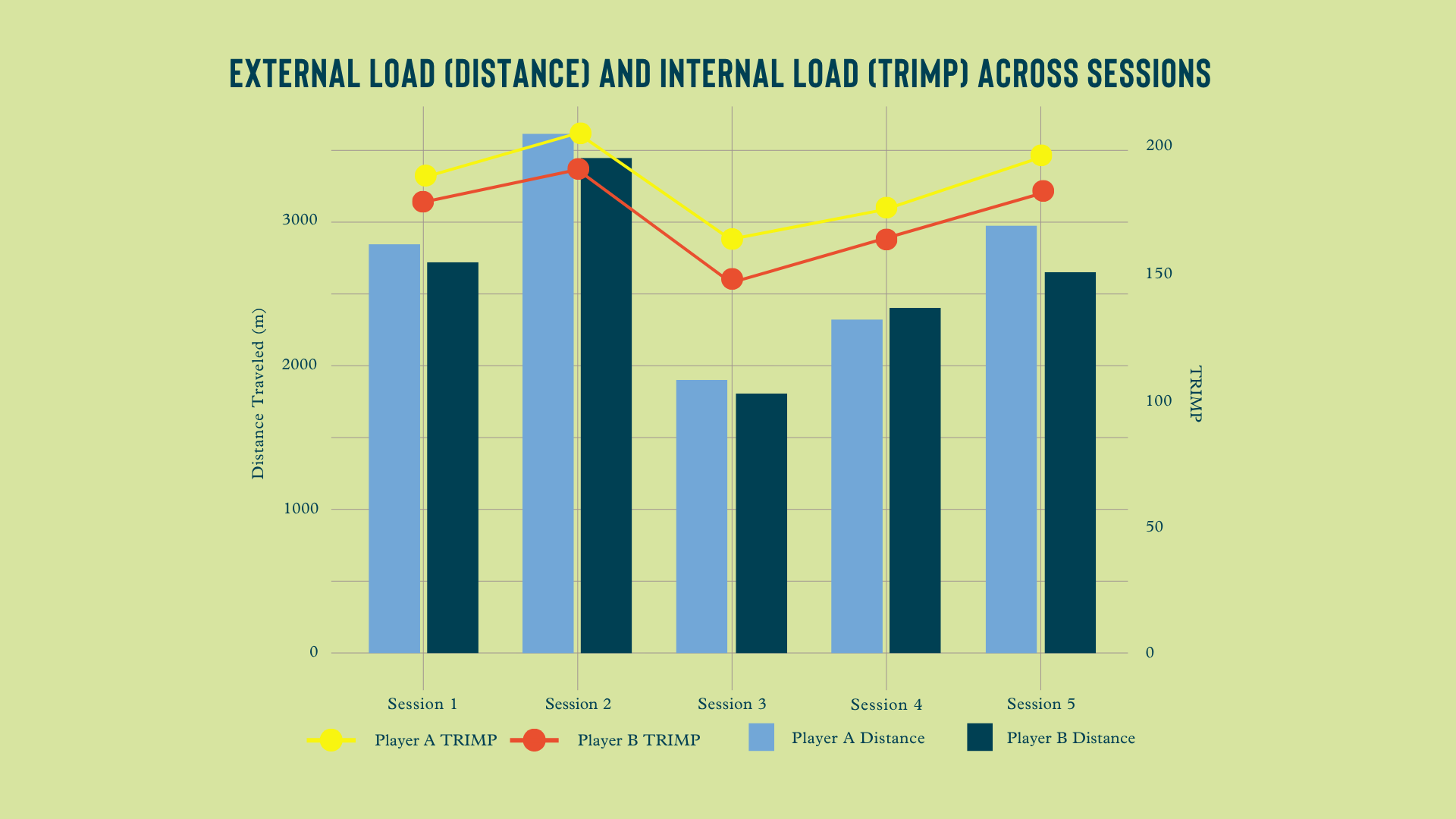
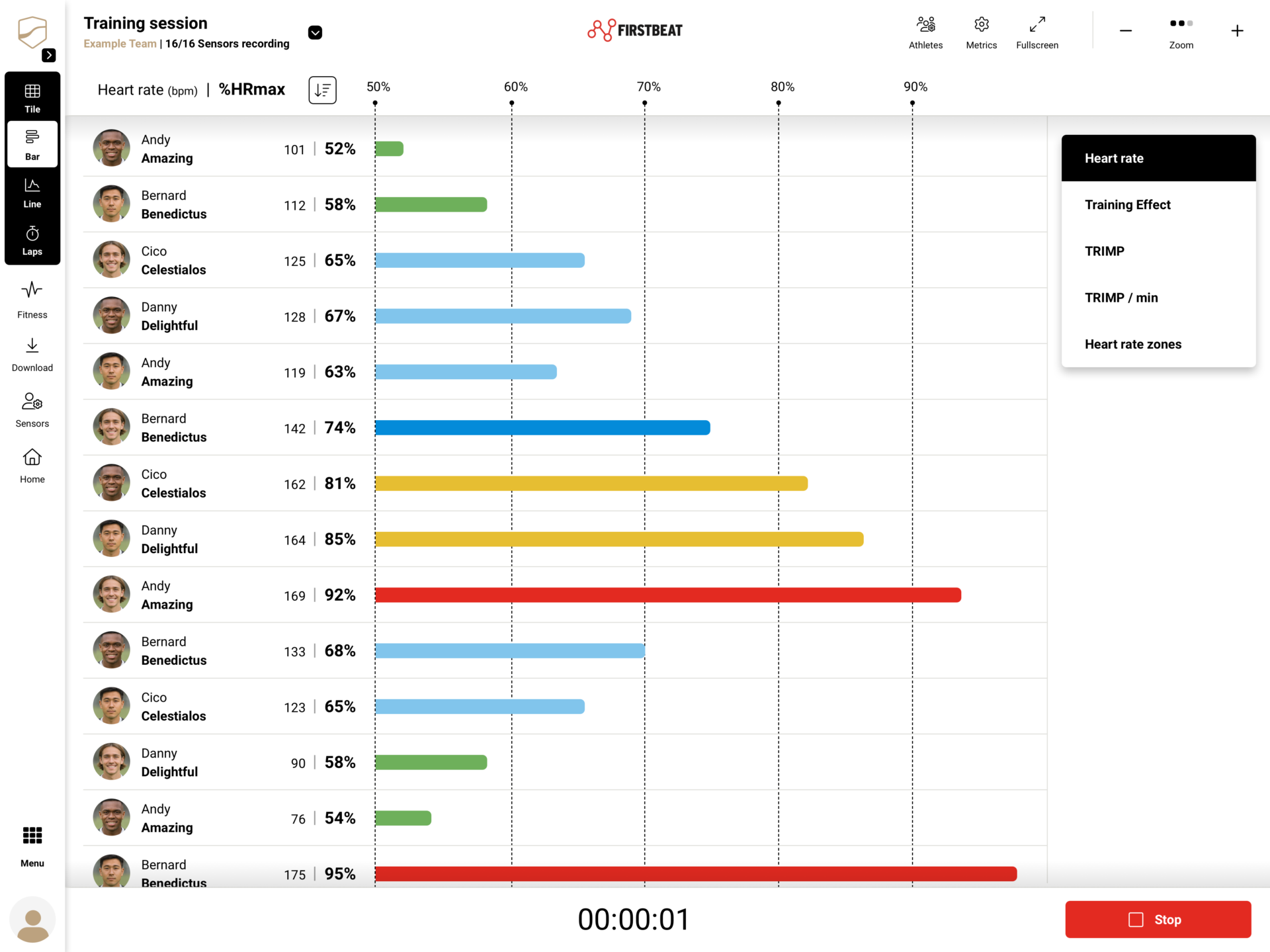
Both athletes completed the same training sessions throughout the week, with a day off between sessions 2 and 3. While the external load was similar day-to-day (Player A always accumulated slightly more distance traveled), Player A’s internal load was much lower than Player B’s. This information does not immediately lead us to any specific conclusions about the two players, but it helps us ask better, more meaningful questions.
Some of the subjective information we collected helped us understand that Player B was struggling to adapt to the altitude, while Player A and a number of our other players had been at altitude for weeks prior to camp. Player B also was coming off significant travel in the weeks prior.
With that additional information, we were able to slightly modify Player B’s supplemental work and inform management of the issues so it would not affect his odds of making the team.
Internal and external load measures are related but capture different constructs, reinforcing the need to monitor both simultaneously.[3] Even in elite sports, strong relationships between internal and external load have meaningful variability, likely reflecting contextual demands not captured by movement metrics alone.[4] In the day-to-day training environment, to omit one is to omit a piece of the training load puzzle.
This highlights the importance of combining internal and external load data with contextual information to guide individualized adjustments during high stakes periods such as training camp.
Tweet ThisTwo athletes exposed to the same external stimulus may respond differently due to variations in training status, accumulated fatigue, sleep, psychological stress, recovery capacity, injury history, positional demands, and environmental factors.
Garrett Blakey
Load monitoring and injury risk: Not so straight-forward
One of the primary motivations for monitoring training load is injury prevention. However, the relationship between load metrics and injury risk is complex and often misunderstood.
Prospective research in professional sport demonstrates associations between training load and injury risk, particularly when rapid increases in load occur across short timeframes.[6] However, the findings remain inconsistent, highlighting the multifactorial nature of injury and the limitations of relying on single metrics.
Injury occurs when applied forces exceed the tissue’s capacity to tolerate or recover from them. These forces may arise from acute high magnitude events or repeated submaximal loading over time.[5] Mechanical load therefore plays a central role in injuries, but accurately quantifying tissue-level stress in applied sport environments remains extremely challenging.
Both internal and external load measures are indirect proxies for the biological processes associated with injury risk.
External metrics estimate mechanical exposure, while internal metrics reflect physiological stress responses. Neither directly measures tissue loading or failure thresholds. Considering this complexity, monitoring multiple load indicators provides a more comprehensive understanding of athlete risk than relying on any single measure. By collecting both, we are better able to understand when our athletes are at higher risk. This lets us tailor our interventions based on each individual player’s external and internal stress.
Accumulated fatigue across the training week
Practice planning in team sports is largely driven by external load. Coaches design sessions based on tactical objectives and sport-specific demands. Internal load does not typically dictate practice design. Instead, it informs how athletes are responding to practice.
Tracking internal load provides valuable insight into the athlete’s recovery status, readiness for subsequent exposure, tolerance to training, and psychological adaptation.
One example is cardiovascular recovery. Two athletes may reach similar peak heart rates during training, yet their recovery between bouts may differ significantly. Faster recovery may reflect higher aerobic fitness or better readiness, whereas delayed recovery may indicate fatigue accumulation or insufficient conditioning.
This often appears across a congested training week in basketball. Throughout the season, some weeks are busier than others in terms of games and training sessions. We often try to ensure a level of balance in our schedule, but sometimes things are out of our control: for example, back-to-back games or four days in a row without a game.
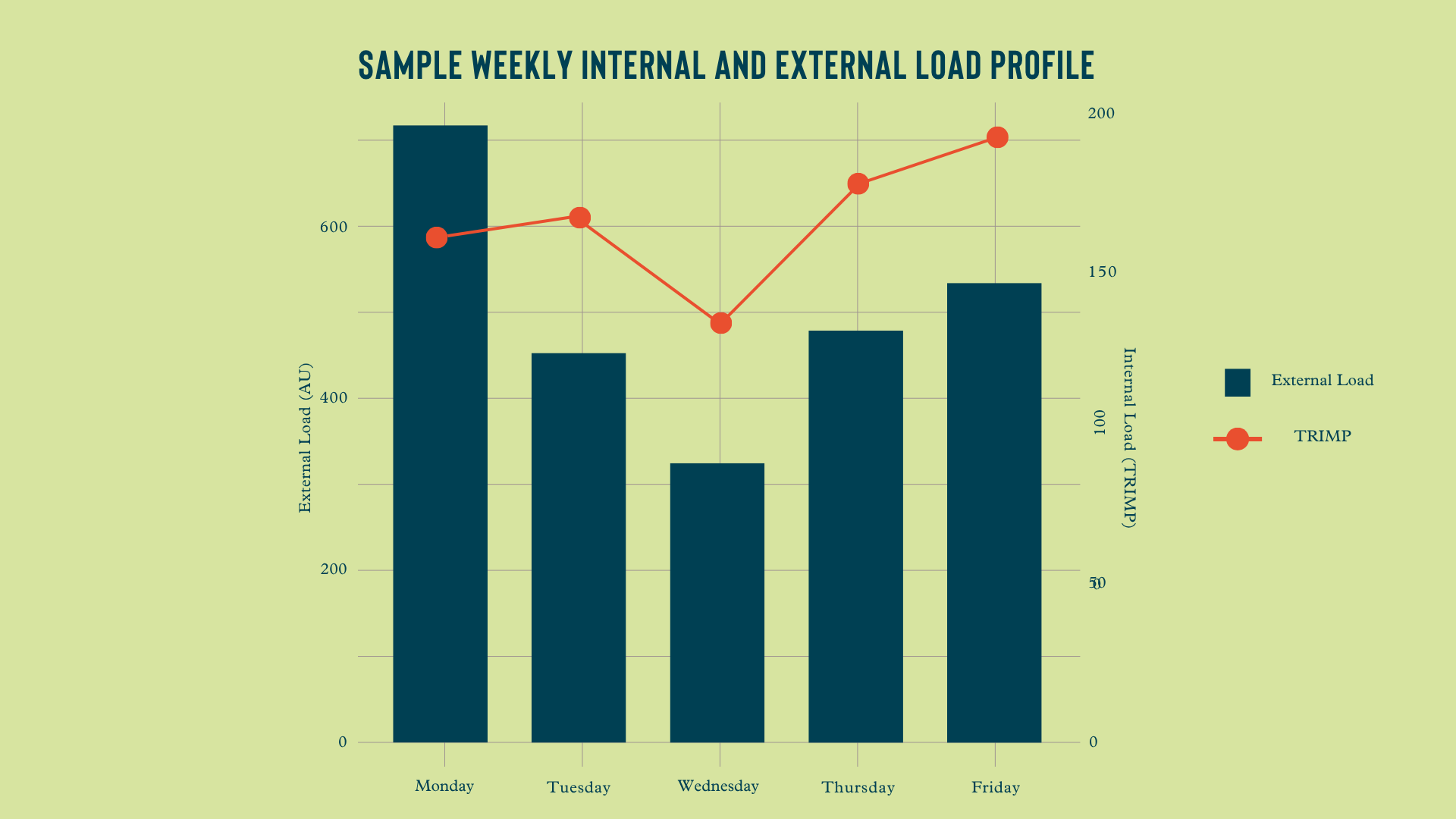
During a week in our season, our team had a practice on Monday to prepare for a team we had not previously faced on Tuesday. We played a game on Tuesday morning, then had a light practice on Wednesday before back-to-back games on Thursday and Friday. Figure 3 shows how for one player lower external loads resulted in accumulating internal load throughout the week.
This is always a tricky situation for the performance team to manage. This was still an early period of our season, which can make it more difficult to navigate and balance the needs of our coaching staff and our athletes. The coaches want to practice as much as possible to continue learning and implementing various concepts, while the players are still adjusting to the volume in season, and balancing games, travel, and training. Maintaining open lines of communication between the performance team and coaching staff is always critical for both performance and recovery.
We showed a graph like Figure 3 to our staff to demonstrate that, despite the “light” practice day on Wednesday, our players still needed additional time to recover.
These visualizations helped us as the season continued. We could speak to the coaching staff about accumulated fatigue and identify and inform them of windows where our players were ready to go through more difficult contact practices, and when they needed to step back a bit or take a full day off.
No matter the level of sport, understanding how training affects our athletes is critical when planning out training sessions.
The balance can be difficult to find, but if we understand how training impacts our athletes, we can better work with coaches and administrators to schedule sessions.
Athletes often only know one speed, especially when they are chasing goals. They want to go. Sometimes our job is to protect them from themselves as much as it is support them on their journey through sport. As practitioners, it can feel like common sense to say, “now we need a day off.” But when armed with data that helps us indicate why we need that day, we often see much better compliance.
Athletes may also respond better to planned rest days or light intensity days, so they know when to really push themselves and when they can afford to pull back a bit.
Tweet ThisTracking internal load provides valuable insight into the athlete’s recovery status, readiness for subsequent exposure, tolerance to training, and psychological adaptation.
Garrett Blakey
Return to play and reintegration
Return-to-play progression is commonly structured around external load, especially in basketball. Practitioners gradually increase exposure to movement demands, intensity, and sport-specific tasks to reintroduce athletes safely.
However, early rehabilitation phases often demonstrate elevated internal load responses despite conservative external exposure.
Several factors may contribute to this, including deconditioning, neuromuscular inefficiency, threat perception, cognitive demand, and emotional stress associated with injury.
Full team integration is often delayed until internal responses normalize relative to comparable external exposures. Establishing preseason baselines and periodic fitness assessments provides important reference points for this process. This has been an important step in our return to play process since integrating both internal and external load monitoring.
During the season, we managed an athlete returning from a grade 2 ankle sprain, who required a structured reintroduction to on-court activity (Figure 4). Throughout rehabilitation, we monitored both external and internal load, using heart rate data during daily conditioning sessions and tracking external workload during off-court work such as bike intervals. This allowed us to build a clear understanding of the athlete’s physiological response to increasing workloads.
When the athlete progressed to individual on-court work, internal responses remained consistent with preseason values despite increasing external demands. As a result, he only needed a small number of individual sessions before reintegrating into full team practice.
The combination of internal and external load monitoring provided confidence in the athlete’s readiness, allowing for a more efficient and informed return to play process. Without this information, it likely would have taken longer to have the athlete return and would have been a less precise approach.
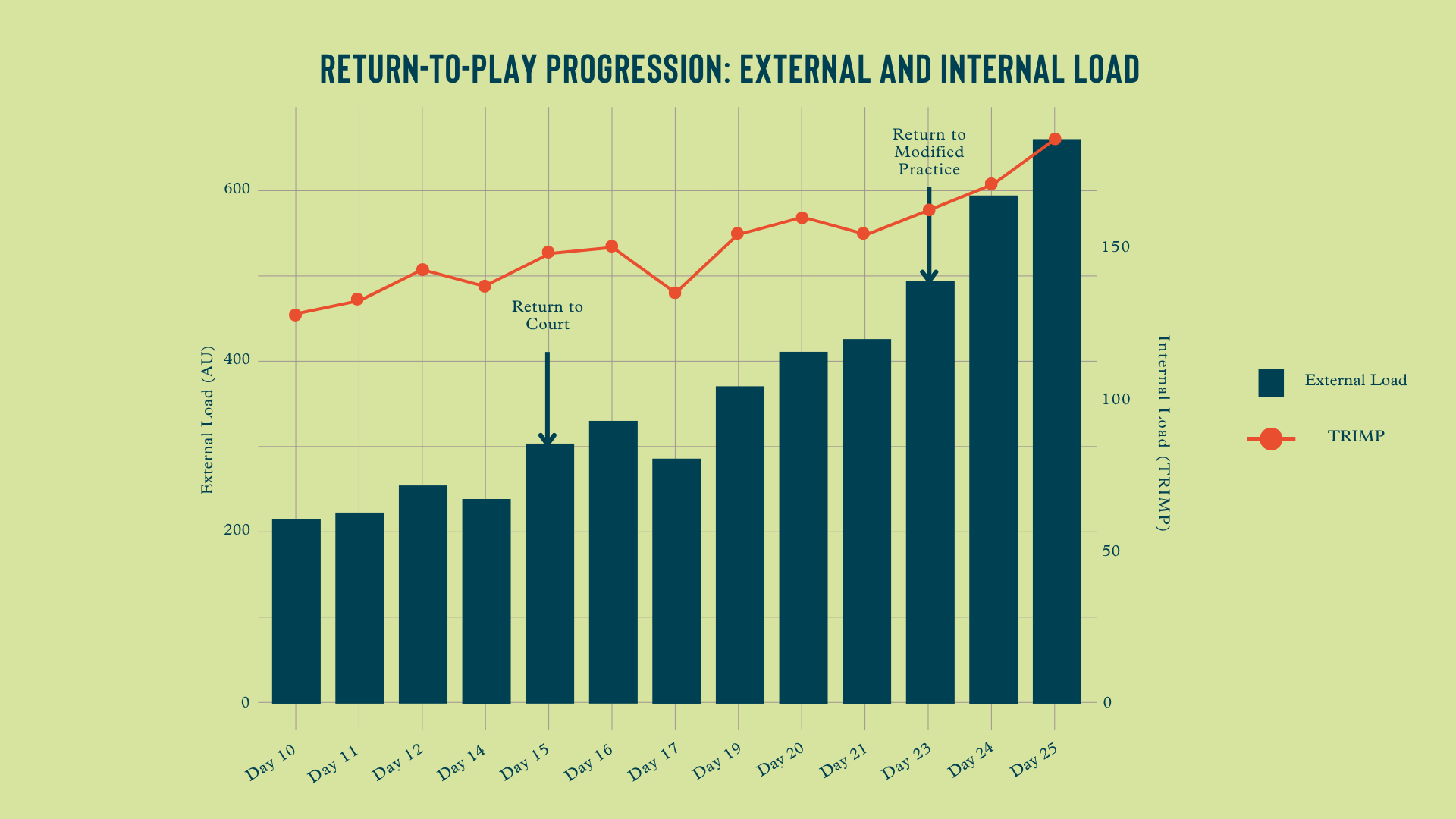

Ensuring athletes return to their conditioned baseline values before full participation helps guide both reintegration into team practice and any necessary playing time restrictions.
External load guides exposure. Internal load guides readiness. The athlete’s subjective feedback helps inform both. This approach can be applied across rehabilitation settings to support more efficient and individualized return-to-play progressions.
Tweet ThisFull team integration is often delayed until internal responses normalize relative to comparable external exposures. Establishing preseason baselines and periodic fitness assessments provides important reference points for this process.
Garrett Blakey
Positional demands and internal load
Within team sports, contextual and positional demands further influence internal responses.
For example, guards often handle the ball more frequently, make more rapid decisions, and defend in high pressure situations, demonstrating higher external loads than forwards. Forwards, on the other hand, often demonstrate higher internal response due to the more forceful nature of the position. They endure more contact and more metabolically demanding work despite moving less. While external movement metrics may appear comparable, the physiological and cognitive demands associated with these roles can produce very different internal responses.
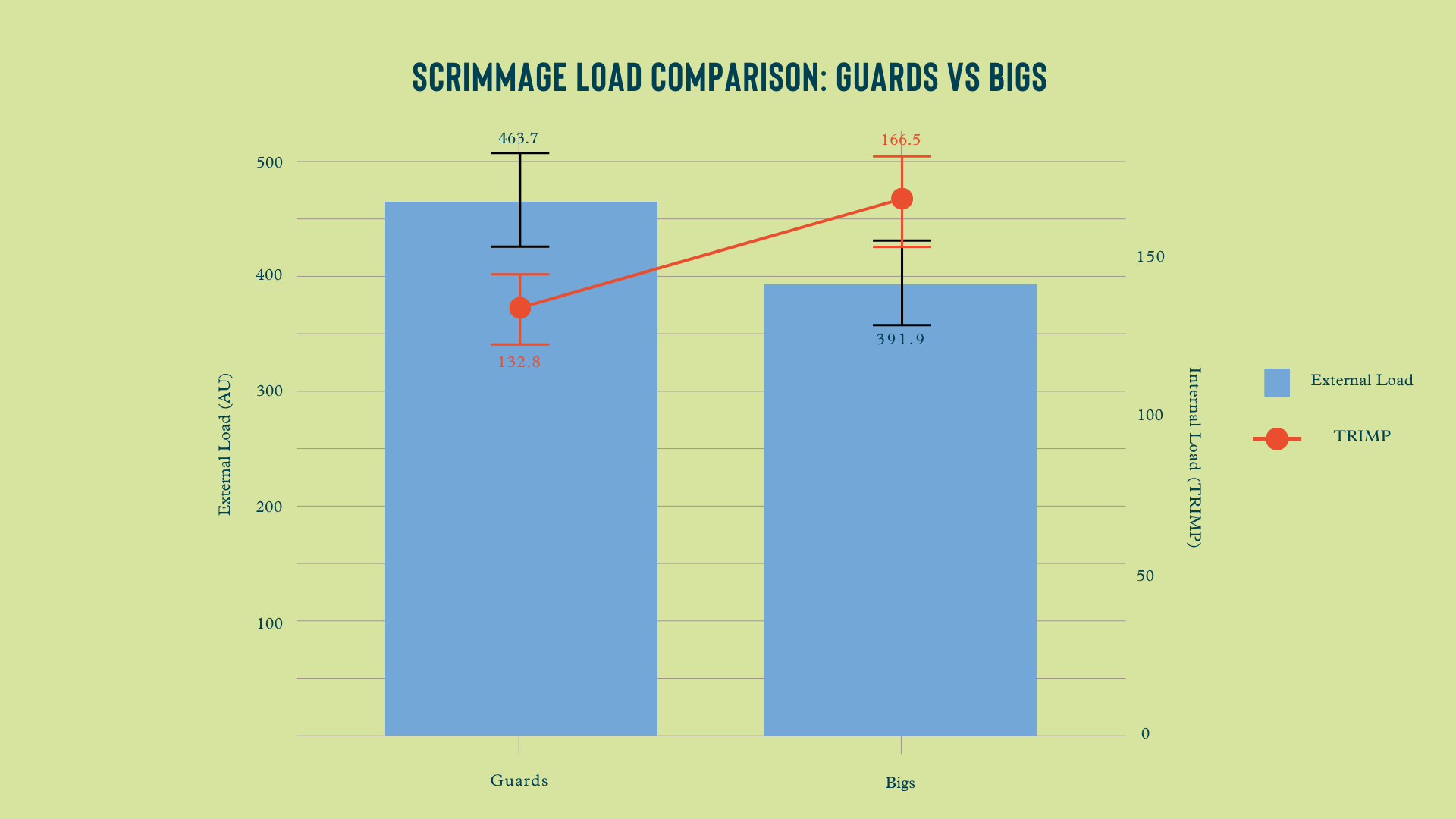
Guards accumulated higher external loads (468.7 ± error AU), while bigs accumulated lower external loads (391.9 ± error AU) but demonstrated a substantially higher internal response (TRIMP: 166.5 ± error vs. 132.8 ± error).
While individual differences always play a role, this example highlights how positional demands can influence the cost of the same exposure.
Contextual factors also influence internal load. Match-up difficulty, the player’s tactical role, coaches’ expectations, everyone’s emotional state, and competitive pressure can also influence the athlete’s internal load. While many of these factors are difficult to quantify, they all provide valuable insight into each athlete’s individual load. For example, in basketball we often track the pace of games, number of possessions, and other metrics related to the difficulty of various match ups. This helps us further examine the load of our players during competition.
Internal load provides insight into demands that are not visible through movement metrics alone.
Tweet ThisContextual factors also influence internal load. Match-up difficulty, the player’s tactical role, coaches’ expectations, everyone’s emotional state, and competitive pressure can also influence the athlete’s internal load.
Garrett Blakey
Disagreement between internal and external load is not noise
When internal and external load diverge, practitioners may interpret this as measurement error. However, these discrepancies often provide meaningful information that should prompt practitioners to investigate higher level questions.
For example, a high external load with low internal response may indicate strong readiness or positive adaptation. Low external load with high internal response may indicate fatigue, illness, or compromised recovery. We don’t know until we dive deeper. They can be viewed as meaningful signals about how the athlete is tolerating training or handling stress (Figure 7).
This type of framework can guide daily decision making. For example, when an athlete demonstrates a high internal response relative to a low external workload, practitioners should start asking about recovery, sleep, or illness. Conversely, a low internal response to a high external workload may indicate strong adaptation or readiness for progression.
As long as we continue to monitor and check back in, we can track this in real time throughout our phases.
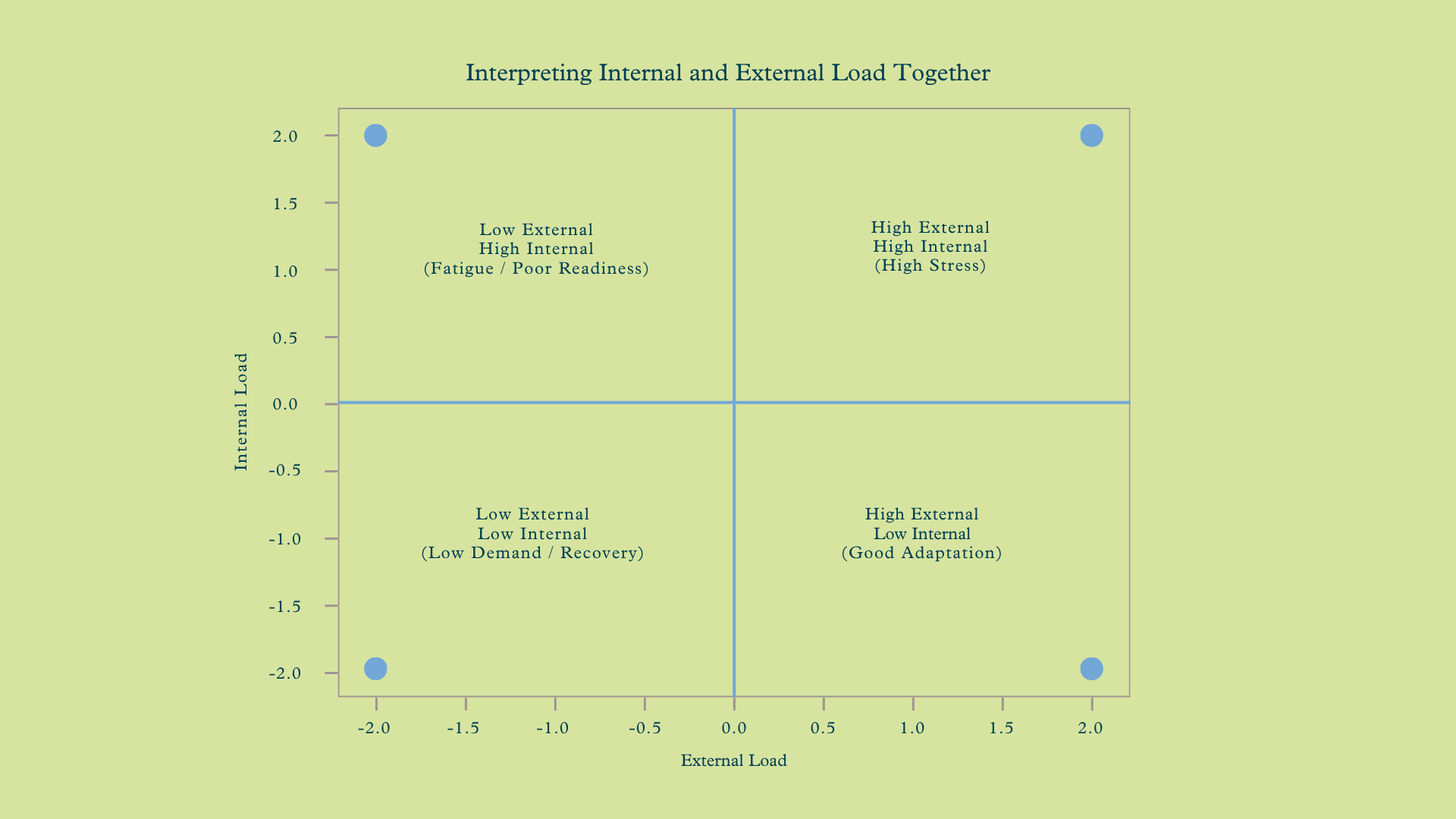
Importantly, research examining training load and injury suggests that causal relationships are difficult to establish because current load metrics do not fully represent biological mechanisms leading to tissue damage.[5] This reinforces the idea that disagreement between metrics reflects system complexity rather than error.
When we see that external and internal load disagree, we need to investigate it, not simply dismiss it.
Tweet ThisFor example, a high external load with low internal response may indicate strong readiness or positive adaptation. Low external load with high internal response may indicate fatigue, illness, or compromised recovery.
Garrett Blakey
Monitoring workflow for internal load
Integrating internal and external load into daily practice does not require complex systems, so it is not the province of professional or other high-budget programs.
A simple workflow begins with reviewing external load to understand session demands, followed by evaluating internal load to understand athlete responses. From there, we can identify deviations from expected responses, communicate with athletes to gather contextual insight, and adjust recovery or progression accordingly.

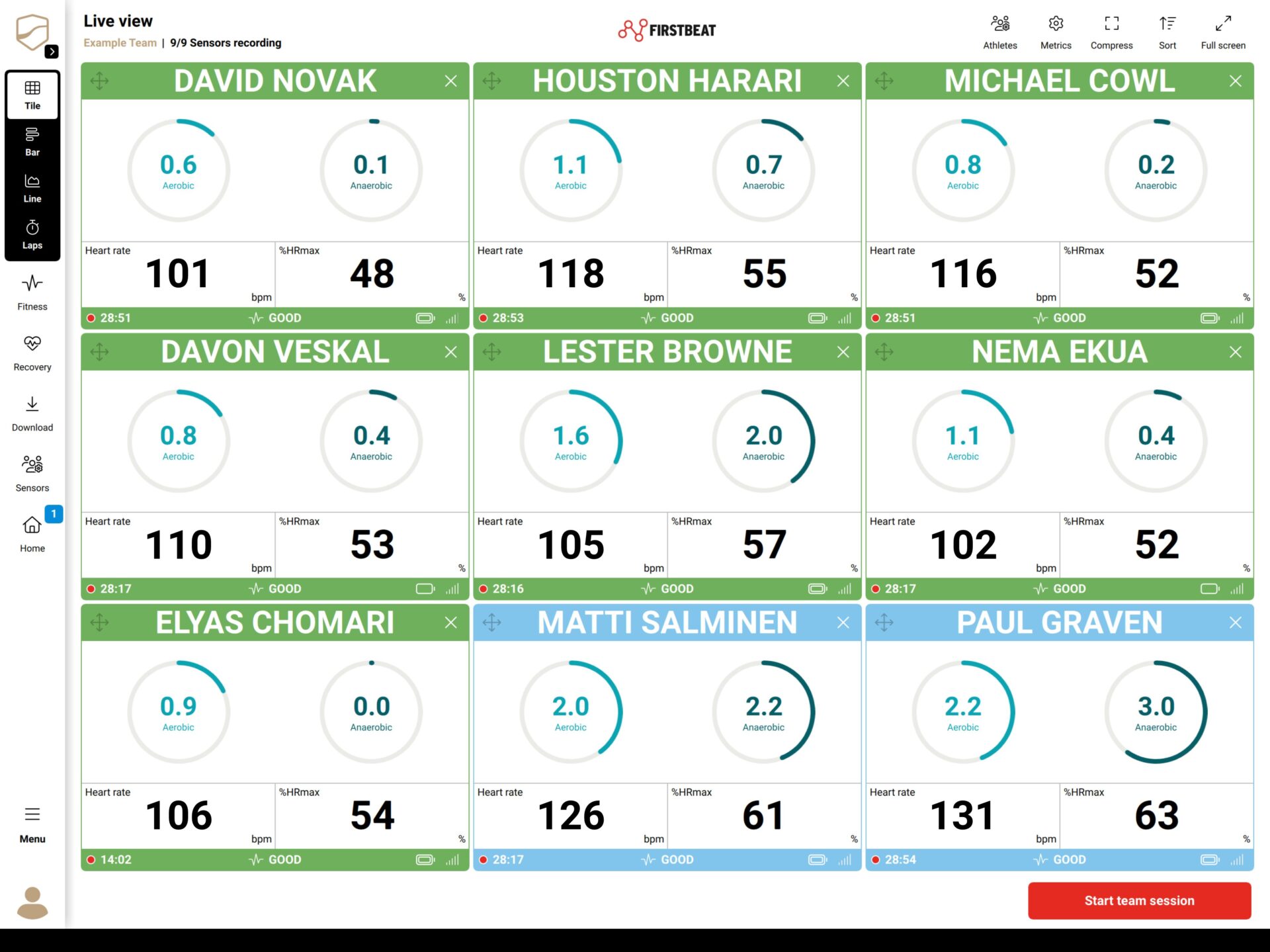
Training sessions are delivered to groups, but adaptation occurs at the individual level. Therefore, our goal is not to modify practice daily. Our goal is to individualize how athletes respond to practice.
When practitioners consider external and internal load together, we gain a clearer understanding of readiness, recovery, and adaptation, allowing for more informed decisions to support both performance and health. Across all of these scenarios, the same principle holds. The work may look similar, but the stress and the cost is not, and those determine whether our training will produce the adaptations the athlete needs.
Tweet ThisWhen practitioners consider external and internal load together, we gain a clearer understanding of readiness, recovery, and adaptation, allowing for more informed decisions to support both performance and health.
Garrett Blakey