
Performance foundations and future series
Performance support appears stronger than ever, with advances in staffing, technology, and analytics evolving alongside athletic capabilities. Yet growing misconceptions and external pressures risk driving practices that stray from core performance goals. This series will ask some difficult questions about current practices in performance and highlight how a focus on foundational principles of planning, execution and communication, supported by modern analysis, can unlock enhanced performance in the future. Each article will be co-written with leading authorities in performance, starting with Martin Buchheit, as we examine misconceptions in GPS load monitoring.
Normative data grew into its role…
Assessing the physical demand that training and competition place on athletes has become central to optimising training adaptations and reducing injury risk. In many sports, GPS is the central tool for assessing this load.
GPS adoption was both rapid and widespread, driven by sophisticated tracking and accelerometer technologies. This combination provided detailed and wide-ranging data for assessing physical loading across diverse movement patterns and intensities, from steady straight-line running to complex, intermittent, multidirectional actions.
By converting raw data into standardised scales, normative statistics make it simpler to interpret whether a given value is “normal” or “in range.”
This approach aligns with the foundational training principles of progression and regression. Fundamentally, they describe how excessive changes in training load can be detrimental. Progress load too aggressively and the athlete risks being overcome by fatigue and injury. Reduce training loads too extensively, and the athlete might detrain and be unable to cope with the demands of competition.
Standardised scaling is especially beneficial when analysing numerous metrics and athletes, and cumulative load across multiple drills and sessions. Normative thresholds, often displayed via colour-coded visualisations, facilitate rapid identification of training loads that may be inappropriate for individuals and groups.
Tweet ThisGPS adoption was both rapid and widespread, driven by sophisticated tracking and accelerometer technologies. This combination provided detailed and wide-ranging data for assessing physical loading across diverse movement patterns.
@drlittletom
…and then outgrew it
It seems paradoxical that something so widespread and conceptually beneficial could have negative implications.
The pressures and trends of modern sport—particularly the drive to reduce injuries—have fostered an environment overly fixated on GPS-based normative boundaries. These data-defined limits encourage practices that may detract from our primary goal of maximising athletic potential while, paradoxically, also increasing long-term injury risk.

Note: A = Typical Z-Score scaling for training load, B = Weekly distance with upper & lower Z-score limits, C = Box- plots for weekly player load, D = Daily STEN scores with Z-Score colour-codes
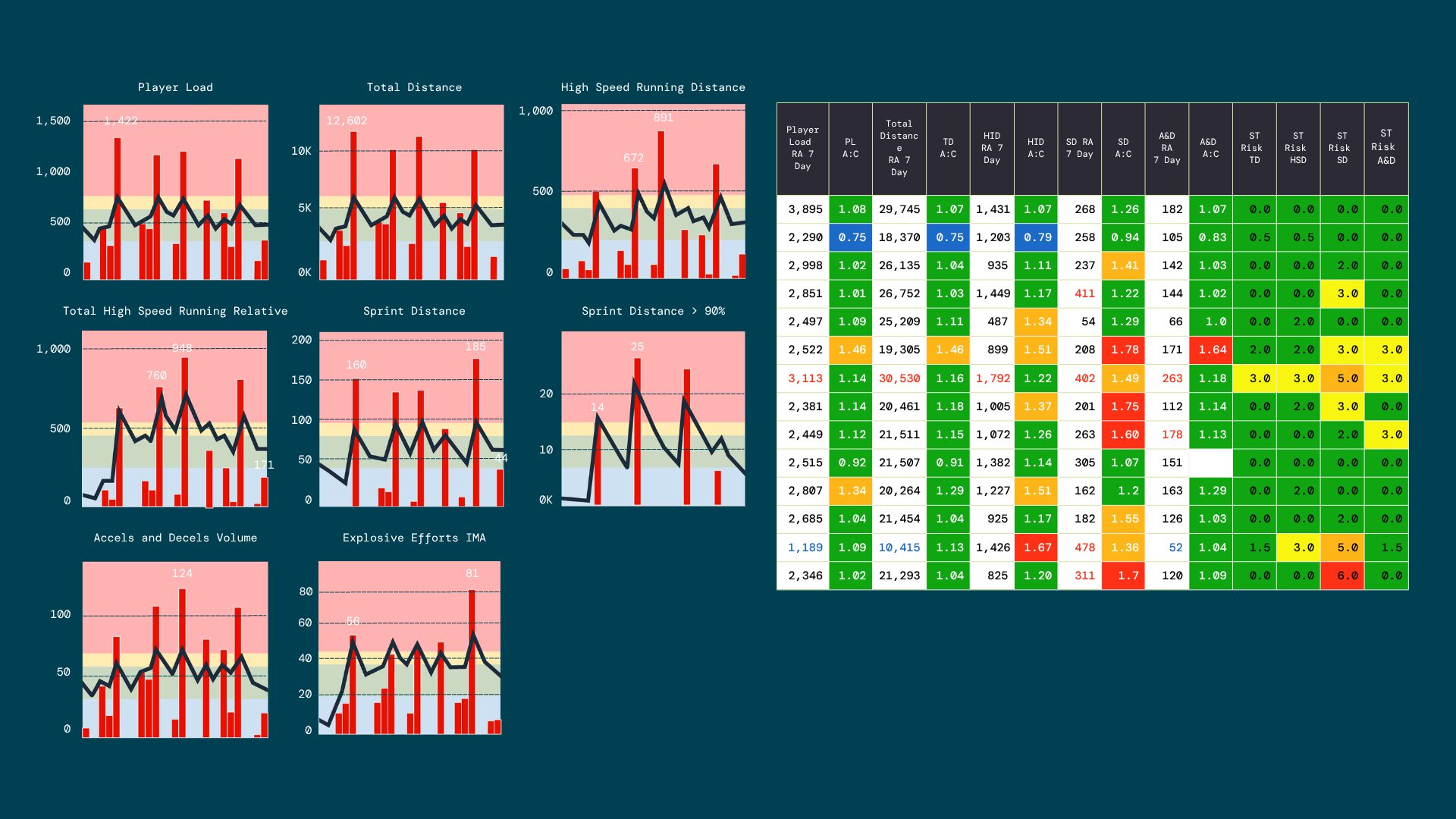
There is growing recognition that the interpretation of commonly used GPS metrics is flawed, misrepresenting the true physical demands placed on athletes.[1]
The acute-to-chronic workload ratio (ACWR) overtook nearly all other metrics in recent years, following numerous studies and consensus statements proposing its association with injury risk. But conceptual and statistical flaws have undermined this assumed relationship. The disproportionate weighting of two factors—low chronic load and increases in acute load—skewed much of the original work on ACWR.[2]
An era of “load management” emerged as professional sports organisations invested substantial resources in personnel and technology to collect, analyse, and disseminate loading information. Load management occupies a central role in multidisciplinary team discussions and executive decision-making processes. Concurrently, comprehensive athlete management systems have become integral for evaluating performance strategies.
For many organisations, injury prevention has become the key goal of load management, superseding athletic potential.
Despite advances in medical and performance support, increased performance demands and more intense competition schedules have caused injury rates to rise, raising operational costs across many sports. Changes in performance departments often follow an injury crisis, as the aftermath of an injury on performance and lost investment are more evident than marginal changes in physical capacity.
The pervasive use of normative analysis and its association with injury justifies aiming for the theoretical “low-risk zone” of normative targets. Practitioners who stay within the lines receive less criticism and have higher job security.
Yet adherence to normative GPS targets can sometimes be misguided.
Tweet ThisThe pervasive use of normative analysis and its association with injury justifies aiming for the theoretical “low-risk zone” of normative targets. Practitioners who stay within the lines receive less criticism and have higher job security.
@drlittletom
Illusion of optimal GPS training loads
Evidence-based guidelines for optimising GPS-derived loading remain limited. This is the case whether the goal is to elicit desired adaptations, balance overall load, or ensure adequate recovery. Empirical observation and practitioner experience underpin how practitioners actually use the data.
Theoretical ideals, therefore, become an attractive alternative for practitioners seeking rigour and a sense of certainty.
Such limits exemplify the risk of blurring the lines between normative and optimal. There are certainly benefits to not changing load too abruptly. That does not imply that the most common or “in-range” training load is the most optimal. But it does give practitioners somewhat false affirmation, prejudicing them to believe that their current practices are optimal.
Normative boundaries could be producing long-term under- or over-training, or imbalanced loading and recovery. Yet specific and cumulative training load recommendations remain based on normative analysis.
Tweet ThisTheoretical limits exemplify the risk of blurring the lines between normative and optimal. There are certainly benefits to not changing load too abruptly. That does not imply that the most common or “in-range” training load is the most optimal.
@drlittletom
Numbers disconnect the what from the how
When analysing load, we typically focus on the value rather than how it was achieved. However, athlete metrics do not arise outside of their specific contexts; and those contexts are central to the meaning and consequences of the metrics. Elements such as movement type, intensity, rest ratios, training area, and environmental factors all have significant effects on load metrics and athlete adaptations.
For example, the distance of high-speed running an athlete accumulates in 45 minutes of a typical soccer match is achieved in just six minutes of a typical linear conditioning drill.[1]
Any metric that a practitioner relies upon must be a valid representation of the physical loading imparted on an athlete.
Accordingly, GPS has an array of sophisticated velocity and accelerometery metrics capable of quantifying training load during different movement strategies and training methodologies. However, misinterpretation of what these metrics represent, coupled with the array required for comprehensive analysis, results in practitioners making decisions based on metrics that distort both external and internal load.
Many sports involve multiplanar efforts that require acceleration, deceleration, and change of direction through cutting, curvilinear motion, and pivoting. Collectively, these are the mechanical load.
Such sports often use small-sided games (SSGs) and multidirectional running drills to condition athletes.
The number of high-intensity accelerations and decelerations (A:D > 3 m/s) is often a proxy for mechanical load, due to the high neuromuscular demands of faster speed changes.
However, high-intensity A:D counts are often inversely correlated to mechanical demands during SSGs.
Mechanical load typically increases as team size and area decrease, due to greater involvements in play and agility demands. Those situations typically decrease the volume of high-intensity accelerations and decelerations due to insufficient space and continuous movement to achieve high velocities.
Speed-based metrics also do not account for the increased centrifugal demands of curvilinear running and turning.
Furthermore, the 20 Hz data capture rate is often insufficient to detect the constant micro-actions that occur in SSGs.
Collectively, these factors result in a substantial underestimation of physical loading during SSGs.

Accelerometer-based metrics provide a more detailed representation of changes in speed and direction, and therefore mechanical load.
However, their adoption is less widespread due to unfamiliarity and the need for multiple metrics and bands. These metrics are also compromised by noise from impacts and GPS unit instability.
There are significant developments in this area, but currently there is no validated global measure for mechanical demands.
Tweet ThisWhen analysing load, we typically focus on the value rather than how it was achieved. However, athlete metrics do not arise outside of their specific contexts; and those contexts are central to the meaning and consequences of the metrics.
@drlittletom
How normative GPS targets can distort training
Our industry has long had excellent knowledge on how to optimise training parameters to improve specific athletic qualities, and how to program training load to balance development and recovery. Historically, loading metrics helped validate training plans and fine-tune parameters for optimal adaptation and recovery.
Today, the pressure to produce desirable data has shifted this approach. Training plans often conform to normative targets rather than physiological needs.
Moreover, the imperative to avoid injuries in the very near-term leads us toward training programs that meet the benchmarks but compromise desired adaptations.
One example is top-ups at the end of a session. Top-ups usually consist of linear running because it offers an efficient and precise method to elicit key external metrics, such as total distance and high-speed running distance. Other typical examples include performing a small number of pitch strides on extensive days to meet high speed targets; or rehabbing athletes performing a few kilometers of low intensity running to achieve weekly distance targets.
But this efficiency and prior loading make top-ups insufficient to induce meaningful adaptation.
Empirical observations indicate an increase in linear-based conditioning. But this, in itself, has emerged from similarly normative-based speed profiling methodologies. That’s a circle of self-justification; or, at the very least, it creates an implicit bias toward efficiently satisfying normative GPS-derived key load metrics.
More challenging, sport-specific training loads may stray from normative boundaries and carry slightly higher short-term injury risk. But they will better serve foundational objectives of enhanced performance potential and robustness over the long term.
Tweet ThisMoreover, the imperative to avoid injuries in the very near-term leads us toward training programs that meet the benchmarks but compromise desired adaptations. One example is top-ups at the end of a session.
@drlittletom
Should non-normative be the norm?
Periodisation is a core principle of training design. Many programs intentionally vary their training content, which undercuts the role of rigid normative boundaries. This variation can occur in sports that use traditional periodisation models; or during phases of rapid progression, such as preseason or rehabilitation.
Even in sports with stable microcycles, factors like fixture scheduling, opponent demands, and injuries frequently lead to significant fluctuations in both training content and load.
Very high intensity actions tend to occur infrequently due to less necessity, while having an exponential effect on fatigue and injury risk. Because they are performed in an all-or-nothing manner, their distribution is often non-normative and skewed low. As a result, a minor change can disproportionately affect normative statistics.
While tools like box plots and log transformations can improve interpretation, decisions based solely on normative data for such metrics are often misguided.
Balancing normative with non-normative data in practice
Normative analysis of GPS loads offers many advantages. However, industry trends and pressures mean many performance coaches feel bound to it.
Fallacies for load metrics associated with sport-specific and highly intensive training mean we often prioritise what we can easily measure and understand, rather than what is truly impactful. Normative data’s alignment with injury prevention is contributing to an environment that sways practitioners towards job safety instead of fulfilling our core remit of maximising athletic potential.
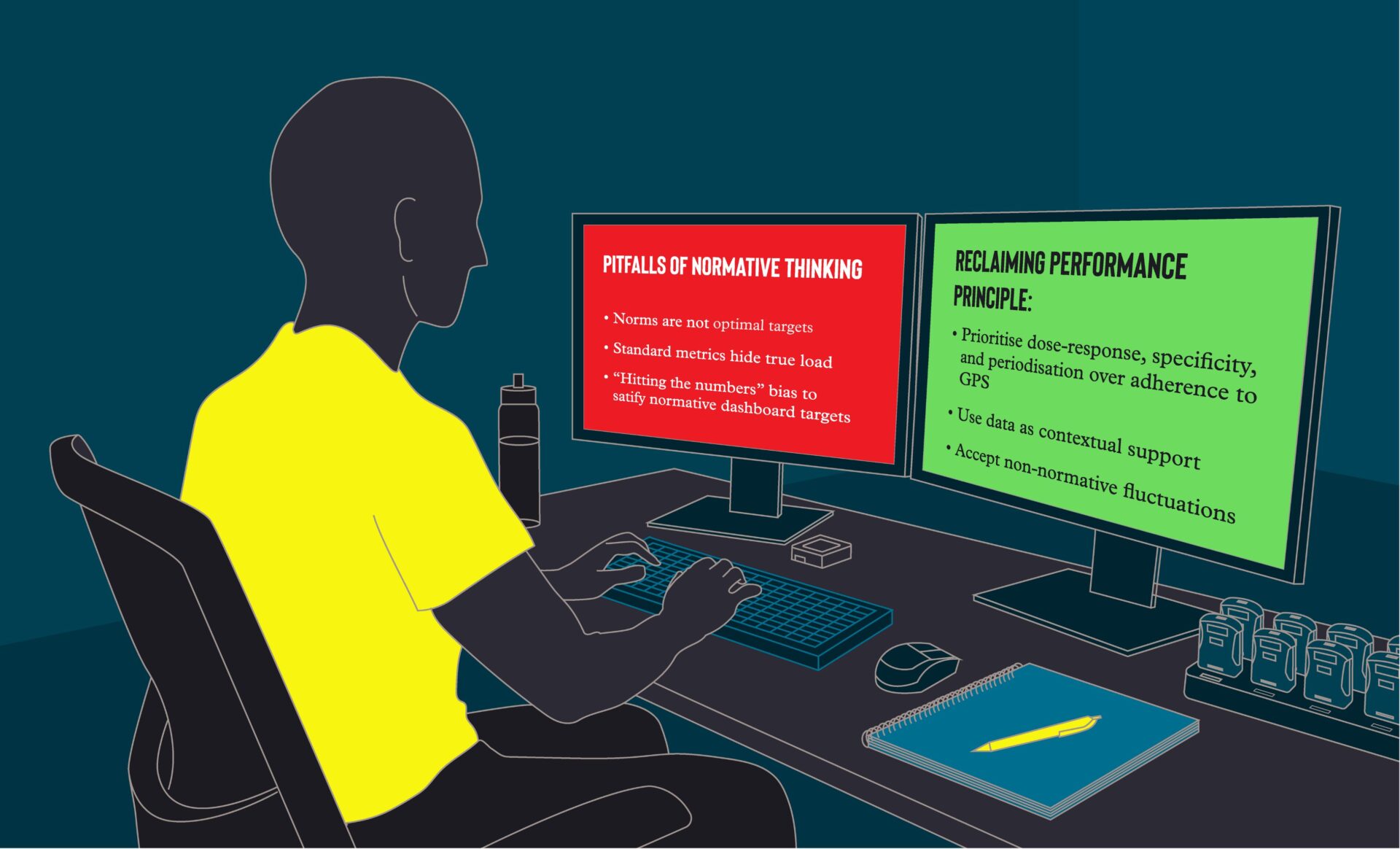
The strong influence of training context, combined with the inappropriate application of GPS metrics—particularly in multidirectional sports—renders broad normative boundaries across multiple metrics both unrealistic and unsuitable.
When aiming to optimise training programs, practitioners should start from foundational training principles. What are the main elements we want to improve? What are the training parameters required to do so? When can we best apply them to optimise performance at specific times?
Applying the answers to these questions will best serve our performance aims and, indirectly, produce a framework that has a proper role for normative data.
Using normative information to adjust the training plan is often advantageous. But straying from normative boundaries should be wholly acceptable if there is good rationale, such as optimising athletic adaptations, periodisation strategies and training specificity.
Tweet ThisThe strong influence of training context, combined with the inappropriate application of GPS metrics—particularly in multidirectional sports—renders broad normative boundaries across multiple metrics both unrealistic and unsuitable.
@drlittletom