
Anyone with experience in a team environment knows that the neatly formed sequences of periodisation theory rarely fit naturally into the real world. There are too many ever changing variables that render even the best designed plan functionally useless. This kickstarts a constant cycle of modifying the plan throughout the season, to the point where the final form bears little resemblance to the original design.
The original idea for this article was tactical periodisation vs. traditional periodisation, pitting the two methodologies against each other in a conceptual title fight.
However, as the article developed, I realised that is not the right approach to take. No one has it so figured out that we can declare a winner and say all other approaches are irrelevant. As any coach knows, ideas are dime a dozen. They are only valuable if they work.
The focus of this article, instead, is tactical periodisation. While it is often misunderstood as just playing the game in training sessions, there is far more to tactical periodisation than that. Understanding the core ideas requires a total overhaul in how you think about the application of training stimuli. It is not just another method to add to the pile – it is more appropriately represented as a methodology, a system of thought or way of thinking.
Tweet ThisAnyone with experience in a team environment knows that the neatly formed sequences of periodisation theory rarely fit naturally into the real world
@GaelicGameChngr
Tactical intent and the game model drive performance staff’s goals
Fully appreciating tactical periodisation requires stepping outside the walls that may have formed when you initially learned about traditional periodisation.
When talking about traditional periodisation, I’m broadly referring to the concepts first proposed by Matveyev in the 1960s. If you attended university, chances are this is what you were taught IS periodisation! And then it is what you were tested on as part of the NSCA CSCS qualification.
Inherent in this way of programming, when applied to a team sport context, is the belief that the systematic improvement of distinct physical attributes will result in improved sport performance. This is breaking the whole into constituent parts, improving these individually with the hope that it leads to increased performance of the whole.
Tactical periodisation changes this way of thinking, shifting the emphasis away from a mechanistic view of individual parts towards a functional system. Tactical periodisation places the tactical intent of the team, which is the desired way of playing, as the single greatest driving force that should shape all preparation, hence the inclusion of “tactical” in the name. Every training activity, be it on the field, in the gym, at team meetings or in video review, should be performed with the ultimate tactical intention in mind. Within tactical periodisation, physical, technical and psychological expressions are subordinate to the tactical intention.
The goal of training is to try to do what you want to do in a game, but in situations of varying complexity, number of people, distances, etc., all the while maintaining the overall tactical goal in mind. The opposite is training an array of individual factors and seeing what can be put together on game day.
Tactical periodisation is a non-linear, cyclical process of trying to implement the desired way of playing. Non-linear means there won’t be a straight trajectory in improvement nor a linear relationship between training activities and game performance. Sometimes the level of performance will appear to stagnate, and at other times it will leap forward. There are too many factors influencing performance in a team sport for any linear improvement in a singular ability to manifest at the team level.

In its purest form, tactical periodisation requires the complete buy in of all preparation staff, but none more important than the manager / head coach.
They ultimately decide the approach the team will take, and ensure all departments embody this methodology in the way they work.
The game model is a defined way of breaking the game down into moments and corresponding playing principles, and is a key aspect of adopting tactical periodisation. The model provides a common language and frame for interpreting the game. The entire preparation staff, including S&C coaches, physios, video analysts, doctors and nutritionists must understand this model.

For example, the manager may decide that her team is going to play with the principle of ball speed during transitions from defence to attack. This tactical intent will then guide all departments and their specific areas of development.
The analysts can create KPIs to determine whether the team is moving the ball quickly enough during transitional moments, and thus identify situations where the team is failing to execute. S&C coaches can perform a needs analysis of this moment to determine which physical attributes the team will need to target in order to be more effective at playing the way the manager wants. The nutritionist can devise specific strategies that enhance the team’s ability to play this way. The coaches can create scenarios in training that encourage the players to move quickly during transitions in order to be successful.
Tweet ThisTactical periodisation places the tactical intent of the team as the driving force that should shape all preparation
@GaelicGameChngr
Morphocycles connect the competitive schedule to the training calendar
I recognise that many readers may not be in the position to dictate that all departments adopt this methodology. Even so, everyone’s situation is unique and physical preparation coaches can embrace elements of the tactical periodisation methodology. The intertwined nature of development across tactical, technical, physical and psychological dimensions in tactical periodisation enables practitioners to design the physical load within the framework of the methodology, possibly encouraging the adoption of the methodology across other departments.
Rather than sequential mesocycles nested inside larger macrocycles, tactical periodisation is based around the cyclical period between two games, called the morphocycle. The main thing physical performance coaches can import from tactical periodisation is the morphocycle when programming loads in the season.
The morphocycle is the period between two games, not necessarily a week. In fact, the time of year is irrelevant to the morphocycle.
This will often result in morphocycles adopting a weekly cycle, with the phases relating to specific days, but there may be situations with a shorter or longer turnaround between games. Therefore, I will deliberately speak about phases and not specific days.
Depending on your situation, you may want to emphasise certain physical characteristics or stimuli at some times more than others, but there should never be a singular focus on a given physical ability, as is characteristic of many traditional periodisation methodologies. This is a methodology of principles and a broad structure. Understanding the principles behind the morphocycle will enable you to adapt it to match your situation.
Maintain consistency across a season of morphocycles
The morphocycle is focused around games, because the game is the ultimate test of how far away the team is from executing the tactical intent. We recognise that the team will never play a perfect game, but it remains the goal.
It is important that games occur on a regular cycle so players can better adapt to the morphocycle. During the competitive season, games may come thick and fast, however, at other periods such as preseason or playoffs, there may be situations with longer periods etween games. Scheduling friendly or in-house games during these periods will help maintain a consistent game cycle.
Stimuli and recovery
Recovery in the tactical periodisation philosophy thinks of the body as a functional system that is constantly adapting to stimuli, and that includes recovery stimuli. Recovery is not the opposite of training, as though they were mutually exclusive complements. Instead, it is a different form of stimulus that can nudge the body towards a desired state.
Within the morphocycle, coaches schedule physical loads according to the rate at which players recover from them, ensuring the players are fresh for the next game. Therefore, coaches have to be aware of how a certain load may affect players and what state it may leave them in by game day.
Physical stimuli are broadly divided into strength, endurance and speed, and each of these abilities are emphasised at different times throughout the week.
- Strength refers to the ability to output force, with the S&C coach responsible for determining which particular aspect of strength is most relevant for their athletes.
- Endurance is the ability to repeat efforts under fatigue.
- Speed is the ability to move fast.
| Recovery after training exposure | |||
| Physical emphasis | Training examples | Training load level | Recovery period |
| Game day execution | Full competitive environment. Maximum levels of volume, intensity, density & collision. | Extreme | ≥72 hours. Based on game play exposure. |
| Regeneration | Run through practice situations at low intensity & low volume. CNS activation (neural priming), low volume & moderate intensity lifting. | Medium (retentive) | 12-24 hours. Based on volume & recovery protocols. |
| High intensity High collision | Tackling/blocking. Frequent changes of direction. Olympic lifting & eccentric loading. Plyometrics. | Large (developmental) | 48-72 hours. Based on volume & recovery protocols. |
| High volume High density | High number of practice plays (60%+ game volume) with minimal rest periods. Aerobic, strength-endurance & hypertrophy work with minimal rest periods. | Substantial (developmental) | 24-48 hours. Based on intensity & recovery protocols. |
| High speed | Low volume sprinting. Low impact jumps/throws. Concentric/explosive lifting. Very low or no eccentric loading. | Substantial (developmental) | 24-48 hours. Based on volume & recovery protocols. |
| Restoration | Run through practice situations at low intensity & low volume. Active recovery, blood flow enhancement. | Small (restorative) | ≤12 hours. Based on volume & recovery protocols. |
The next section will detail how to incorporate these physical stimuli into the overall training cycle, and how they complement the techno-technical development during the cycle.
Sport performance programming in a morphocycle
There are three phases to the morphocycle that interweave each of the player elements: tactical, technical, physical and psychological. While the focus here is on the physical element, coaches should be aware of how the other elements are integrated.
| Phase | Game | Recovery | 1 | 2 | 3 | Game |
| Physical | Strength | Endurance | Speed | |||
| Tactical | Individual | Unit | Team | |||
| Technical | Correct | Integrate | Execute | |||
| Psychological | Recover | Learn | Communicate |
Recovery
The game will exert the greatest demands on your athletes, so allowing them sufficient time to recover is vital. This period gives the coaching staff time to assess the team’s performance from the previous game and develop a plan for the coming morphocycle. It is also an opportunity for non-playing members of the squad, or those who received little playing time in the last game, to get exposed to a game-like load and thus sync up with the rest of the team for the coming morphocycle.
Phase 1
Since we are always focused on arriving at the next game in the freshest form possible, we put strength development in Phase 1 due to the length of time it can take to recover from this kind of load. Another factor to consider is players’ need for time to recover from the load of the previous game.
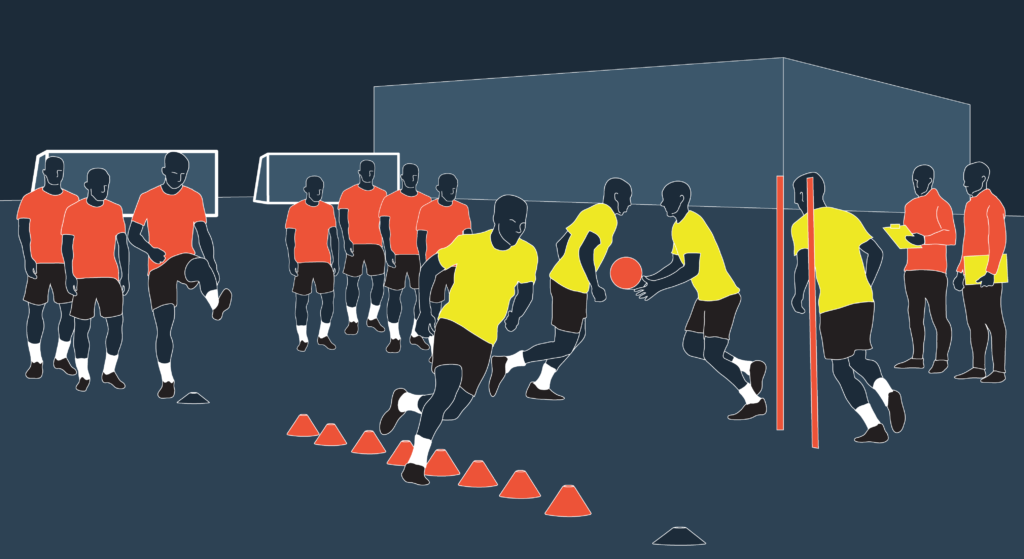
On the field, this phase should employ training activities in small spaces to encourage accelerations, decelerations, cutting, contact (if applicable) and change of direction – movements that place a high eccentric load on the muscles in a game specific context. To complement this in the gym, coaches can include sprint starts, resisted sprinting, Olympic lifting with the catch phase, loaded and unilateral jumps and other typical strength and power training modalities.
From the tactical / technical perspective, this would relate to a phase where players are correcting mistakes from the previous game and working on individual improvement. Training activities with small groups – 1v1 up to 3v3 – are best for this, as they allow frequent touches with the ball and many opportunities to try different options. They also enable coaches to interact with players on a more individual basis.
Phase 2
Physically, this phase develops endurance specific to the game, using frequent repetitions with minimal rest to challenge the players’ capacity to repeat efforts. Work on the field uses larger spaces to allow players to make longer runs with far less cutting and turning. Players should not have time to completely rest between efforts, in order to stress their endurance capacity. The gym component will usually be full body strength endurance work or other forms of extensive endurance work.
Tactically and technically, players in this phase players focus on integrating the corrections from Phase 1 into their unit, plus learning new things like aspects of the game plan for the upcoming game.
Interacting with more players in training activities with medium sized groups (5-8 players per side for small sided games) allows players to learn to coordinate with those they will most closely play beside in games.
Phase 3
As the final phase before the next game, the focus is on speed. Players should have the opportunity to express maximal speed through game situations. Sufficient rest between efforts is vital to ensure they perform each effort with the intent to play as fast as possible. Complementary work such as flying sprints can ensure the players hit a top speed exposure if they do not achieve them during the training activities. Explosive movements such as Olympic lifting without the catch phase, jumps and plyos can round out this phase.
This phase focuses team-wide game play rehearsal. Therefore, the intention should be to execute as quickly as possible, which is about more than just running at top speed. The players will need plenty of rest between efforts to maintain this and manage the load.
| Standard morphocycle (3 collective sessions + match) | |||||||
| Sunday Game | Monday | Tuesday Individual | Wednesday Unit | Thursday | Friday | Saturday | Sunday Game |
| Physical layer | |||||||
| Execution of individual skills, in team context under pressure on full sized pitch | Recovery & restoration | Small space, quickness, long rest Strength, explosive deceleration, change of direction | Bigger space, medium-long efforts, repeated efforts Endurance, repeated movement without sufficient rest | Max speed with long rest, short efforts Speed, moving fast, max accels, no decels | Execution of individual skills, in team context under pressure on full sized pitch | ||
| Psychological layer | |||||||
| Execution of individual skills, in team context under pressure on full sized pitch | Recovery & restoration | Low emotion, teaching, relaxed, psychologically safe | Cognitively challenging, highest emotions of the week, high coach instruction | Minimal psychological demands, players executing on habit and instinct | Execution of individual skills, in team context under pressure on full sized pitch | ||
| Tactical layer | |||||||
| Execution of tactical decision making in team context under pressure | Recovery & restoration | Focus on understanding role, what may be expected, specific situations 1v1 to 3v3 | Working with other players as a group, specific situations, backs, forwards, 6v6 to 10v10 | Putting it all together | Execution of tactical decision making in team context under pressure | ||
| Technical layer | |||||||
| Execution of tactical decision making in team context under pressure | Recovery & restoration | Individual skills, isolated (1v1, 2v2, 2v3), high number of touches, interactions, tackles | Skill execution within unit, skill selection to achieve a task, 6v6 to 10v10 | Putting it all together | Execution of tactical decision making in team context under pressure | ||
There are many different ways to implement the morphocycle concept depending on the scenario and constraints unique to your team from cycle to cycle.
Below are some examples of how the three phases could unfold. These examples, drawn from Gaelic Game Changer, were designed for an amateur team, where collective training activities are not possible every day, demonstrating the flexibility of the morphocycle.
| Alternative morphocycles | ||||||
| Monday | Tuesday | Wednesday | Thursday | Friday | Saturday | Sunday |
| 3 collective sessions, 1 gym + match | ||||||
| Individual correction & recovery | Unit focus | Gym | Team rehearsing game plan | Game | ||
| 3 collective pitch sessions (1 for each phase), 1 individual gym session and a game | ||||||
| 2 collective sessions, 1 solo + match | ||||||
| Individual recovery | Individual correction & unit learning | Team rehearsing game plan | Game | |||
| 2 collective pitch sessions (phase 1 & 2 combined), 1 solo session (recovery) and a game | ||||||
| 4 collective sessions + match | ||||||
| Individual recovery | Unit learning 1 | Unit learning 2 | Team rehearsing game plan | Game | ||
| 1 solo session, 3 collective sessions (phase 2 extended across 2 sessions) and a game | ||||||
| 2 collective sessions + match | ||||||
| Game | Individual correction & recovery | Team rehearsing game | Game | |||
| 2 collective sessions (phase 2 skipped in short week scenario) and a game | ||||||
| 2 collective sessions + match | ||||||
| Game | Individual correction & recovery | Unit learning & team rehearsal plan | Game | |||
| 2 collective sessions (phase 2 & 3 combined in short week scenario) and a game | ||||||
| 1 collective session, 1 solo + match | ||||||
| Game | Individual recovery | Individual correction & team rehearsing game plan | Game | |||
| 1 collective session (phase 2 skipped & 1 & 3 combined in short week scenario), 1 solo session (recovery) and a game | ||||||
Morphocycles can exist outside of “total” tactical periodisation
Short of your team wholesale adopting the tenets of tactical periodisation across all domains, sports performance practitioners need to find ways to integrate its principles into their practice. Fundamental to this is sitting down with the head coach to understand in detail how they want the team to play: what is the idealised form of play they are working towards? This will frame every decision you make going forward.
After that, the first thing you can do is influence the size of the activity areas you use throughout the week, assuming this matches up to what the head coach and the technical coaches want to achieve.
The desired outcome is modifying the movement profile your players express, and consequently the physical stimuli of the session.
Phase 1 employs small areas to encourage contact, cutting, turning and explosive movements. Phase 2 expands into large areas to enable longer runs without excessive cutting and turning. And phase 3 typically takes advantage of the full length field, allowing players to express speed, but narrowed to control load and limit multidirectional runs
Active rest stations between technical / tactical activities are a way to integrate complementary “gym work.” Designing these activities to elicit a specific contraction type or energy system involvement can be an efficient way to target an overall physiological adaptation within a session, provided the activities are specific to the desired way of playing.
Gym work actually in the gym typically comes after the pitch sessions to ensure players can give the pitch sessions their full focus and energy. They can then self regulate the gym work based on the difficulty of the pitch session, and to address specific individual needs.
Interrogating the tactical periodisation approach
Tactical periodisation is not without criticism. A 2020 review of the literature for any research assessing tactical periodisation in any sport found “no empirical evidence on the subject.” In that review, while they found several papers referring to tactical periodisation, ultimately they determined that none of the papers actually studied the theoretical concepts tactical periodisation puts forth.
The author of that study, José Afonso of the University of Porto, highlighted some other potential issues with the morphocycle structure and, specifically, how it may be implemented. He felt the focus on short term performance may inhibit long term adaptations; and that there is potential for contradictions to exist between the weekly structure and established motor learning principles, due to the limited time that the team can spend rehearsing any specific part of the game, particularly planned set moves.
Despite this, José isn’t in opposition to the ideas of tactical periodization, rather his concern lies in the communication of its ideas as scientifically validated when the research still hasn’t been done to support it.
Like any theoretical approach, a gulf will exist between the theoretical concepts and what is put into practice on training fields around the world. For this reason, the concepts forming the morphocycle have been described in this article with principles rather than rules. Flexibility is a core feature of the morphocycle, and practitioners should take advantage of that attribute to adapt tactical periodisation to their specific circumstance.
David Tenney, High Performance Director of Austin FC, countered Alfonso’s claims, suggesting that the constant integration of all aspects of performance during development is more important than quantifying improvement in any specific vertical. Ultimately, the performance of the team is what matters, and this is what tactical periodisation focuses on.
If the team improves, but some players don’t get physically stronger, is this really an issue?
Physical performance coaches’ concern about demonstrating physical improvements to justify their job is legitimate, but to embrace the tactical periodisation methodology eventually requires leaving this frame of reference behind.
Despite this, Tenney also pointed to some emerging research that examines whether athletes can make physical improvements within the morphocycle. While this research is early, results are promising.
Tactical periodisation is about far more than just playing the game in training. It is a methodology that requires a significant shift in your philosophical approach to programming from what is commonly promoted in universities and accreditation courses. It is a non-linear, cyclical process of trying to implement the desired way of playing.
While the complete adoption of the tactical periodisation encompasses all members of a teams support staff, to dogmatically assert that it’s all or nothing – at the expense of integrating as much as possible – leaves so much value on the table for physical performance staff.
Tweet ThisTactical periodisation requires a significant shift in your approach to programming from what’s commonly promoted in universities
@GaelicGameChngr