Movement skills coaching exists in the grey area of performance, which makes some practitioners uncomfortable and others overly contentious. This article won’t go into any of the philosophies around speed development, nor will it give you A-skip progressions, but it will provide a conceptual framework to evaluate your movement skills program against.
As our industry evolves, the best jobs in sport will go to those coaches who can work with a head coach to design learning environments that create maximal performance improvements the most efficiently. Skill coaches and performance coaches who work together to create drills that meet multiple physical, technical and tactical criteria all in one go will be the most highly rated and in-demand amongst their peers.
Coaches can’t expect this to be an overnight process. But once the performance coach (I hate the S&C job title, but that’s for another time and a different article) has a good grip on what the head coach thinks is important, they can start integrating those priorities into the movement skills sessions with the added scope to throw mix these elements into the gym sessions
But first, let’s review exactly what not to do.
Tweet ThisAs our industry evolves, the best jobs in sport will go to those coaches who can work with a head coach to design learning environments that create maximal performance improvements the most efficiently
@SpencerGoggin
Viral videos show coach-centric drills at their worst
Just about every almost coach on the planet has heard about the constraints-led approach in some form within the last few years. These are not new concepts. Bernstien [2] was an open critic of the rote repetition, hierarchical training models that existed at the time.
A traditional model might isolate drills, far removed from the performance environment, on the assumption that competitive pressures suppress the rate of skill learning [12]. These methods overemphasise rote repetition of movement techniques, believing that only once a movement skill is relatively stable and programmed in the mind will it become resilient to the stress of dynamic performance environments [1,10].
This archaic strategy has persisted for so long because they are based on hierarchical models that put the coach at the centre of the coaching process. Coaches want to try to keep their job. Looking busy through demonstrations, explanations and feedback – that is, noise – is one vehicle through which they can convince the powers that be that they are “good” coaches.
In reality, the unrelenting wave of noise from the coach isn’t making athletes better and it may even be making them worse. Drills often give coaches the opportunity to become the centre of attention.
Since the Super Bowl had just taken place when I wrote this, let’s watch a few examples from the NFL.
This is what a running back needs to do in a game:
Admittedly, as you are about to see, my knowledge of American football is basic, at best.
But the point here isn’t to learn the intricacies of the game. It’s to watch the drills and ask the all-important question: How closely does the training environment match that of competition?
Here are my key observations from the video above.
- No context at all
- No snap
- Some random cone footwork
- No opposition
- Gets slap from coach #1??
- Dodges rubbish bin held by coach #2??
- Misses a stiff arm on a helmet attached to a pole by coach #3
Video 2 doesn’t get much better.
- Again, no context or snap
- Unrealistic footwork over bags
- Throws a haymaker at the sausage thing
- Then gets the left right goodnight from the coach. Luckily, he has a scrum hat on his helmet.
These drills may well be a single component of a wider session that includes more ecologically valid drills, that the video (and, by extension, I myself) has taken out of context.
But the drills these athletes are engaged in are a waste of time.
When you have athletes on the training field, be sure that they are getting exactly what they need. This becomes an even higher priority when you consider that the athletes in the video are on multimillion dollar contracts: Athlete #1 makes $25.5 million, plus bonuses, or $70,000 per day. Add to that the coaches’ salaries, operating costs for the facilities and everything else that goes into a session, and it’s now a very expensive poor use of time.
Drills have their place. We don’t need to throw the baby out with the bath water. However, if a component of the program is designed to improve sports performance, then you want to be sure that it’s making a difference, not just getting them better at dodging a trash can and throwing haymakers.
Tweet ThisCoaches want to try to keep their job. Looking busy through demonstrations, explanations and feedback – that is, noise – is one vehicle through which they can convince the powers that be that they are “good” coaches
@SpencerGoggin
Give athletes something to learn (then get out of the way)
How many game defining moments might happen as a result of something that doesn’t exist in a playbook?
Learning is about perceiving the performance environment in relation to its meaningfulness for the learner (the athlete). The coach’s aim is to create an environment and then guide the intention and attention of the athlete through the information that those interactions produce [10]. Learning environments can be re-defined as “an ongoing dynamic process involving a search for and stabilization of specific, functional movement patterns” across the performance landscape as each individual adapts to a variety of changing constraints [4].
When you consider skilled performance in this realm we obtain a clearer idea of what athletes need to learn and how they decide to act.
Sport is a chaotic, dynamic stimulus constantly churning out information. Even sports that appear relatively stable are influenced by the demands of competition in that specific moment.
If the intention of a long jumper is to make a safe jump, they will approach the board at a different speed than if they were aiming for a maximal jump [8]. If a tae kwon do athlete is ahead on the scoreboard, they will fight differently than if they are behind [7].
The best players perceive these critical points and exploit them. Looking at skilled performance in this light, rather than through the successful navigation of a cone drill with a coach yelling at you and a whistle blowing, highlights the stark contrast in outcomes from the two learning environments.
Tweet ThisThe unrelenting wave of noise from the coach isn’t making athletes better and it may even be making them worse. Drills often give coaches the opportunity to become the centre of attention
@SpencerGoggin
Success stories from the NFL
It’s not all bad over in the NFL. Some of the best coaches practicing these principles are there.
Yearby et al. [13] outlined case examples of how players within the NFL use systems principles to unpack performance and find the next cutting edge. Their findings will resonate with a lot of coaches who are approached by players to work on a specific part of their game.
Identifying the missing skills and strategies
The athlete in question identified his lack of movement strategy options as a potential rate limiter as he progresses through his career. He has two potent strengths that he can call upon regularly to make a big play. But under certain conditions, e.g., against a mobile quarterback, he was far less effective.
While the performance staff set aside time at training to work on individual needs, their drills lacked any level of task representation. They were mostly blocked practice or 1v1’s with all contextual information removed – probably very similar to what we have already seen above. This meant the athlete received fewer exposures than necessary to make a worthwhile change to performance.
When team sessions came around, the goal of training was to secure a starting spot by keeping someone else out of the jersey. Under those conditions, naturally, athletes will stick to performing what they are best at.
Less instruction, more learning
The authors describe how the athlete must first be willing to explore the perceptual-motor workspace (the training session) to discover opportunities to organise movement in novel and creative ways. This is the process of creating an intention.
Then the athlete explores new movement solutions, which often entails “losing” to players he would be well accustomed to “beating.” This process of exploring perception-action events would become the point of difference when the season started. The athlete draws attention to the new environment.
The athlete returned to his team training camp with a range of new movement strategies to use when engaging the opposition (e.g., spin move, jab step, acceleration manoeuvre). The new task was calibrating and refining these moves within the competition environment.
Yearby et al. [13] go into great depth about what information they considered important when building tasks for the athlete to navigate, including:
- Having the player face different opposing players. Consider this when delivering group training in pairs. How often could they be facing or racing someone else?
- Changing the down and distance on each repetition of the simulated task, i.e., changing the scenario to change the player’s attention and intention.
- Including additional players into the problem, increasing the complexity of a scenario to 1v2 or 1v1+1.
- Performing these tasks under the influence of key performance inhibitors such as fatigue or anxiety.
There are other similar examples of this process available in tennis (Muller et al 2020), volleyball (Echeverría et al 2021), long jump (Mcosker et al 2021) and cricket spin bowling [5].
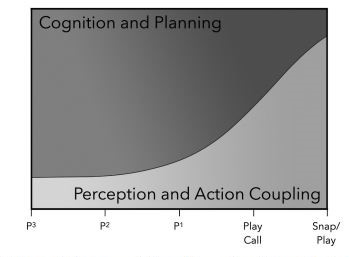
Perception and Action Coupling
Two key pointers from watching field sport coaches deliver their sessions are defenders not giving up their inside shoulder and an attacking player’s ability to “skip” to the outside and pressure edge defenders.
These short clips give an idea of the types of situations that athletes should experience to learn sport relevant movement skills, as opposed to drills that improve their ability to do drills.
The aim throughout this component is a gradual increase in ground reaction forces and shortening of ground contact times. Then challenge the pattern with the use of bands, plates, sticks, etc. If the athletes have no experience, remove the bands.
Teach the shape, teach the rhythm, teach the intent. Go to your toolbox if you see a technical change you want to implement.
This is a warm up. Set the tone for challenge and exploration.
These are short accelerations in a low complexity environment. Catch the ball and run to the try line, evading one fairly passive defender. There’s the potential to even have one defender working across two grids, where in some reps they may have to evade someone and some they won’t.
Change partners regularly, and increase the chances of a max velocity exposure by increasing the distance between the poles and the try line. Add defenders to increase the number of agility exposures.
The second drill is in an area of the pitch players are going to encounter in scoring situations. The 2v2 grid is intentionally wide to provoke skipping to the outside, and the defence is staggered to give the outside attacking player a good chance to score. The only tactical constraint was that they could only pass the ball once.
Coaches sometimes worry more about players being bored then they actually are. I used this drill four weeks in a row. The time spent executing quality reps improved week on week, and the players had plenty of opportunities to dial in their intention. Week one will most likely look like players left their brains on the sidelines, whereas by week 4 we were into a self-organising group who knew what “good” looked like. Only then is it time to change things.
Potential progressions to this drill would be to start the defenders on the try line and have them move straight up the field, increasing task representation; take the timing of the drill from the play of the ball (similar to a snap in the NFL examples); or adding a third defender from marker to apply additional pressure to the first attacker.
Curvilinear running has enormous potential benefit for team sport athletes. This is a perfect way to include it in your week without putting down 57 cones in a perfect arc.
Potential constraints to manipulate are:
- The width the “zombie” has to cover. A narrow channel induces more stop-start type manoeuvres.
- The frequency from which the runners can start. Having them go one by one gives the zombies a chance to reset. Having them go in quicker succession means some get a chance to just sprint straight up the drill. No two reps ever look the same
- Multiple zombies on each line.
These drills have up to 8-10 players all moving at the same time. They are noisy and player led. While the drills may not be perfect, I don’t know how to quantify the value of having this type of atmosphere around movement skill training. It feels like play, as it should. If you work with experienced athletes, use them to help create situations that get what you want and what feels right for them. You may think you know what the game looks and feels like, but they play it, so ask them!
Yearby [13] provides one of the most detailed overviews in the scientific literature on how ecological dynamics and systems theory can help you create better learning environments. Your coaching staff is your day-to-day gold standard and reference point for knowing what movement skills you need to develop in the players. Talk to the head coach, talk to the analyst, talk to the GM.
And when it comes to the players, just let them go. Set the drill up and leave it alone. Like the toddler who is told not to eat the treats when the adults leave the room. sometimes we as coaches just can’t help ourselves. Praise the intent and effort you have identified as important, then let them explore.
You may still not be convinced. You might be saying things like, “But that’s the coach’s job!” Sure, if the performance coaches haven’t put in the time to build relationships with the field coaches, or if you don’t have an implicit understanding of the technical or tactical outcomes they want to achieve.
If you let that happen, you’ll just be the person telling athletes to run, jump and push. Eventually, that will cost them in performance and wins, which may cost you your job.
Tweet ThisWhen it comes to the players, just let them go. Set the drill up and leave it alone. Praise the intent and effort you have identified as important, then let them explore
@SpencerGoggin