

We have all heard the phrase “sprinting is a skill”, right? Well, sprinting is not just any skill – it is an automatised skill. That is, in the context of adult athletes, it is a movement skill performed with little to no attentional capacity and has been developed by a set of dynamic interactions over an extended period of time. By adulthood, an individual’s movement strategy during sprinting is typically well-ingrained, stable and unique to that individual. It has been shaped by their physical characteristics, injury history, physical training, coaching received and many other factors.
So, what does this all mean if we want to change the way a team sport athlete sprints? To make robust changes to someone’s movement strategy when sprinting – one that stands up under pressure in heat of competition – it means it will probably take a lot longer than most people think. It means that the decisions made about making any technical changes need to be well informed. That doesn’t mean it has to be labour intensive for the coach trying to facilitate these technical changes (as you will see later in this article), but it does mean that we need to be willing to accept that there isn’t always a quick fix.
Tweet ThisTo make robust changes to someone’s movement strategy when sprinting – one that stands up under pressure in heat of competition – it means it will probably take a lot longer than most people think
@wildy_jj
In the same way the foundations of an athlete’s existing movement preferences during sprinting emerge over time in response to their experiences, any interventions employed to elicit technical changes also require time for such changes to materialise sub-consciously in competition. However, there is a limited amount of information available on how to implement interventions aimed at changing the technical features of an automatised skill. The purpose of this two-part article is not to propose how team sport athletes should sprint, or to advocate which technical changes we should be looking to make. Rather, it is my intention to cover some of the pertinent issues to do with making technical changes and to provide insight into methods that can be used to help facilitate technical changes of an automatised movement skill – specifically the sprint acceleration technique strategies of team sport athletes.

Determining what technical changes to make
How do we decide whether technical changes are necessary for a team sport athlete during sprint acceleration? This is a big question and one which I cannot answer fully in the scope of this article. There are many factors which need to be considered here including how fast the athlete is, what their current and longer-term priorities are within their sport and how motivated they are to want to change, for example. Perhaps one of the more important questions to answer is this; how confident are we there is a technical change to be made which will result in performance enhancement and/or reduction in injury risk? The problem here is that making the decision regarding what technical features are worth trying to change is not always that straight forward.
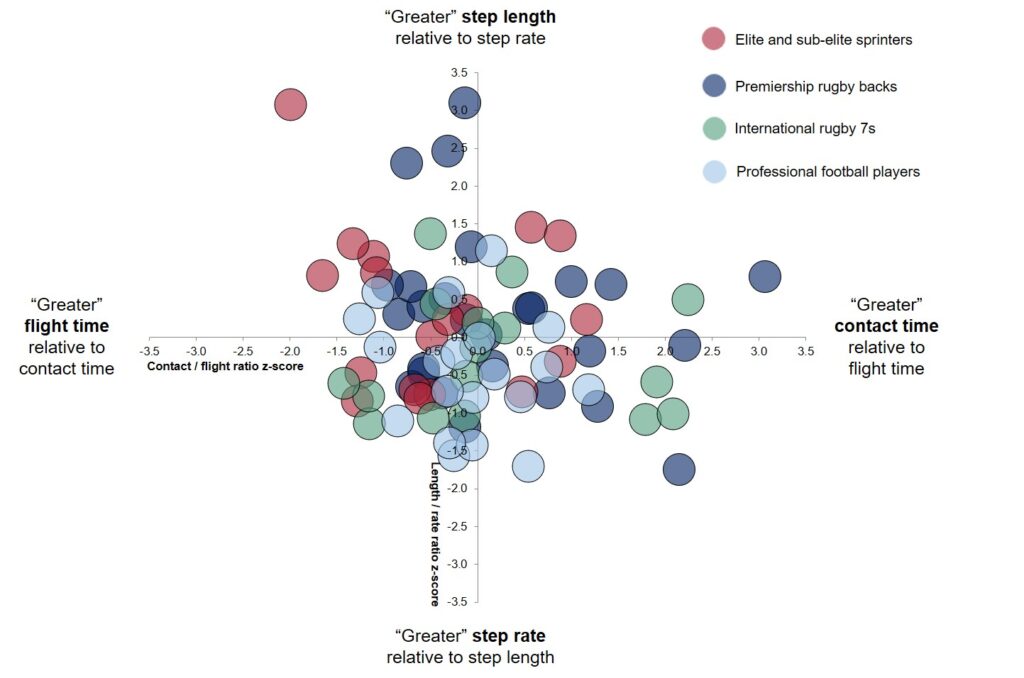
So how do we decide what needs changing or not? One way in which coaches decide on this is to establish a criterion model to compare the athlete’s technical strategy against. This can work well when there are noticeable deviations in the technical features of the athlete from the criterion model. However, this approach ought to be used with some caution owing to the levels of degeneracy which exist across athletes completing motor skills. The word “degeneracy”, in simple terms, refers to the different ways the demands of a task can be fulfilled (see Tononi et al., 1999, for suggested reading). As part of my PhD findings investigating the contributory factors to the acceleration performance of team sport athletes, we observed levels of inter-individual degeneracy in professional rugby union backs in terms of their angular and linear kinematics, and spatiotemporal variables, during the initial sprint acceleration phase (unpublished PhD data). Not only did we find that players used different technique strategies to accelerate, but we also found no clear differences in initial sprint acceleration performance between the different strategies adopted. I then cross checked these findings in sprinters, rugby 7s players and football (soccer) players too (Figure 1). I found the same thing. Therefore, by using a criterion model template to compare our athletes against, we are assuming that we know what the athlete needs to change to help them sprint faster, when in actual fact we may not!
I’ll repeat what I said earlier – the use of a criterion template to compare our athletes against is useful – especially when there are significant departures in the movement features of athletes from this technical model. However, if we are too precise with that model and try to shoe-horn all athletes from a group into it, then we may be missing what is favourable for the individuals within that athlete group. As such a more longitudinal approach to establish how the technical features of an athlete correspond to their sprint acceleration performance over time may provide us with more confidence in deciding which movement strategies are worth changing slightly – or not. To help with this decision-making conundrum, a diagnostic profiling process may be of benefit to provide actionable, rather than just descriptive, information.
Identifying barriers for technical changes
Let’s assume for whatever reason the decision has been made to change the technique of a team sport athlete during sprint acceleration. We then need to establish what barriers there are which may prevent us from making these changes. By the way, when I refer to a technical change in this context, I am not suggesting substantial wholesale changes in the way someone sprints. As already alluded to, the way an adult athlete sprints will be deeply ‘set’ and to make very large changes in their movement strategy – one which emerges within a competitive setting in the absence of conscious effort – is near impossible. This doesn’t mean that changes will not necessarily be discernible to the naked eye, but for the most part I am talking about subtle (albeit meaningful) shifts in their movement features.
Back to the barriers which may prevent an athlete from achieving shifts in their sprint acceleration movement strategy. The purpose of identifying these barriers is to try and establish whether the change(s) we want to make is feasible and how much of it can we actually change. To help with this, we need to consider physical constraints which may block our attempts to make these changes. If these barriers are unmodifiable then it is unlikely to be possible to make these technical modifications, without at least sacrificing performance. A lot of time and energy may be spent on this also, which could turn out to be a waste of time.
As a hypothetical example, let’s take a rugby player whose coach feels they would benefit from being able to cover a slightly greater distance when in contact with the ground during the initial steps – to essentially ‘push more’. The hypothetical athlete typically relies on a high step rate with what appears to be an abbreviated contact phase with limited leg extension of the stance leg at toe-off. The coach feels that by ‘pushing’ slightly more during each step it will result in a higher amount of horizontal propulsive impulse – a key determinant of sprint acceleration performance. However, it turns out there is a possible reason why this hypothetical athlete does not achieve a larger horizontal distance between the toe of their stance foot and their centre of mass at toe-off (toe-off distance) compared to the coach’s criterion template model. She has a history of trauma to her big toe.
Over the years this had led to arthritic changes and the development of bone spurs limiting the amount of hallux dorsiflexion available to her. Maintaining the same angle of trajectory of the centre of mass when pushing off in a step but increasing the toe-off distance through greater leg extension will likely require greater hallux dorsiflexion of the stance foot. Assuming this is not feasible for the athlete due to her limited hallux dorsiflexion, then it is likely that attempts to increase the amount they ‘push’ in each step could result in worse performance and / or increased injury risk.
For example, extending the leg more whilst maintaining the same magnitude of hallux dorsiflexion during each step will likely result in a more vertical trajectory of the centre of mass at push off. Subsequently, this will likely mean a greater proportion of the athlete’s step cycle in flight, thus reducing their ability to accrue horizontal impulse in the first few steps. Alternatively, if the athlete was able to maintain the same centre of mass trajectory angle at toe off, but still managed to ‘push’ more they may manage to do so by some form of compensation (e.g., greater calcaneal eversion or greater external rotation of the structures higher up the limb). This may place undue stress on tissues, which over time could manifest in pain and injury. Such an example raises the importance of working as part of a wider athlete support team where the input of the medical team can help inform the decision making around the feasibility of technical changes.
We know that physical constraints will influence an individual’s movement strategy (1). If we are able identify modifiable physical constraints which underpin the movement strategy, we want to shift an athlete towards, then it would make sense to measure this physical characteristic of the athlete. For example, strength qualities represent physical constraints which are modifiable. In professional rugby union backs, I observed the combination of higher unilateral hip extensor peak torque during a hip torque assessment and greater vertical stiffness during unilateral repeated jumps-in-place to be significantly related to a range of technical features. The video below shows these strength-based tests being conducted.
The technical features these strength qualities were related to included higher order kinematic variables such as step rate and contact time (i.e. step rate was higher and contact time was lower when these strength-based measures were higher). They also included several linear and angular kinematic variables, which underpinned how the higher step rates and shorter contact times were achieved. For instance, higher magnitudes of hip torque and vertical stiffness were related to smaller touchdown distances and contact lengths, and more forward rotated (i.e., towards the direction of travel) foot, shank and thigh segments (unpublished PhD data).
Let’s imagine then that a higher step rate, through the production of lower contact time and associated changes in the linear and angular kinematics mentioned above, have been identified as important for a team sport athlete. In such circumstances, we might want to assess the specific strength qualities mentioned. If the athlete presents with low levels of hip torque and vertical stiffness, then changes in these strength qualities will likely be necessary so that the desired sprinting action is available to that individual (2). Practicing sprinting towards the newly desired movement strategy concurrently whilst these strength-based changes are made, will likely accelerate the rate at which robust technical changes are made.
Opportunities to facilitate technical changes during sprint acceleration in team sports
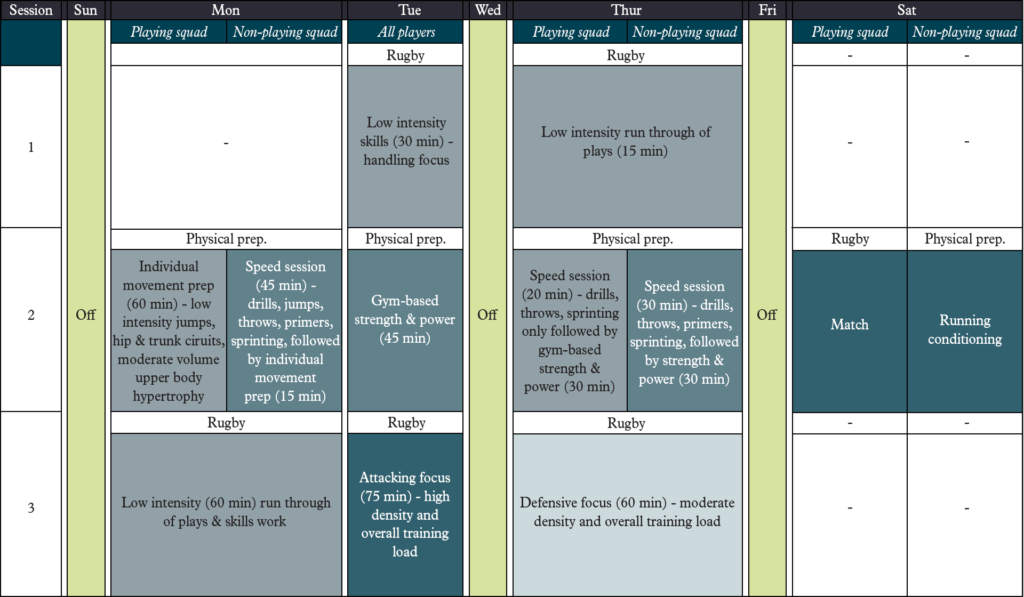
If no barriers to making technical changes are found, a more direct approach may prove fruitful where the athlete can practice the sprinting action desired during appropriate times identified in their training week. Consistency of practice is required for adaptations of the nervous system to occur in response to the training undertaken. This consistent practice results in more skilled control of the movement being trained and so it is important to establish times in the week when it is possible to work on facilitating technical changes, if this has been deemed important for the athlete. Something I hear from time to time is that there is not enough opportunity to work on manipulating the sprinting technique of a team sport athlete. For the record, this is simply not true. The opportunities are well and truly there. For example, Figure 2 shows an in-season weekly training schedule for a professional rugby union backs (assuming match days are on Saturdays).
For the playing squad (i.e., players being selected for match day), there is a total of up to six occasions when some kind of work could be carried out to help facilitate changes in the movement features of players during initial sprint acceleration. Apart from the obvious opportunity to do this during the planned speed session for this group (session 2 on Thursday), there are three other occasions when player’s will be accelerating during warm-ups (session 3 on Tuesday and Thursday, and on match days). Now, provided the athlete is clear on what is expected of them when they get an opportunity to accelerate on these occasions, there is no need to have any input from the coach – it doesn’t need to be labour-intensive on the coach’s behalf. We really do not need to be there to hold their hand the whole time.
Tweet ThisProvided the athlete is clear on what is expected of them when they get an opportunity to accelerate, there is no need to have any input from the coach – it doesn’t need to be labour-intensive on the coach’s behalf.
@wildy_jj
An important point to make here is that it should be made abundantly clear that the player(s) should not focus on this technical shift during a match. This will slow them down. Also, for a team sport athlete in a match-based situation, it is critical that the way she or he sprints is sub-conscious so that the conscious mind is free to focus on other important features within their playing environment, such as the execution of tactics or recognising patterns of play. However, provided they have been educated on what is expected during the appropriate opportunities available to them in the week when they are accelerating, and assuming they have bought in to this process, there are plenty of occasions to practice the desired sprinting action.
There are also secondary opportunities where technical changes can be supported during other physical preparation-based sessions (e.g. for playing squad – Monday session 2 and Tuesdays and Thursdays session 2) which can help to elicit the changes in physical qualities underpinning the technical features being worked on. For the non-playing squad, there are even more opportunities to work on facilitating these changes. And we haven’t even touched on how therapy-based input can help with this process also. Even in team sport environments where specific speed-based sessions are not undertaken, there will still be occasions in the training week (e.g., warm-ups, gym-based work) where it is possible to work on facilitating technical changes, when it has been deemed important to do so. We just can’t expect these changes to happen overnight.
How to determine the technical features of a team sport athlete which may be worth investing time and energy in is not always clear from the outset. It is important not to rush into making such decisions and it is helpful to spend some time building a profile of the athlete in a more longitudinal way to help inform this decision-making process. In the very least, the athlete will still be able to partake in the fundamentals of speed training (unless there are injury concerns) whilst this profile is built. This will elicit the specific speed adaptations being sought which will cater for most of their speed training needs. As part of the decision-making process to make technical changes, as outlined, it is important to take into account the factors preventing an athlete sprint in the newly desired way sub-consciously, because ultimately a plan in place to remove such barriers will need to be actioned. I am confident there are opportunities to help facilitate the sprint acceleration techniques of team sport athletes, regardless of their training environment, but it will require a well thought through and integrated plan. Once we have identified the opportunities in the training week to facilitate these technical changes and have an understanding of what we are seeking to change, then it is useful to consider a range of methods which can be used by coaches or other practitioners to action these changes. This is what will be covered in part II of this two-part article.