The quality of coaching and the commitment of the athletes govern the success of any youth strength and conditioning programme. However, the most effective strength & conditioning programmes for young athletes will complement highly skilled coaching and athlete commitment with an appropriate use of testing and monitoring data.
The science and practice of developing young athletes should not be viewed as separate disciplines. Rather, they are critical and complementary elements of the long-term athletic development process. Undoubtedly, there has been an increase in the number of youth sports attempting to take a well-rounded approach of delivering high-class coaching informed – not blindly driven – by the data that they have at their disposal.
Training young athletes is more than setting up obstacle courses and just “letting them play.” That is not to say that those types of activities are inappropriate – far from it. They feature in the programmes we deliver at our own facility. But given the unique developmental changes that young athletes will experience as they progress from childhood, through adolescence and eventually into adulthood, we have to consider many factors to optimise the training response.
Tweet ThisTraining young athletes is more than setting up obstacle courses and just “letting them play.”
@DrRSLloyd
This article addresses three common questions that we often hear at our training facility. In doing so, I’ll highlight how a little bit of data can help inform our decision making when constructing training programmes.
Question 1: “What types of training should my child be doing?”
Many interacting factors that influence athletic development fluctuate during childhood and adolescence (Figure 1), and coaches should consider these when designing training programmes [6]. In his recent Sportsmith article, Perry Stewart outlined how growth and maturation can influence physical development. Natural developmental processes clearly influence improvements in athleticism during childhood and adolescence, and these interact with any given training stimulus.
For this article, “athleticism” is the ability to repeatedly perform a range of movements with precision and confidence in a variety of environments, which require competent levels of motor skills, strength, power, speed, agility, balance, coordination and endurance [10].

Acknowledging the influence of growth and maturation, the initial response to our first question, then, should be: “What adaptation does the athlete need?”
At the risk of using a broad brushstroke, many modern-day young athletes likely will need to improve both form (i.e., their motor skill competency) and function (levels of muscle strength and power). This is certainly what we have seen in our own training facility over the years, and it reflects epidemiological data for levels of fundamental movement skills [3] and muscle strength [4] in youth populations.
The second question to ask is “How technically competent is this athlete?” This is critical because technical competency will largely dictate exercise selection and training prescription (e.g. intensity, volume). For example, a young golfer may need to improve their whole-body strength as a means to enhance club head speed, and loaded compound movements might be the desired training mode. However, if the young athlete is not yet able to demonstrate technical competency in movements such as squatting and pulling, then the programme will need to initially focus more on the development of rudimentary movement skills, with body weight as an appropriate resistance for much of the work. We presented a range of practical strategies to develop athletic motor skill competencies in young athletes, using a combination of warm-up games, body management exercises, obstacle courses and basic resistance training exercises in a recent paper [15].
The next question to consider when answering the initial broad inquiry is “How biologically mature is the athlete?” If the athlete is prepubertal, a programme built around neuromuscular training methods will complement the naturally occurring neural adaptations they are experiencing as a result of development. For athletes experiencing rapid periods of growth, coordination might be temporarily disrupted, in which case the programme will likely benefit from training methods that target movement or neuromuscular deficits. If the athlete is post peak height velocity, then the natural increases in hormonal concentrations will enable the athlete to achieve large increases in muscle size and architecture, which indicates combined training methods to realize hypertrophic changes. This notion of aligning training stimulus with growth and maturity is known as “synergistic adaptation [6].”
Case studies: Youth gymnast and soccer player
To illustrate the multidimensional nature of programming, baseline data for two young athletes is in Figure 2. Athlete A is a prepubertal gymnast, while Athlete B is a postpubertal soccer player.
We collected the data from some basic pre-season performance testing, with the benchmark data coming from a cohort of young athletes of similar maturity.
We assessed technical competence with the resistance training skills battery (RTSB); whole body strength via the isometric mid-thigh pull (IMTP); maximal sprint velocity during a 20 m sprint; and a range of explosive strength/power qualities with the squat jump (SJ), countermovement jump (CMJ), drop jump (DJ) and standing long jump (SLJ). Of note, the RTSB is a movement screen that includes a simple scoring system to grade movement competency in a range of movements – body weight squat, push-up, lunge, suspended row, standing overhead press and a front support – that has been validated in children [11].

The radar plots for both athletes can help inform our programming based on our previous questions.
For Athlete A, the data show that this gymnast is below average on all aspects of athleticism, but the poorest performance was in whole-body strength. Their technical competency was also poor. Therefore, the training programme should prioritize these fitness qualities. From a maturity perspective, we know that this gymnast is prepubertal so any training-induced improvements will likely come from neural adaptations. Prescribing a programme that is geared towards developing a breadth of movement skills and basic levels of strength would be a logical and appropriate direction to take.
Athlete B’s IMTP, squat jump and standing long jump data were all above average, so this soccer player appears to be relatively strong and can perform well in more concentrically dominant tests. This player is postpubertal and, given their existing levels of strength, it would be tempting to now focus on targeting their explosive / reactive strength capabilities. However, testing revealed a poor RTSB score. The training programme should initially prioritise improving movement competency to ensure they have the requisite foundations of movement competency and strength upon which they can develop other athletic qualities. Given the transient nature of strength, any programme would still need to maintain an element of strength training to ensure the athlete does not experience any detraining effects.
These examples show that maturity data is just one – albeit an important one – of the factors to consider when making programming decisions for young athletes. Taking into account the desired training adaptation, the movement competency of the athlete and their maturity status will hopefully enable training programmes to reflect an athlete’s individual needs.
Question 2: “Is it worth testing youth athletes?”
Much like evaluating literacy and numeracy, testing athletic qualities in youth athletes captures information that can aid programme design and help practitioners better understand fluctuations in physical fitness.
Both the National Strength and Conditioning Association [10] and International Olympic Committee [1] advocate that the goal of athletic development programmes should be to develop young athletes with well-rounded levels of athleticism. Conceivably, the periodic use of a well-rounded testing battery that assesses various athletic qualities would be optimal. However, context is key here. Practitioners working in a volunteer after-school programme are unlikely to have the resources that may exist in elite sporting pathways, and might therefore need to rely on more field-based and less sophisticated testing methods. Nevertheless, irrespective of the personnel, equipment, finances and time that we have available, fitness tests should be both reliable and valid in paediatric populations to make testing worthwhile [6].
Having an awareness of test reliability is important when interpreting fitness data in order to distinguish whether changes in performance result from the training stimulus or simply reflect the noise in the measure. However, because fitness increases naturally due to growth and maturation, when interpreting test data of youth athletes we need to consider if a given change in fitness exceeds both the typical error and the magnitude of change we might expect from natural development.
Considering our earlier case study, let us assume that athlete A increased their IMTP relative peak force from 24.9 N/kg to 27.6 N/kg (∆ = ~10.8%) over the course of a 20-week training programme. Given the established typical error for this test variable in prepubertal girls is ~9% [12] and that IMTP relative peak force remains fairly stable as girls transition through different stages of maturity [13], we could be reasonably confident that our training programme has been effective. Alternatively, practitioners in a school environment may rely on more field-based measurements, with performance variables (e.g., height or distance) during different jump tests serving as surrogate measures of strength and power. In such instances, practitioners should still interpret any changes in performance with an eye on the associated typical errors for that test. For example, the My Jump 2 App produces typical errors of <10% in primary school-aged children for both squat and countermovement jump heights [2].
The process of collecting and feeding data back to athletes and coaches is an important consideration for practitioners working with youth populations. Educating young athletes about the process and purpose of testing enhances understanding and fosters athlete buy-in.
For example, take a young athlete at the peak of the adolescent growth spurt who is experiencing breakdowns in coordination and movement control. Growth data can help them better understand why this might be happening, and reassure them that it is a temporary disruption due to maturation.
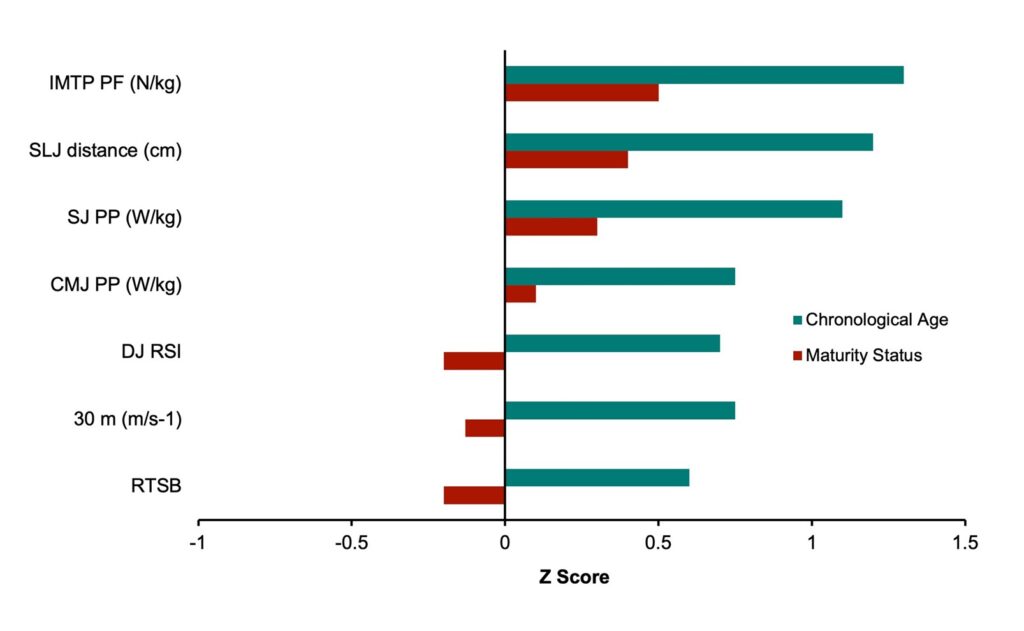
Similarly, data can explain test results from athletes within an age group that has a wide spread of physical maturity levels (Figure 3). In this instance, if we presented data relative to chronological age, an early maturing child will invariably outperform their peers, especially in tests of strength, power and speed. However, in the context of normative data from youth of the same maturity status, the athlete’s scores are much closer to the mean, and in some instances below the mean. Therefore, at first glance, while the athlete might appear exceptionally athletic compared to athletes of the same age, when we factor in maturity status, their profile is very different and some physical weaknesses may surface, which we can then target with relevant training [5]. Overall, practitioners will conduct a more fair and insightful comparison of athletes if they present performance data relative to maturity status [17].
Importantly, much like coaching in a practical environment, practitioners need to use developmentally-appropriate language through each step of the testing process and will have to introduce data and concepts in a visually appealing and simplified manner. The earlier that young athletes can understand, value and be involved in the data collection process, the greater their long-term engagement will be.
Question 3: “How do I manage the programme of an early specialised young athlete?”
Early specialisation involves intense training schedules and chronic exposure to the same sporting skills during the developmental years. This limits young athletes’ exposure to sport diversification and could lead to reduced long-term participation in sport [9]. There is a growing concern around the potential negative consequences for youth athletes who specialise in a single sport from a young age. While the evidence is somewhat in its infancy, existing data indicate that specialised youth athletes may be at an increased risk of injury [8].
When faced with this type of young athlete, practitioners should incorporate training that targets the development of movement competencies that are not inherent in their specialist sports, in order to increase the breadth of athleticism and to develop well-rounded individuals [14]. This ensures that programming does not solely focus on “sport specific” requirements, but rather develops athleticism in a broader and more holistic context.
For a 13-year old rower who is very dominant in lower-body concentric movements and upper-body pulling, a greater bias towards lower body posterior chain work (e.g., eccentric hamstring and hip-dominant exercises) and upper body pushing exercises could be beneficial to address the “movement gaps” in the athlete’s athletic profile. Similarly, encouraging opportunities for movement creativity and exploration via non-structured forms of training like obstacle courses, playground games and partner challenges are also useful to promote greater movement variability within the programme [15]. Designing training programmes with greater variety of movements could also help reduce the risk of overuse injuries in early specialising athletes, as different movement patterns will vary the point of force application and co-ordination demands.
Practitioners should also aim to monitor young athletes’ internal (i.e., biological stressors) and external (work done per session) training loads to assess individual responses to training and reduce the risk of maladaptive training responses [16]. Managing load is particularly important in those with a lower training age, those going through a growth spurt or young athletes exposed to higher volumes of training.
The available monitoring tools are almost limitless, and attempting to integrate a comprehensive monitoring battery can be challenging. While coaches will have a variety of external load metrics at their disposal (e.g., loads lifted, distance) a viable method of monitoring athletes’ internal responses to training across a wide range of training modes is the session-rating of perceived exertion (sRPE). Research validates child versions of the RPE scale within resistance training [7] and field-based sessions [16], which indicates its applicability in youth sports.
Remember the fundamental purpose of youth sports
Whether you are a strength & conditioning coach, technical coach, parent, medical professional or perform any other role in a young athlete’s developmental journey, there should be a common purpose: helping young athletes enjoy sport, improve and maximise their abilities, and realise their goals and aspirations. Combining good coaching skills with relevant scientific data should enable our young athletes to receive the most evidence-informed and individualised programmes to optimise their development and involvement in sport.