
In my last article, I addressed the confusion around describing sprinters as “pushers” or “pullers.” Coaches can understand “pushing,” but often misunderstand “pulling,” confusing it with the explicit instruction to “pull the track back.”
This confusion arises from blurring the difference between a category and a label, and then is made worse by these words we’ve come to use.
A category is a group to which items are assigned based on their similarity, while a label is the name we give something to distinguish it as a part of a certain category. The initial categorization simply referred to the athlete’s biases – how they most-naturally prefer to move – not the coaching instruction.
But over time, we are perhaps confusing the pull-push category with the pull-push label. Pulling and pushing are categories, but many coaches – myself included – have erroneously used them as labels: She is a pusher, but that other athlete is a puller.
And so there is a need for an update, one that better defines “category” in a way that distinguishes it from a “label.”
I suggest these two categories remain as-is, but we use different terms as the labels. These new terms will better describe the actual kinematic outcome of how an athlete moves down a track (or field) and can, therefore, work as more actionable labels.
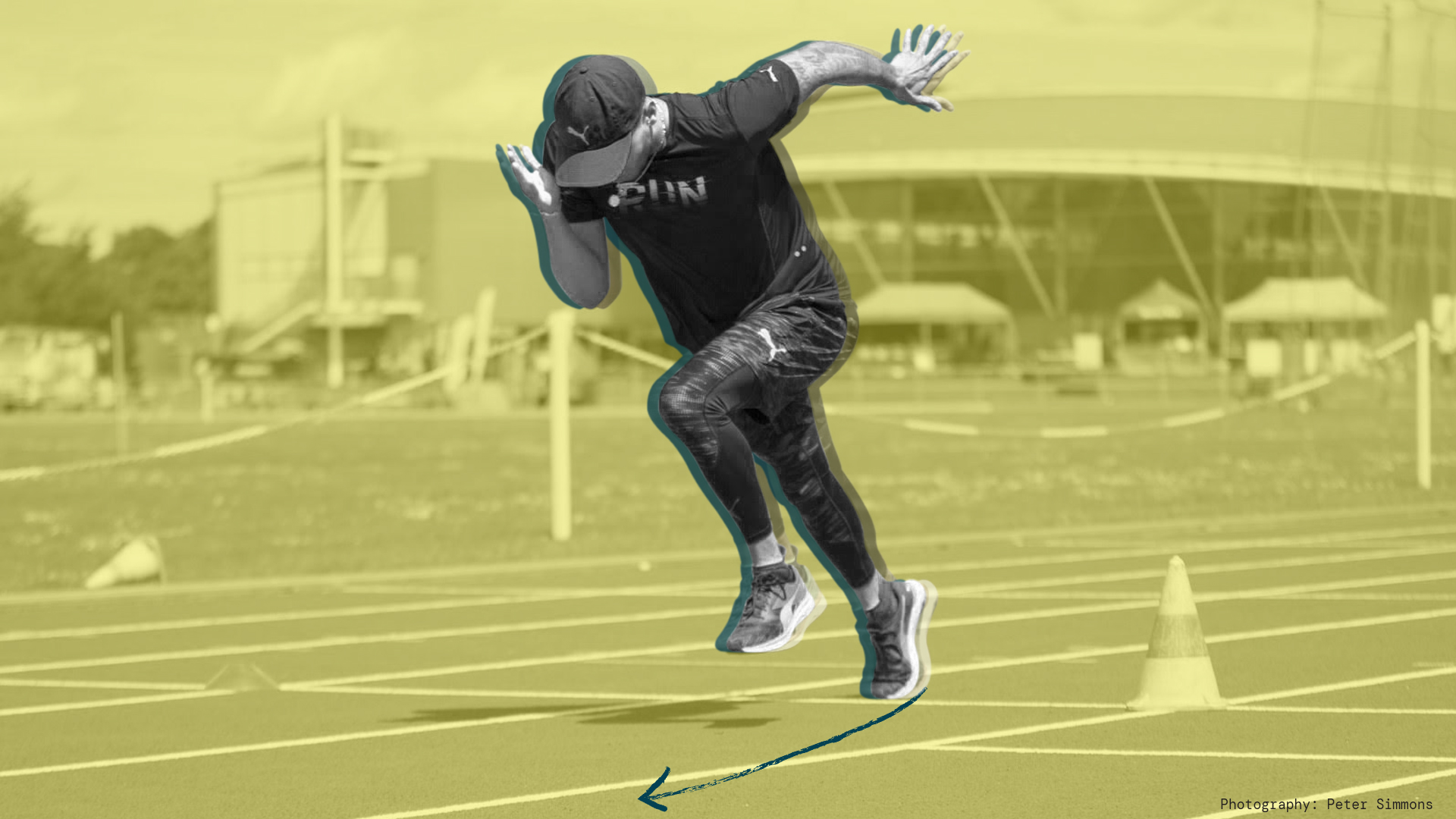
Athletes who are more push-dominant tend to drive down the track, spending a little longer time on the ground. Athletes who are more pull-dominant tend to be more reactive and elastic. They have shorter ground contact times and longer flight times compared to their push-dominant counterparts.
Tweet ThisAthletes who are more push-dominant tend to drive down the track, spending a little longer time on the ground. Athletes who are more pull-dominant tend to be more reactive and elastic
@StuartMcMillan1
The first athlete “drives,” while the other “bounces.”
Su Bingtian exemplifies a “driver” sprinter
The more push-dominant “driver” is generally good at the beginning of a race, where the increased ground-contact time helps him or her apply high levels of horizontal force, generating a large amount of acceleration.
Ground-contact time is often a part of a coach’s instruction. “You can’t apply force while you’re in the air” is a common coaching mantra when it comes to describing the importance of ground-contact during acceleration. That statement is true. But the same thing that aids in an athlete’s acceleration – ground contact – is the very thing that slows an athlete down when they’re at or close to maximal velocity!
We have seen this play out on the international stage as recently as the Tokyo Olympic Games, where Su Bingtian split 6.29s at 60m on his way to running an Asian record 9.83 at 100m in the semifinals. As you can see below, he was pretty free and clear early in the race, but only just hung on to win, edging out American Ronnie Baker and eventual gold medal winner, Marcell Jacobs.

The downside of this drive-oriented strategy is that if the athlete doesn’t execute the start effectively, they have no real reserve to draw from. If they’re not clear enough at 60m, there’s little they can do about it in the closing stages, as we saw from Su in the final.
In the semi-final, compared to Su, both Baker and Jacobs excelled later in the race. Baker was 6.37 and Jacobs 6.40 at 60m. They made up .08 seconds and .1 seconds, respectively, over the final 40m. They spent less time on the ground per step and more time in the air than Su did over the final 40m. In essence, they “bounced” better.
Tweet Thisthe same thing that aids in an athlete’s acceleration – ground contact – is the very thing that slows an athlete down when they’re at or close to maximal velocity
@StuartMcMillan1
“Bouncers” are the second-half stars of sprint races
“Bouncers” tend to excel in the closing stages of a sprint. Their more elastic qualities enable them to apply larger vertical forces earlier in the stance phase, resulting in greater vertical impulse. This provides the air time necessary to reposition their limbs in time for the subsequent step.
Perhaps the best current examples of bouncers are Andre DeGrasse, Noah Lyles, Allyson Felix and Gabby Thomas.
Their bouncing ability is so superior to most of their competitors that as long as they are in the ballpark just past the halfway point of the race (e.g., 60m of a 100m or 120 of a 200m) they are pretty confident they can roll past their competition by the finish line.
The common critique of the bouncer is “if only they had a better start!” The assertion there is that if they improved their start, it would improve their overall performance. Such comments followed Carl Lewis over the course of his entire career, then Donovan Bailey and, most recently, Usain Bolt.
However, just as it is with the driver who is not as effective at the end of the race as a reflection of his natural bias, so it is with the bouncer. The very fact that he bounces well reduces his effectiveness earlier in the race.
This is a classic trade-off. If the bouncer was to drive better earlier in the race, it would most likely negatively affect performance later in the race. Additionally, coaches such as Tom Tellez have proposed expending a significant amount of energy earlier in the race will reduce the amount left for later in the race.
In fact, there is generally a negative relationship between early acceleration and late race maintenance.
Consider Su Bingtian’s performance in the Olympic final compared to the semi-final. He was almost .2 seconds slower to 60m, but was actually faster from 60-100m.
| Semi final | Final | |||||
| 0-60 | 60-100 | 100 | 0-60 | 60-100 | 100 | |
| Su | 6.29 | 3.54 | 9.83 | 6.48 | 3.50 | 9.98 |
| Baker | 6.37 | 3.46 | 9.83 | 6.43 | 3.52 | 9.95 |
| Jacobs | 6.40 | 3.44 | 9.84 | 6.41 | 3.39 | 9.80 |
His total time was slower because he simply did not take advantage of his bias towards driving, and just doesn”t have a high enough maximum velocity to make up for it.
Marcell Jacobs, on the other hand, ran exceptionally well at the beginning of the race and the end of the race in both the semi-final and the final.
Similarly, the women’s Olympic Champion, Elaine Thompson-Herah, has exceptional elastic qualities. but she is also really good earlier in the race. Are Jacobs and Thompson-Herah good at both driving and bouncing?
Elaine Thompson-Herah and Marcell Jacobs “climb” up the podium
So what strategy is better: driving or bouncing? In a word, neither. There are plenty of examples of elite sprinters in either category, and some who fall into both.
Many of the best sprinters, especially more recently, are what I have termed “hybrids.” They sit somewhere in the middle of the continuum. While they might not be the best in the world at either, they can drive well and bounce well. They can both produce high forces and are elastic.
But “hybrid,” like “push” and “pull,” is a category, not a label.
A better term I’ve come to user is “climber,” because of how these athletes “climb” out of their acceleration. Donovan Bailey might have been one of the first athletes to excel at both driving and bouncing. He was an amazing climber. Asafa Powell, Usain Bolt, Fred Kerley and Marcell Jacobs, among others, have a similar blend.
Elaine Thompson-Herah is probably the best example in the women’s sprinting world. But before her, Veronica Campbell-Brown and Dafne Schippers were good examples of hybrids.
These athletes tend to excel in the middle of the race, the so-called “transition” from acceleration mechanics to upright mechanics. This transition between driving and bouncing is typically the hardest thing to get right, and where many races are won or lost.

Training the transition to maintain pressure
We tend to analyze only two mechanical models in sprinting: acceleration mechanics and upright mechanics.
However, athletes spend their entire time transitioning from one to the other. Often, the ones who do this best succeed.
You’ll often see sprinters “lose pressure.” They reach a point in the race where they might be applying high forces, but not effectively. This usually happens somewhere around 20-40m, where they struggle to transition from a “drive” to a “bounce.”
While this loss of pressure is often only 2-4 steps with elite sprinters (it is much more at the sub-elite level), this is often enough to cost the athlete the race. It invariably leads to an overly horizontal force application when upright, reduction of front-side lift, and late-race straining as they attempt to make up for this loss of pressure through the middle.
The “climbers,” on the other hand, tend to do a really good job of maintaining pressure throughout the race, and therefore have a little more room for error.
If a great “driver” has a relatively poor start, it’s going to be really difficult for her to run fast, because she lacks the bouncing ability to make up for it at the back end of the race.
Similarly, if a great “bouncer” finds herself too far back at 60m, there can be a tendency to over-push through the middle in an effort to catch the relatively faster starters. In these cases, it doesn’t matter how well she bounces. If the great driver has executed effectively, there’s just no catching them!
From categories to coaching: How to move beyond labels
My coaching instruction in cases where the driver takes an early commanding lead over a bouncer is centered around patience.
“Patience” in this sense relates to J-B Morin’s effectiveness of force application, or ratio of force (RF). This tells us that the sprinter takes longer to get up to speed by being “patient” with their climb. They increase their center of mass height over distance, along with their cadence. Many athletes shorten their arm carriage, for example, in an effort to increase their stride frequency.
Many coaches tend to organize their training to develop driving qualities in the earlier part of the season through increasing force producing capability and bouncing qualities later on by targeting the ability to produce force rapidly. Basing their ideas on modeling the best sprinters in the world, they recommend high step frequencies in their programs before their athletes have developed the requisite force production.
But the ability to produce high forces effectively is a prerequisite to fast sprinting. As Vince Anderson has said, the athlete has to “earn the right to spin.” Coaches should aim to develop the specific force-producing abilities before worrying too much about step frequency.
Tweet ThisThe ability to produce high forces effectively is a prerequisite to fast sprinting
@StuartMcMillan1
A few metaphors I use to help athletes with being patient include:
- Feel like they are a plane taking off from a runway, not a helicopter.
- Build pressure like a kettle boils water. Allow the water to continue to boil until it finally boils over, releasing the pressure.
- Build the pressure in a balloon by blowing into it. It gets harder and harder to continue blowing up the balloon until, finally, the pressure releases when the balloon bursts.
If the athlete is confident in their model and understands the models of the other athletes in the race, then there is a better chance that they will remain patient if the great starter gets ahead.
This was so often the case with Carl Lewis throughout his career, as well as Donovan Bailey in his 1996 Olympic Final win and world record. They were so confident in their models, and knew that any deviation would simply play into the hands of their competitors. They knew what made them good, and rather than getting distracted by the other athletes, they simply trusted in their abilities.
Their examples highlight the importance of accurate categorization in the first place. The athletes had to know what abilities they were trusting. If Lewis or Bailey didn’t have the maximum velocity they did, relying on it wouldn’t be an option. While this may seem obvious, it might not be as evident when determining the biases of developing athletes with less-obvious skill sets.
Categories matter if they improve athlete performance
Over 20 years after first encountering these categorizations, I still use them in my coaching practice today. I will continue to recommend their use – plus the new addition of “hybrid” – to others in the coaching community. While the labels of drive, climb, and bounce are meant specifically for sprinters and sprint coaches, they may also be useful for team sport coaches who are looking to improve the sprinting mechanics of their athletes.
If an athlete displays a significant bias towards pull-dominance or push-dominance, and we are confident in this categorization, then there is a strong chance that this information can help us understand how they move and how we can better develop them as athletes.


