
Innovation in sports performance is the new teenage sex: everyone thinks everyone else is doing it, so everyone claims that they are doing it [1].
Whether the motivation stems from wanting to keep up appearances or a case of FOMO, the jury is still out as to whether teams and athletes actually need to innovate in order to have success, despite plenty of supporting evidence in other fields (see [1-2] for examples). But in an increasingly competitive landscape, chances are that more of us are going to be “doing” innovation, whether you’re working at a high performance organisation targeting marginal gains (sorry, Team Sky) or a tech start up, where it’s part of your very reason for existing.
Tweet ThisInnovation in sport is the new teenage sex: everyone thinks everyone else is doing it, so everyone claims that they are doing it
@robertson_sj
I work with a range of sports focusing on diverse problems, including organisational decision-making, developing athlete skill and accelerating start-ups. Most organisations grapple with two main issues around innovation:
- Identifying the right project(s) to invest in, and
- Ensuring they have the appropriate infrastructure and systems to sustainably maximise their innovations’ outcomes.
With these in mind, this article starts with five key questions that we should consider before undertaking the next innovation project. Then I provide five of the biggest areas that should be targeted for innovation in sports performance right now.

What to consider before starting your next innovation project?
What’s your innovation appetite?
Some organisations don’t know where to start in innovation. Others jump at the first opportunity that presents itself. Some of the key starting questions that organizations often miss are:
- Do you have adequate resources – time or money – as an organisation or individual to innovate? Or, perhaps more importantly, can you afford not to?
- Which areas of your business or practice are you willing to experiment in? And where are you prepared to fail?
Of course, that’s only part of the story. The answers to these questions should correspond with the overall goal or mission of your organisation or department, and with the competitiveness of your environment.
If you’re a founder of an early stage start up focusing on athlete tracking, then you simply have to innovate to succeed. The opportunity cost of not doing so is simply too great, or you may get left behind the existing big players if you don’t. In contrast, if you’re a professional football club with a well-credentialed performance staff, then taking large risks in coaching practice might be a very small part (if any at all) of what you do. What constitutes acceptable risk and reward will differ depending on the context and the organisation. There isn’t a one-size-fits-all approach, so make sure you’re clear on what it is before you start.
Assessing your innovation appetite
- Set the volume of the appetite: how much innovation you want or need to pursue?
- Set the nature of the appetite: in which areas do you want to pursue it?
- Ground these positions in evidence.
- Ensure you articulate it and make it transparent to everyone in the organisation.
What problem am I REALLY trying to improve or solve?
This might read like the most obvious point in this entire article, but it bears mentioning. We don’t ask this question enough in sport, and even when we do we need to connect the answer to the way in which we ultimately act. How many pieces of equipment do we acquire or which practices do we adopt just because someone else was doing it or we saw it on social media?
Really think about it and be honest.
It’s easy to get caught up in artificial intelligence and Web 3.0 because you think everyone else is (yep, more teenage sex). But do you even know how to use it? If not, what is it going to cost to upskill in order to do so? And how exactly are you going to take advantage of it?
Even when an idea has merit, a lot of the time it’s simply solving a problem that was never really there in the first place. I have been critical publicly of sport science and, more recently, sports analytics for doing this: elegantly answering questions that no one was asking. Innovation in sports performance runs the same risks.
Another consideration is defining the problem appropriately. An example in team sport might be concluding that our athletes are too slow. But being too slow is not actually the problem. It’s not what causes the team to concede points or lose. The problem is players getting caught out by the opposition on turnovers. Here, how we define the problem shifts the potential intervention from countless speed and acceleration sessions in the pre-season to a more well-rounded and impactful view of the solution, such as one that includes tactical or coaching interventions.
One of the best ways to identify the highly impactful opportunity that is sitting under your nose is through the Socratic method [3]. Being skeptical and constantly questioning does not make you or your organisation a negative one. On the contrary, a skeptical outlook is more likely to lead to continuous improvement. Challenging dogma and existing practice is too often frowned upon. Most of us have such behaviours driven out of us as children (let’s face it, as a parent or teacher we can find constant questioning tedious).
It’s especially important in sport, as most of our practice is grounded in:
- Tradition: “It’s always just been done this way.”
- Unvalidated replication: “Team X were doing this and they had success last season. We should copy that as a starting point.”
- Politics: Whoever is in the highest role, makes the most noise or is closest to the coach tends to win out.
- Convenience: “It takes more time and effort to set up multiple and individualised warm up drills, so we just run one together as a team.”
Of course, the longer things are in place, often the harder they are to change. That’s not just because people don’t want change, but because change often affects the places they have most to lose. That’s also why some of the best opportunities for innovation lie in the most ingrained areas of practice.
Be clear that what you’re trying to solve is:
- Really a problem to start with: not just buying some new tech and calling it “innovation.”
- You have a problem worth solving and innovation is likely to lead to meaningful improvement.
- You have the capability and capacity to impact it.
Understand the environment you’re operating in
Clubs operating within a professional league exist within a known, largely controlled environment. There’s a set number of games each season and the number of teams is constant. There are very few “unknown unknowns.” The moment they start to operate in foreign, less structured markets such as starting an esports team or getting involved in venture capital, the dynamic is turned on its head.
In these complex systems it becomes a lot harder to identify what actual facilitates and blocks success. If an innovation project is to take place in such an environment, they should include an independent “disruptor” at this stage. The primary roles of this person are helping the organisation identify factors they’ve missed and overcoming any biases. Often, people within organisations are too close to the problem to consider it from a different perspective. They also typically don’t have a lot of time built into their role to really brainstorm ideas. Consequently, they tend to not be very good at it. This disruptor can be an external subject matter expert, thought leader or entrepreneur, someone familiar with the broader landscape and also capable of projecting the likely outcomes into the future.
I also normally recommend running a pre-mortem [4] at this stage. Imagine that the project has failed. Then identify all of the possible reasons why it did. This entails a brainstorm session involving multiple stakeholders across the business. Did you not see the emergence of a new technology looming? Did a competitor you should have been aware of beat you in being first to market?
The importance of diversity in sporting organisations has become a hot topic recently. This scenario provides further support. It’s another way for us to obtain a broader view of the problem at hand and avoid the limitations we have in our own perspective and imagination.
With greater complexity, it’s also harder to assign cause and effect. Let’s say that you have identified the problem you’re trying to target. Are you really sure that what you’re proposing will solve the issue? What else could play a part that you haven’t accounted for? In the example above of the team being caught out in turnover, it’s very unlikely that a single factor will lead to the solution. Fixing the problem is more likely to involved a myriad of factors, from different tactical training to improving the athletes’ physical profile to even their motivation and willingness to play for the coach.
Map your environment
- Be clear on all of the different facilitators and barriers, and whether they’re under your control or not.
- Many innovations we want to implement are not focused on creating outcomes for the short-term. Project your thinking into the longer term before implementing.
Establish your role in bringing the innovation to life
Now that you’ve identified your innovation project and mapped the environment, determine your role in actually bringing the project to life.
In sport, most big initiatives almost never emerge from a single organisation. Overconfidence or naivete can often result in organisations chasing this anyway. But it’s simply not the remit of most businesses to deliver on a “full stack” basis. Just think of what goes into developing a new piece of technology. From the ideation to the design and manufacturing phase, through to establishing the value proposition, quality testing and applied validation in the field… it’s a hard ask for any sporting organisation to do it all on their own.
Once you know where you fit in to this complex picture, stick to that role. If you’re a professional club, don’t expect your staff to generate ideas and then deliver on them from start to finish. They have to concern themselves primarily with the athletes. I’ve worked with organisations where I grew frustrated with a lack of progress on innovations I thought we should have been targeting. But on reflection, those organisations weren’t doing anything wrong by not adopting them. They were just focused on their core business. I was the one in the wrong place – I should have been at a tech company or university.
Collaboration facilitates this aspect of innovation. There’s no point in putting time and effort into developing something that you’re not very good at when there is someone else with relevant expertise who can help you. We’re all stronger together when it comes to chasing sport’s biggest innovations.
Evaluation and governance
I talked above about establishing cause and effect. I mention it again here because so often we either forget to evaluate our decisions or put this job in the “too hard” basket. It may seem too difficult to separate an outcome from everything else that we’re doing in practice.
At its core, evaluation is a tricky question. How do we do it? Is it ever just as simple as how much money it generates, or how much improvement it leads to? Even well-established measures such as return on investment aren’t as simple as value in vs. value out. There is always an opportunity cost, something else you could have worked on or dedicated time to.
Over what time scale do you evaluate? If you don’t achieve early success on a project, do you run the risk of it being viewed as a failure? Most sports don’t tend to have much patience.
Most of the time you’re not the only stakeholder in an innovation project, so your evaluation of the project isn’t the only one that matters.
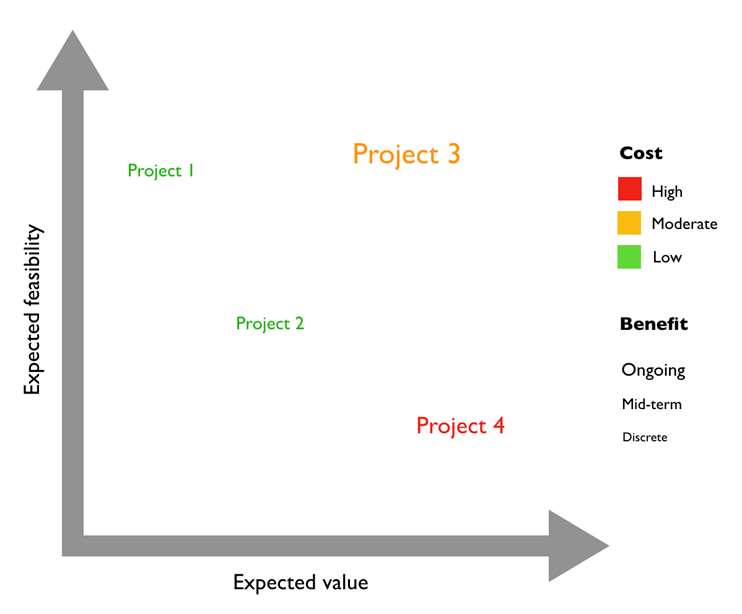
Figure 1 shows a tool I’ve used to help identify the right project to pursue or to evaluate multiple projects concurrently. The key consideration is typically how much value you expect the project to create balanced against how feasible it is to implement. Adding features to the plot create a more detailed snapshot: colour coding for expected cost of the project, font size to indicate the nature in which you expect the benefit to manifest. Whatever you decide to show, the goal is sharing a quick overview with other stakeholders.
And while it’s not the sexy stuff, good evaluation should also consider governance. Is the brief straying from its initial purpose? Is it blowing out in time and budget? Is the organization adhering to its own ethical and legal standards?
Five areas prime for innovation in sports performance
“Gee Sam, some of that was pretty dry,” I hear you say. “Where’s the groundbreaking new tech ideas? The revolutionary new training methodology?”
Don’t get me wrong, technology is and will continue to be one important part of sports innovation. But very rarely is it a solution to our biggest problems. It is simply part of it, a facilitator. As a result, technology is nowhere near the most crucial area for sport to collectively target right now.
As you read the sections below, notice the emphasis on human factors and soft skills, things that require very human characteristics such as humility, empathy, communication and collaboration. Not only do these have bigger bang for buck, but invariably they’re more sustainable, longer-lasting and likely to keep staff content and not looking for the exit door.
Efficiency
Efficiency is number one for a reason. Like moths to light, we get sucked in by flashy innovation, but it’s more often the structural or methodological initiatives targeting efficiency that truly transform your business or practice. Of course, it’s tempting to notch small savings here and there by going with a cheaper technology provider or paying junior staff the minimum possible. I currently work in some capacity in over 10 sports, and there isn’t a single one that wouldn’t benefit from improvements to efficiency – perhaps more so than any other area.
Visit just about any organisation and you can probably find at least 5-10 hours that each staff member could “save” each week. Whether they are sitting in meetings with no clear aim or manually coding video of the latest game, it’s pretty easy to calculate the number of staff affected by an inefficient or redundant process. Multiply that by their hourly rate and come up with a cost savings relatively quickly.
The big opportunities are not just the processes we undertake: they’re our entire jobs. One of the best ways to find the most impactful efficiency innovations is auditing the work week: your own, the athletes’ and the staff’s. This can be done with software or simply monitoring diaries.
The more you look, the more you find opportunities to cull and replace, so much so that you start to question why some roles in high performance sport exist in the first place. Which brings me to…
Organisational structures and roles
We’d like to think that the structure of our staff teams in high performance sport and the corresponding position descriptions are the result of years of careful refinement. But as I said earlier (and have written about previously [5]), a lot of what we do in sport isn’t grounded in hard evidence. The way we’ve set up our staff teams is no different.
Of course, it’s hard sometimes to know what best practice looks like in our structures, especially when we know that athlete and team performance are not directly connected to a specific exercise in the gym or a treatment they received the morning before competition. Many organisations would function a lot more effectively and efficiently if they better connected function to both structures and staff roles. I don’t want to pick on any job specifically here, because you can make an argument for just about any role in sport looking a lot different than it does now.
As performance staff teams go, all nuance aside, when we talk about function in simple terms, they have two responsibilities: 1) improve or maintain athlete performance, and 2) maintain health and wellness. Different stages of the year may require an emphasis on different skill sets.
Are we really often setting up departments with these overarching purposes in mind? Or, if we really look more closely, is it more to suit the preferences of our staff? If the business world is embracing agile methodology, why can’t we do the same? We’ve used similar approaches with some of our analytics research and work, and we’re not the only ones (see [6] for an example).
The simple and honest answer is that change is hard. Staff may not immediately like it. This approach also forces us to write more detailed position descriptions, which, in turn, forces us to be more accountable. But maybe we’d get more bang for our buck?
Almost anything that is currently measured subjectively
Now before my psychology colleagues slide into my DM’s and give me a rocket, I am not saying subjective measurement doesn’t have value. But there are a lot of constructs or phenomenon out there that we’d all have use for if they were objectively quantified, reliably and validly.
Leadership, mindset, chemistry, culture.
These are just a few terms that people regularly use to define the performance of leading athletes and teams. Yes, there are ways of assessing these in a research environment (see [7-10] for examples). But objectively defining them using new and enhanced technologies and processes, or even standardizing them qualitatively within organisations, would help accelerate their uptake in increasingly data-driven decision-making environments. In turn, this would hopefully place greater relative value on these characteristics compared to existing technically- and physically-dominated models.
Out of these five innovation areas, this is perhaps the most unknown presently. It’s very difficult to speculate on how we might measure them 50 years from now. But it likely will require considerable collaboration from individuals with a range of expertise – from psychology to human systems to technology – to bring these types of characteristics to the forefront of sports decision making.
Feedback
This is really just a specific example of one of those currently qualitatively-measured constructs. Feedback includes everything from verbal communication back to a practitioner to haptic feedback automatically collected from an athlete performing a sporting movement.
Of course, we’ve been able to measure feedback in the laboratory for a long time. More recently, through wearable sensors we’ve obtained a reasonably detailed understanding of gross body movements and physiological responses to exercise and practice.
The improvements will have the potential to revolutionise sports (and health, for that matter) when we develop fully integrated information streams. These could incorporate continuously measured physiological responses, real-time neurofeedback and verbal communication from athletes, all presented as readily actionable information for the coach or practitioner.
One of the main benefits of being able to measure feedback more comprehensively and in more detail is that it helps refine one of the other main areas ripe for innovation in sports performance: learning.
Feedback provides an insight into what and how an individual learns, and it allows for adjusting coaching based on their responses. Developing new ways to collect feedback in situ, viewed comprehensively in multiple forms, will ignite some serious refinement in this process. This has the potential to facilitate faster rates of development in many athletes and help them reach new peaks of performance. But it’s more than that. It could also launch a proliferation of alternative training or teaching techniques, particularly those that had been viewed skeptically but are now measurable. And, of course, it helps improve the staff, too.
Non-traditional, broader value creation
When we start being more explicit in connecting roles in sport to function, we may drift towards unusual situations of out-sourcing, specialization and consultant / freelancer work. But a sports industry with people undertaking bit roles for multiple organisations or the disappearance of in-house specialists just won’t always be feasible or preferable.
Savvy individuals will connect themselves to generating value in broader areas of their sport or organisation. Part-time performance analyst? How about tinkering with the coach’s presentation that the digital media team is working on, thereby showing your worth to another area of the business.
Tweet ThisThe big opportunities will be in connecting to organisations’ growing value proposition in areas much larger than wins and losses or world record times
@robertson_sj
People are already doing this, and it will be news to no one that making yourself more broadly valuable makes you less expendable. But staff also now have an increasing number of prospects to think even beyond the scope of the performance department. The big opportunities will be in connecting to organisations’ growing value proposition in areas much larger than wins and losses or world record times. Specifically, we’ll continue to see organisations and staff pay more attention to the organisation’s broader social and environmental responsibilities. The United Nations Sustainable Development Goals [11] is one such charter, and each organisation will need a champion. Managing partnerships with universities, cities / regions or third parties represents another growth area. Many of these newer methods of value creation are resulting in additional revenue streams and, in some cases, a chance to achieve higher upper limits of performance across the business.
Innovating intentionally and productively
This may all feel a little daunting. Taking on even one of these areas has the ability to transform an organisation, and could be a full-time job. Some of the points above are relevant to anyone in sport, regardless of their role. Others are more niche.
There are no special secrets for achieving traction for any of it.
Socialise the ideas first with coworkers to assess their appetites. Determine what the actual problems are or will be at your organisation. If you’re not sure, then evaluation will be a great ally. Don’t take my word for it. Build your own evidence base or supporting argument for pursuing the areas above. Burnt out staff or unmanageable workloads? Have a look at opportunities around efficiency. Misalignment between coaches and athletes on training outcomes? Have a look at the way in which you obtain feedback. Your organisation will thank you for it.
[1] As best as I can tell this quote was originally attributed to Dan Ariely – he was referring to big data rather than innovation though.