Zone 2 training has become a buzzword in endurance and now team sports. What is its relevance or limitations for team sport athletes?
It might be relevant, but not as much as the influencers will have you believe for team sports. They also misunderstand what Zone 2 even is!
Volume drives the adaptations that Zone 2 training provides. But it’s not feasible for team sport athletes to attain these volumes in a way that endurance athletes can. Endurance athletes can accumulate up to 20 hours a week of lower intensity endurance-based training.
We are never going to get close to that in team sports settings.
Achieving the volumes of work to make Zone 2 training worthwhile would require a large amount of time in the training ground. Asking someone to sit on a bike for two hours after training is about as efficient as it is exciting.
However, if you are smart and deliberate with your training planning, you can still get a decent dose in your training week to develop players in this area. If I decide that dedicated Zone 2 training would benefit a player, I’d much rather they go walk the dog on a brisk hike through nature, or go on a long bike ride with their kids, than force them to do hours of low intensity exercise at the place they already spend long enough in.
Using heart rate monitoring, you’d be surprised how much “Zone 2” work players already pick up in their training week.
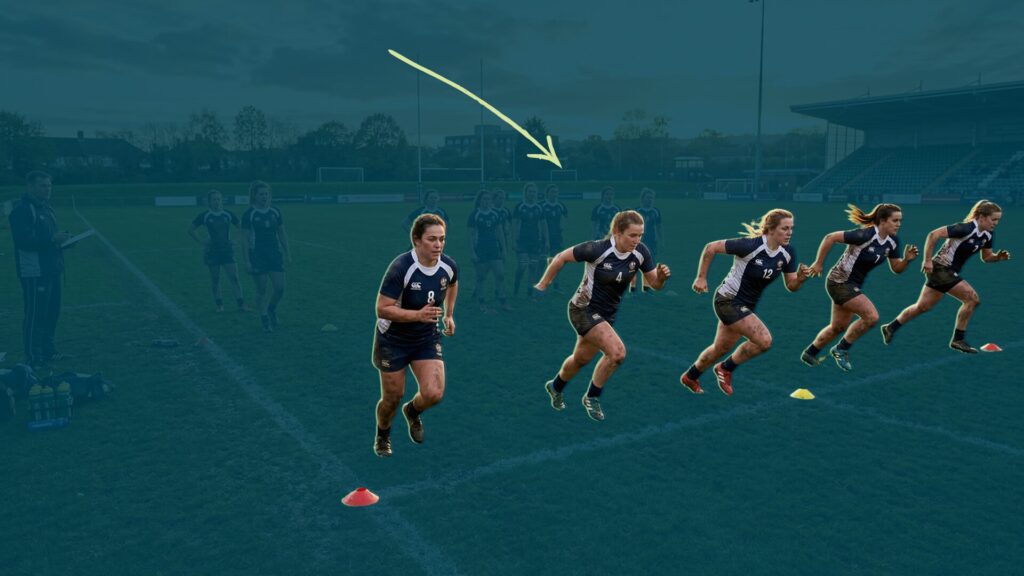
For example, in rugby, low level tactical work, skills performed at low intensities, technical contact work, and even cross training like wrestling, judo, or Brazilian jiu jitsu can all accumulate to the adaptation threshold. A sustained passing drill or a “box” in football might satisfy the physiological needs while also developing technical capabilities.
If the volumes of these drills are sufficient, 30 minutes of them is preferable to 30 minutes of low intensity cycling.
If you start to piece all these bits together and perform them with good intensity discipline, you can arrive at a decent dose of Zone 2 training.
Failing that, I would still prefer Zone 2 being a secondary outcome of other work rather than being the primary goal of the training. Wherever possible, create it within the context of other activities like skill or tactical work.
Tweet ThisIf I decide that dedicated Zone 2 training would benefit a player, I’d much rather they go walk the dog on a brisk hike through nature. Asking someone to sit on a bike for two hours after training is about as efficient as it is exciting.
@peteburridge
If not traditional Zone 2 work, how do you develop the aerobic system in your athletes? What principles guide your approach?
Volume is a key driver of central adaptations like improved cardiac output and increased VO2max, which is why extensive Zone 2 training has been a large part of endurance athletes’ programs for decades.
Knowing that you can’t achieve those kinds of volumes in team sports, you have to dial up the other side of the equation: intensity. Obviously, if you push intensity too much you won’t be able to sustain the work. But if you get it “just right,” you can get a potent stimulus in less time.
One of the best cues to get athletes to go at the right intensity is “go as hard as you can hold” while perhaps leaving just enough in the tank to “sprint for home” on the last rep.
This is one of the only times where being a last rep hero is permitted!
In order to put as much stress on the heart while maintaining some level of intensity, program negative work-to-rest ratios to keep the heart stressed during the rest periods.
This might look like 4 minutes:1 minute, or 60 seconds:20 seconds. I’ve gone as high as 8 minutes:2 minutes and down to 30 seconds:10 seconds. Either way, the rest is just enough to maintain the quality of work, without the heart rate dropping off too much in the rest periods. Then select the volume that tells you how many reps. Most development sessions in this area are 30-60 minutes long, 1-3 times per week.
Modalities should require larger blood demand to drive the heart response up. Whole body activities like swimming, assault bikes, rowing, or Sparc trainers are best. Running would obviously be great, too, but you’re likely going to want players to do this work off-feet in order to save your on-feet budget for sport specific training.
On-pitch training provides a full spectrum of intensities in a task-specific context. Getting this right is the most important thing when developing the aerobic system in team sports.
Tweet ThisThis might look like 4 minutes:1 minute, or 60 seconds:20 seconds. I’ve gone as high as 8 minutes:2 minutes and down to 30 seconds:10 seconds. Either way, the rest is just enough to maintain the quality of work, without the heart rate dropping off.
@peteburridge

Many Zone 2 advocates suggest it enhances recovery between high intensity efforts. Do you see evidence for this in team sport environments, or are there better ways to achieve that outcome?
It absolutely will do so. Sports like rugby are won or lost by a series of high intensity efforts. These efforts use the PCr system for energy, so sometimes it’s easy to think of just preparing athletes for those high intensity actions and the energy systems that feed these. But replenishing PCr is an oxygen dependent process. Athletes need a good aerobic base to be able to repeat these efforts. The centrally-driven aerobic system is the launchpad for those peripherally-driven high intensity efforts.
Put another way: in the highest intensity rugby games, the ball is in play for about 40 minutes of an 80-minute game. That leaves about half of the game for the players to get their breath back and recover.
Any work that enhances this recovery between bouts is going to be valuable. Zone 2 training is one method that can do this.
But, crucially, Zone 2 training isn’t the only kind of training that can produce the adaptations to recover from these high-intensity efforts. There are more efficient ways of getting there within the context of an average team sport’s training week.
Depending on your coach and their preparation philosophy, the players are probably getting a decent amount of Zone 2 work already in their technical training sessions.
Tweet ThisBut replenishing PCr is an oxygen dependent process. Athletes need a good aerobic base to be able to repeat these efforts. The centrally-driven aerobic system is the launchpad for those peripherally-driven high intensity efforts.
@peteburridge
Given that heart rate and lactate thresholds underpin most Zone 2 prescriptions, how do you assess or monitor aerobic development in team sport athletes without relying on those endurance-based measures?
Many fitness tests are available, but the ultimate answer to “Are the lads fit enough?” is the game. No running or off-feet test can tell you that. But they do leave clues to your answer.
Start with the subjective. What do the coaches say about the player? What does the player think about his own fitness levels?
Then move to the objective. What do his outputs (e.g., GPS data) look like? What is the internal cost (heart rate) of that output? How does this compare to the rest of the team’s data? Is there a gap between what they are capable of and the absolute demands of the game? If you have reference training sessions that are measurable—specific small sided games, linear running drills, or even off-feet sessions—how is the athlete performing in these?
These all provide clues pointing to a well-informed answer. They also support a “testing is training, training is testing” approach, wherein you get more regular checkpoints of someone’s fitness.
Then, if you still need more data to monitor or answer these questions, you can perform dedicated fitness tests to profile or assess targeted qualities. These could be maximal tests like the Bronco, or 1 km or 2 km time trials. But these are hard to perform regularly without interfering with the training, especially in football given fixture congestion. Submaximal fitness tests or monitoring resting HR or HRV might provide a less invasive and more repeatable measure to inform training decisions.
One way I’ve been able to demonstrate athletes’ aerobic progress is the heart rate trace and steepness of the drop during the rest period of 4 minutes:1 minute sessions. The steeper the drop, the greater their ability to recover, which usually implies a more efficient aerobic system. When athletes are achieving higher outputs in the work period but their HR is nosediving back into lower zones in the rest period, it’s a sign that a decent amount of adaptation has taken place.
Tweet ThisThen move to the objective. What do his outputs (e.g., GPS data) look like? What is the internal cost (heart rate) of that output? How does this compare to the team’s data? Is there a gap between what they are capable of and the match demands?
@peteburridge
If a practitioner wanted to integrate some Zone 2-style work into a weekly microcycle, what would be the most effective and least disruptive way to do it?
There are multiple ways to attack this. They could go for sessions early in the morning before breakfast, because it’s easier to layer other interventions like being fasted to augment adaptations. Or they could finish the day with it, using the blood flow in the lower intensity exercise to help speed up the recovery process for the next training day. That assumes that you are not layering on any extra mechanical stress by doing things like running. This is where water-based work like swimming really comes into its own by adding a recovery element to this work, too.
Be wary of the concurrent training effect of this work, and be smart about where athletes perform it amongst other training modalities.
This volume of low intensity exercise has the potential to wash out some of the body’s signals for strength or hypertrophy adaptations.
I’ve softened my stance from being a cell signalling pathway zealot. As long as there is enough time and sufficient protein, concurrent training does not have too large of an effect on overall training results. But be mindful of this if you’re looking to do this work for a sustained block of training with an athlete who might also need to build muscle mass.
During preseason, lower intensity days would be ideal for this work, e.g., Tuesday and Thursday during a high-low weekly format. In season, you might do it on MD+2 at the end of the day to help with recovery and get the lads a bit of a sweat on a day where they would have lots of meetings and want some movement to boost recovery.
Finally, one example that worked with an athlete who was deficient in this area was putting this work on the recovery days away from the training ground. He did things like walking his dog with a 10 kg vest rucking in the woods, surfing, or paddle boarding. It was way more fun for him and better for his social schedule. Thinking outside the norm for what we prescribe and taking a more holistic view of what we were trying to achieve contributed to far greater compliance over a longer period of time.
Tweet ThisThere are multiple ways to attack this. They could go for sessions early in the morning before breakfast. Or they could finish the day with it, using the blood flow to help speed up the recovery process for the next training day.
@peteburridge
What do you think the current Zone 2 conversation reveals about how we approach conditioning and recovery in team sports? Where do you think the focus should actually be?
I think it shows us that we aren’t immune to social media fads shifting our philosophies on how we prepare athletes.
Being able to think critically about how something can fit into the bigger picture of the program is key for coaches. For example, if I worked in endurance sports, Zone 2 training would barely be a thing because it would just be how we spent most of the training. But with team sport athletes, it’s something I do with some targeted interventions but do not emphasise very much because there is a lot more that I need to focus on.
In some form, Zone 2 training should be part of physical preparation in team sports. But we need to focus on getting the main things nailed on first. We should be focused on ensuring training is at the right intensity, with the right level of challenge, for our players to learn and develop both technically and physically, rather than worrying whether our supplemental work should be lower or higher intensity.
Yes, Zone 2 training can be effective. But it really isn’t as big of a deal as some people make it out to be. You’re likely doing a lot of it already anyway!
Smart manipulation of basic scientific principles like volume, intensity, frequency, density, and progressive overload will produce better results than one set training methodology or fitness trend. If we stay true to these principles, we will be able to make consistently better, informed training decisions. From there we can decide how the next fad or repackaged training methodology fits into our program. It all comes down to doing the basics well.
Tweet ThisSmart manipulation of basic scientific principles like volume, intensity, frequency, density, and progressive overload will produce better results than one set training methodology or fitness trend.
@peteburridge