Over recent years, there has been a greater demand from golfers to hit the ball further. A revolutionary approach highlighted how PGA Tour golfers who increased their drive distance by 20 yards should save 0.75 strokes per round [3], equating to three shots over a four day tournament. As Table 1 shows, Justin Thomas had a better scoring average than Kevin Na by 0.749 strokes. This resulted in him winning $2,911,171 more than Na over the 2021 tournament season, despite Na playing in three more events than Thomas. Essentially, 0.749 shots equates to a multimillion dollar difference in prize money for pro golfers.
| Justin Thomas | Kevin Na | Difference | |
| Scoring average | 69.773 | 70.522 | 0.749 |
| Prize money | $6,537,153 | $3,625,982 | $2,911,171 |
| Events played | 23 | 26 | 3 |
Clearly, the majority of golfers are not PGA Tour players, therefore increasing drive distance will not equate to large increases in their earnings. However, Broadie [3] emphasized that the lower a golfer’s skill level, the greater the advantage of gaining an extra 20 yards. The impact of longer drives increases exponentially among these golfers: three golfers, playing off handicaps of 8, 18 and 28 would gain 1.3, 1.6 and 2.3 strokes per round, respectively. Given this inherent, demonstrable value, a greater number of golfers are seeking strategies to maximize their drive distance. Unsurprisingly, then, more golfers are incorporating strength & conditioning into their weekly routine. However, poor information plagues the golf fitness industry when it comes to implementing S&C.
Movement screens: Forget the sand trap. Beware the specificity trap
Movement screens are incredibly common within golf. While there are anecdotal suggestions linking screens to movements in the swing, there is very little research to substantiate these claims.
One of the reasons why screening has become so popular is that a lot of the assessments look like the swing, and therefore are sold as being “golf specific.” However, selecting an assessment based solely on the visual resemblance to the sport is known as the specificity trap. When you delve into screening with a critical mind, you start to see the fundamental flaws. Let’s have a look at some examples of common screening tests and how they are often linked to the swing.
Tweet ThisMovement screens are incredibly common within golf. While there are anecdotal suggestions linking screens to movements in the swing, there is very little research to substantiate these claims
@JackWells009
Overhead squat: Complex movement, simplistic conclusions
The overhead squat is one of the flagship movement screens. Advocates suggest it has strong links to loss of posture, defined as a significant change in the body’s angles from set up.
For example, the Titleist Performance Institute [17] states:
“We have found several correlations between [the overhead squat] test and the golf swing. First of all, if a golfer is unable to perform a full deep squat with their heels on the ground, then it is almost impossible for them to maintain posture during the downswing.”
In fact, they go on to suggest that if you cannot perform an overhead squat, there is a 95% chance you will lose posture. If we fail to use our critical mind, we can fall into the trap of assuming that there is a mechanistic link between the overhead squat and loss of posture.
First, data supporting this contention has not been published in a peer reviewed journal. Second, this statement violates one of the most basic rules in statistics by suggesting that a correlation is a cause. Just because two variables relate does not mean that there is a mechanistic cause and effect relationship. For example, 91% of the golfers in one research study presented loss of posture within the swing [16]. But the overhead squat is incredibly hard to pass for anyone, golfer or not. A lot of golfers lose posture and they also can’t overhead squat. But now we’re told there is a link because a lot of people fall into the category of “I lose posture and I can’t overhead squat.”
Likewise, a lot of golfers lose posture but they also can’t complete a Rubik’s Cube within 30 seconds. If we follow the same logical fallacy and accept that a correlation is causative, shouldn’t we expect that completing a Rubik’s Cube in 30 seconds will lead to a reduction in loss of posture? Absolutely not. However, practitioners still mechanistically link loss of posture with a failed overhead squat.
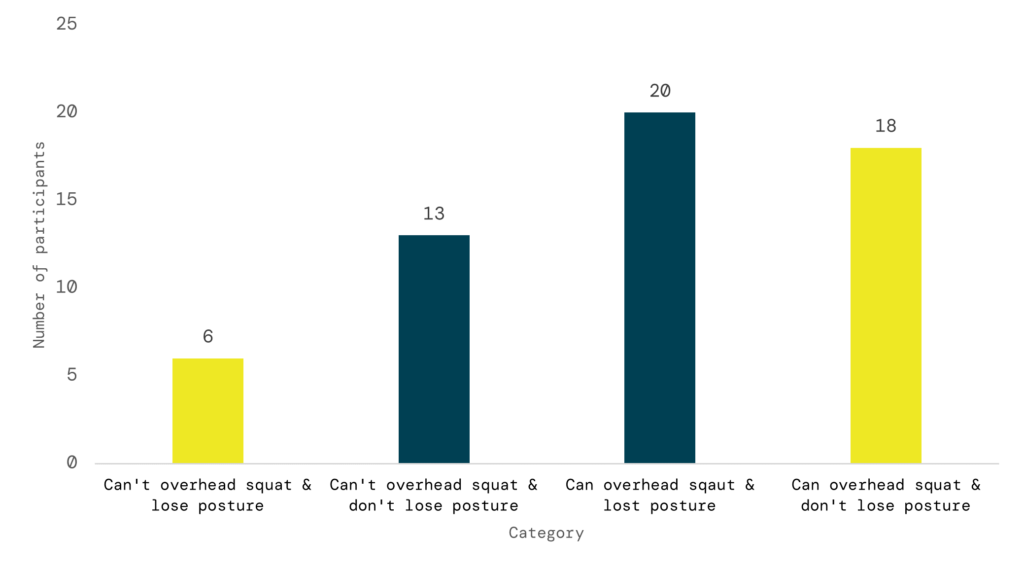
A growing body of evidence has started to shed light on these concerns. Through a mini-experiment (Wells, n.d), I assessed 57 highly skilled players (handicap <5) on their ability to perform an overhead squat and whether they had loss of posture in the swing. They broadly fell into four categories:
- Can’t overhead squat and loses posture.
- Can’t overhead squat and does not lose posture.
- Can overhead squat and loses posture.
- Can overhead squat and does not lose posture.
If we agree with the Titleist Performance Institute’s suggestion, we would expect that 95% of the participants would fall into categories one or four. However, Figure 1 highlights that 57% of the sample (i.e., 33 out of 57 golfers) don’t align with the suggestion that there is a link between loss of posture and the overhead squat.
The true test of any correlational research is an intervention. If we found that a physical intervention improved the overhead squat, which then transferred to a reduction in loss of posture, we would be able to form strong links between the two variables. However, Langdown et al. [11] found that a significant improvement in overhead squat performance following an eight week intervention did not result in any changes in swing kinematics.
The overhead squat is not linked to loss of posture in the swing, and therefore coaches should not be utilizing it to predict swing mechanics.
Tweet ThisThe overhead squat is not linked to loss of posture in the swing, and therefore coaches should not be utilizing it to predict swing mechanics
@JackWells009
Single leg balance: Are we looking at the same sport?
Before using any test, a practitioner should ask “Is this valid? Is this measuring what we think it is measuring?” In the case of a screening, we want to know if the test is a valid predictor of the movements in the swing. If the test is valid, we then want to know if the results are reliable: if we performed the test over multiple occasions, would we get consistent results? If neither criteria are met, then we shouldn’t be using the test(s).
Another nonsensical screening test used to predict movements in the swing is the single leg balance. The proposed idea is that if a golfer struggles to perform a single leg balance, they are more likely to present lateral movements of the pelvis, often termed sway or slide. Common sense should make us question why this would even be considered a valid predictor of movements in the swing.
The single leg balance is a static task, lasting 25 seconds, performed on one leg, with your eyes closed. The golf swing is a dynamic task, lasting about 1 second, performed on two legs, with the eyes open [8]. This supposedly “golf specific” test lacks any specificity.
From a more scientific perspective, in order to understand why someone moves in a particular way, we need to appreciate Newell’s model of constraints [14] (Figure 2).
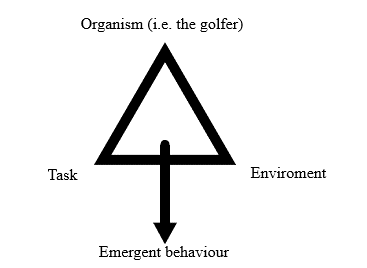
Newell’s model suggests that the golfer, the task and environment interact to cause an emergent behavior or movement. When we consider the task element of the model, the single leg balance uses ground reaction forces to try to stay as stable and stationary as possible. Within the golf swing, however, ground reaction forces interact within each leg to help a golfer move in a multitude of directions. We can’t use the single leg balance to help us understand why a golfer moves because they are completely different tasks. Research supports this perspective, as single leg balance was not a significant predictor of sway or slide within the swing [7].
All the single leg balance does is tell us how good the golfer is at balancing on one leg. It provides us with no insight as to why a golfer may move a particular way while golfing.
The single leg balance doesn’t get past first base in our basic requirements for employing a physical assessment. But, for fun, let’s assume it is a valid predictor of the swing. How does it perform when we assess its reliability?
A recent investigation compared the reliability of performing a single leg balance test with the eyes closed vs. the eyes open [9]. The eyes closed test was much less reliable than the eyes open test (varied by 9.2% and 3.1%, respectively). This means that if a golfer improved their single leg balance with their eyes closed by 8% – which is quite a lot – it could simply be due to the natural variability in this assessment.
For good reason, there is a direct relationship between a test’s reliability and the confidence we have in it. The more unreliable the test, the less confident we are that the results are “true.” When we consider the single leg balance, common sense and research tell us that it is neither valid nor reliable.
Hip rotation: Does a 6-iron look or move like a pelvis?
The ability to internally and externally rotate the hips is certainly important for golfers. A common test to assess rotations starts with placing a 6-iron on the floor against a flat surface. The Titleist Performance Institute uses a 6-iron because they suggest the average lie angle for this club is 60 degrees (in fact, it is actually 62 degrees, but never mind). The video below shows how to perform this test:
This is an average lie angle and can vary depending on how the club has been fitted to the player. For instance, custom fitters will change the specification of the club depending on the flight of the ball and the player’s anatomical profile. The lie angle can change by 3 degrees either side of baseline. If we take our average of 62 degrees, we will often see players using a lie angle ranging from 59-65 degrees. For instance, a taller player will typically (depending on the ball flight) have a shaft that is more upright, with the lie angle at 65 degrees. This can present a number of situations where there may or may not be a hip “limitation” (I use this word loosely).
Imagine that a golfer achieved 61 degrees of hip rotation, which this test considers a pass. Because the club has a lie angle of 65 degrees, the golfer has actually failed this test.
Another important issue with this test is the test-retest reliability. If you look at the bottom of your golf clubs, you will notice that your irons have a rounded surface. This means that when we set the club against a flat surface, it is very difficult to determine the assessment angle. If we are unable to accurately determine where we set the club, then are not able to accurately measure the angle the shaft creates. Due to the nature of assessing the physical ability based on the lie angle of a 6-iron, the process results in the player and the intervention becoming a slave to the club.
Anyone who has assessed their athletes’ hip mobility will recognize that the hip joint has much less internal rotation than external rotation. The aforementioned test with a 6-iron disregards this fundamental aspect of human anatomy and uses a benchmark of 60 degrees as a pass rate for both internal and external rotation. Players are being set up to fail. The negative connotation associated with these binary pass-fail tests sells sickness and can create a dependency on the trainer, neither of which is healthy for the golfer.
Tweet ThisThe negative connotation associated with binary pass-fail tests lke the lower quarter rotation test sells sickness and can create a dependency on the trainer, neither of which is healthy for the golfer
@JackWells009
Pelvic tilt assessment: Even if you could, so what?
Another common method of assessing golfers is to look at the position of the pelvis at address, typically when holding a 5-iron.
The pelvis can be in three broad positions: neutral, anterior tilt and posterior tilt. The Titleist Performance Institute believes that an anterior pelvic tilt can cause swing characteristics such as reverse spine angle (when the spine is pointing towards the target at the top of the backswing). The issue here is that practitioners can start to believe that a particular posture at address can force the golfer to move in a particular way. This, then, assumes that a golfer can’t adapt their swing around this physical feature, which is a poorly misguided suggestion. For example, the pelvis isn’t stuck or somehow fixed in that position. It can quite easily move through different ranges during the swing.
Like with the single leg balance, we should consider the reliability of measuring the pelvis. Assessing the tilt of the pelvis isn’t overly reliable, even among skilled clinicians [12]. If we assessed the position of the pelvis, we may think that it is anteriorly tilted when, in fact, it may be neutral. If we can’t reliably assess it, then the information we get is of no use to us.
But what about more scientific methods of assessing pelvic tilt? Previous research has assessed the reliability of measuring posture with 3D motion capture systems. Although most segments can be reliably assessed, the authors noted that measuring pelvic tilt was unreliable [6].
Not only are the field-based methods unreliable. The scientific methods are, too.
Let’s address the other burning question on the links between the position of the pelvis and the mechanics of the swing. If there was a mechanistic link between the position of the pelvis and the motion of the swing, then surely if we changed the position of the pelvis we would induce a change in the swing.
Bull [4] conducted an eight week intervention to assess the effects of myofascial release and activation exercises on “correcting” pelvis posture and the kinematics of the swing. Participants performed seven different exercises five times a week and were assessed before and after the intervention by a skilled physiotherapist and a 3D motion capture system. The headline findings were that “standing posture” improved, but there were no changes in pelvis kinematics during the entire swing. The author concluded that “The findings suggest that pelvic posture has little impact on swing kinematics” (Bull [4], p. 130).
Let’s step back and look at what has happened here:
- Organizations have sold us a message that the pelvis dictates movements of the swing.
- We use unreliable methods of assessing this and find that there is an “unwanted” tilt, which is itself an “issue.”
- An intervention consisting of 40 sessions (five sessions for eight weeks) is employed to address this “issue” [4]. That is a big time commitment for the player.
- The intervention has zero impact on the swing, which is what want to change, but it has changed standing posture.
Now imagine that you’re working with a high performing golfer who has placed their trust in you as a practitioner. If we adopt interventions such as these, you’re wasting their time.
Practitioners have a responsibility to critically assess the assessments
As practitioners, we need to think critically and deeper about the decisions we make when physically profiling the golfer. Research and basic common sense converge to demonstrate that screening does not robustly link to movements in the swing.
Even more worrying is that there are now phone apps that attempt to predict movements in the swing based on the results of a movement screen. On one hand, this may sound very appealing to the practitioner because predicting the future is something that not many humans are able to do. However, the fundamental flaw in this prediction is that it assumes that a physical limitation will directly cause a particular movement in the swing. This ignores one of the most important aspects of the swing: intent, that is, what is the golfer trying to do and what is the golfer’s understanding of how they should move in the swing?
Most good golfers have videos of their swing on their phone. If you really want a phone-based assessment, you can simply look a video of the swing yourself rather than trying to predict the movements via an app.
Additionally, a physical screen isn’t just a measurement of physical capacity. It is also a measure of skill. For instance, if a golfer hasn’t performed an overhead squat before, they will probably struggle with the test because they don’t know how to squat properly.
Using screening to predict movements in the swing is a dangerous leap of faith and is more akin to reading tarot cards. Your prediction may find a “link,” but it’s not mechanistic. It’s a spurious relationship that often leads to the application of a poor physical intervention.