Even high-performance athletes have low-performance influences. Family members, agents, school coaches, friends, “this guy that started showing me a few things at the gym, he said he’s a trainer” – some well-meaning, some overbearing, many or most truly clueless. And then there’s the other way they answer our patience-at-the-breaking-point “What made you think that was a good idea?” “Saw it on Insta.”
Now turn it 180. After a gym session or a week of following your nutritional advice, your athlete asks you “Where did you get that idea from?” Be honest. Was it from @ProfessorSpikes’ Twitter thread or @TrainHardEatHard_Strength_Coach’s epic Instagram Reel? Will you level with your athletes and admit to some low-performance influences of your own?
Hammer thrower Kevin Becker didn’t have to worry about his coaches writing programs 60-seconds or 280 characters at a time. Becker competed in one of his two USA Track & Field Olympic Trials before Kim Kardashian opened her Twitter account in 2009, and had several national championship appearances before Instagram launched in 2010. “My understanding is that most of my coach’s ideas were from mentors and previous coaches in their network. My throws coach trained off and on with Jud Logan for many years, and many of his ideas were from his interactions with Jud. He was also active in attending NSCA events and did a lot of reading from people like Charles Poliquin,” Becker says, looking back.
Sports performance practitioners almost all say theirs is evidence-based practice. The unasked question lurking in that phrase is, what constitutes valid evidence? Peer-reviewed RCT? Case study from a pro team? Article in Sportsmith? Saw it on social, and, if so, how many followers does the account have?
Tweet ThisSports performance practitioners almost all say theirs is evidence-based practice. The unasked question is, what constitutes valid evidence? Peer-reviewed RCT? Saw it on social, and, if so, how many followers does the account have?
George Perry
Sports’ researchers are as vulnerable to social media as practitioners
Sports and human performance are fertile grounds for having a social media presence that far outstrips actual professional accomplishments. These are highly visible, extremely sexy fields with high demand, high status jobs that offer proximity to fame and celebrity in the form of individual athletes and beloved teams. The work lends itself to punchy threads and short videos with captions implying – or flat-out stating – the viewer is getting a taste of the secret sauce that makes the poster such a winner, or a magnet for winners, as exemplified by the next post in the feed showing the practitioner with one of his or her marquee (or simply hot) athletes.
These individuals become niche celebrities, famous-for-being-Twitter-famous at a scale and on a time frame over which they would never be respected-for-being-accomplished.
This is not just the case for practitioners, but for research scientists, as well. Where a physio posts 10-second rehab-workout videos (with no context of the injury or progression), the scientist tweets the acceptance letter for their most recent article (but not a link to the preprint or data). While the nutritionist is talking up their post-workout supplement regimen, the scientist posts a picture of themselves on stage giving a keynote speech (but not a link to the video). Just as the S&C coach tags pro athletes in his Insta bio so you know that he coached them, the scientist verifies his H-Index is up to date in his Twitter and LinkedIn bio.
While sports has some unique exacerbating features, many scientific and academic fields experience this phenomenon. And what do scientists do with observable, repeatable phenomena? No, they don’t tweet about it. They quantify, publish and refine it.
Applying the Kardashian Index to sports and human performance academics
The Kardashian Index is a “measure of discrepant social media profile for scientists.” While it seems custom built for the sports and human performance fields, the K-Index originated in the journal Genome Biology. The article has been cited over 125 times, with articles analyzing the K-Index or the Modified K-Index (MK-Index) for researchers in such diverse and – in the context of taking scientific or clinical advice from Twitter – sometimes disturbing fields as cardiology, electrophysiology, hepatopancreatobiliaric surgery, interventional and neuro-radiology, dentistry and urogynecology.
Ebrahim’s MK-Index refined the formula so the citation input can be Google Scholar citations, making the data freely accessible.
MK-index = F(a) / 43.3 (5.961 + 0.460CGs)0.32
F(a) is the researcher’s number of Twitter followers and CGs is their number of Google Scholar citations.
In his conclusion, Neil Hall exhorts his colleagues: “If your K-index gets above 5, then it’s time to get off Twitter and write those papers.”
5?! Maybe in genomic biology, but in sports and human performance…
Separating the impact from the influence
Data collection started by me thinking of researchers in the sports and human performance fields: those that I know, others that I’ve read enough articles from that they came to mind, Sportsmith contributors and EGOals contributors. As I looked up their Google Scholar citations or Twitter followers, I’d click on their frequent co-authors that Google Scholar lists or Twitter’s “You might like” recommendations. Rob added a few names of his own, which led to a few more recommended names, and easily enough we reached 86 researchers.
We wanted to avoid unfairly calling someone a “Kardashian” when, in fact, they are a career-long practitioner who co-authored a few articles, therefore giving them a low number of citations. We did our best to include only true researchers, acknowledging that some will shuttle between academia and practice, or do both simultaneously. However, to be on the safe side, we removed the bottom decile of Google Scholar citations. That set the floor at 789 citations.
Figure 1 plots the z-score of Google Scholar citations against the z-score of Twitter followers. We see that the Kardashians are, in fact, a relatively exclusive club. Over half of the researchers are in quadrant 3.
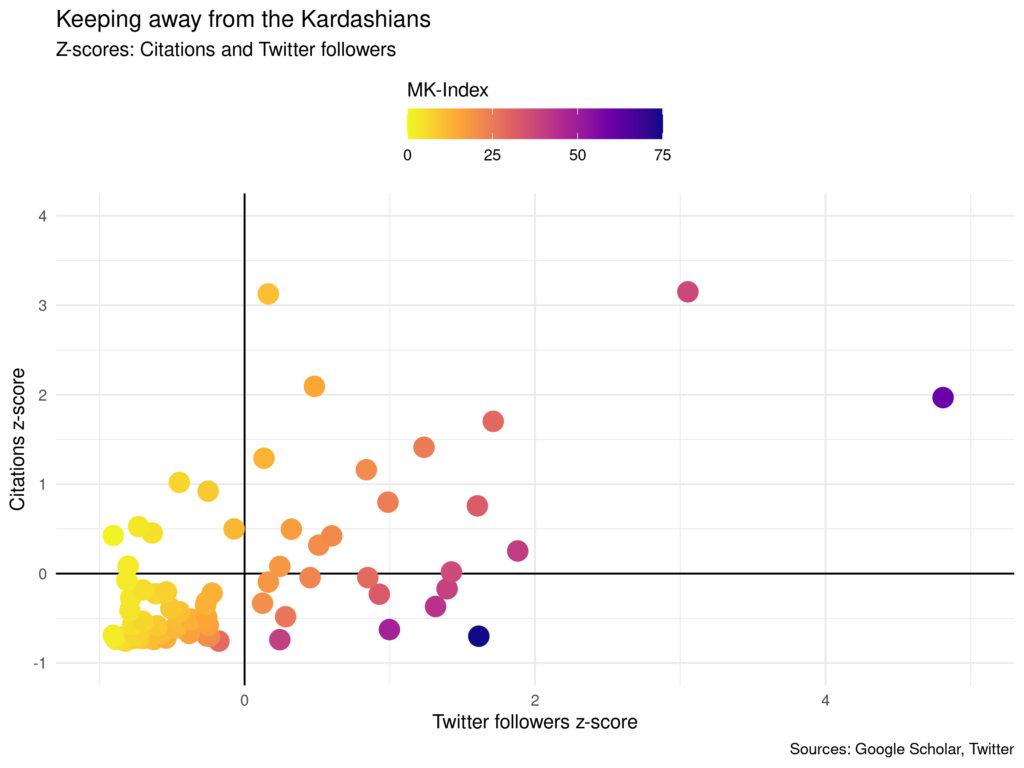
Quadrant 4 holds the anti-Kardashians, not famous when perhaps they should be. They’re not slouches on social media: seven of the eight have over 1,000 followers, and three have more Twitter followers than the median of our sample. But none have more than the mean of our sample. That’s the Kardashian skew.
But what makes a true Kardashian of sports and human performance? An MK-Index above some threshold, being in quadrant 2 or a combination?
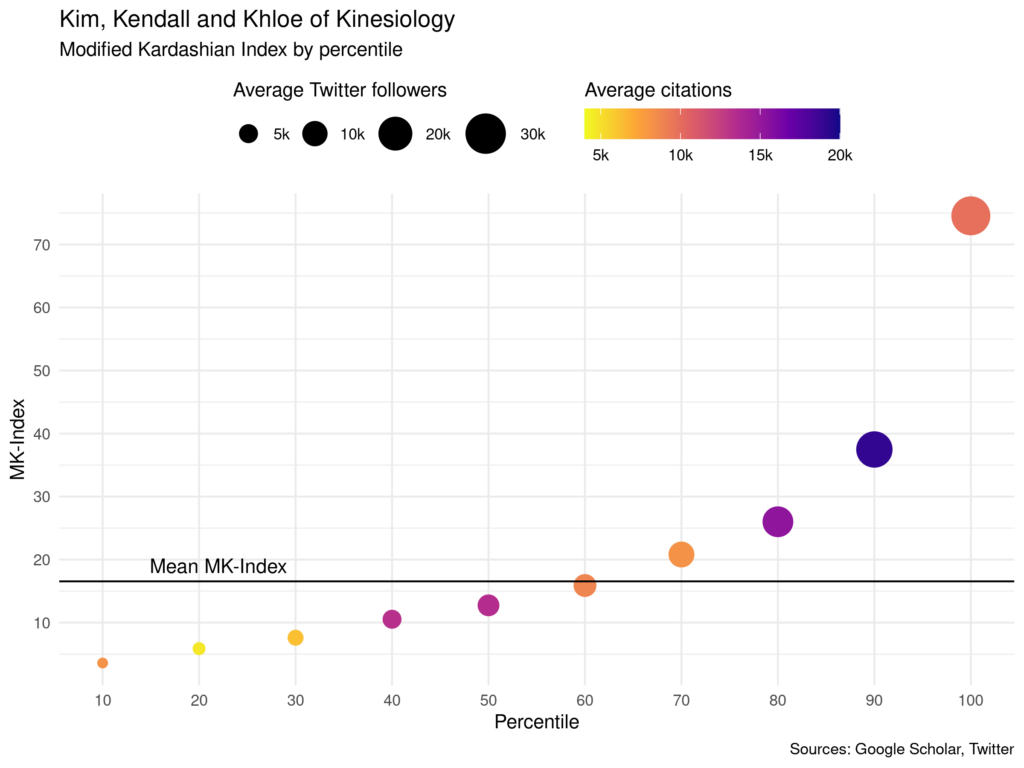
Five of the seven researchers in the top decile of MK-Index are “underwater” with their z-scores. Similarly, in Figure 2 we see the MK-Index taking off exponentially in the top decile, while these reserarchers’ citations drop into the range of their less “influential” peers. If anyone has a claim to being the Kim, Kendall, Kylie, Kourtney and Khloe of kinesiology, it’s them.
Caveats for the MK-Index and the sports industry
The Kardashian Index has a few shortcomings relevant to sports and human performance.
First, it only considers Twitter. Twitter is great for academics because it allows links within posts; threads that can read as a monologue where each post in the thread has its own link, image or video; and, across all fields, it’s where the Very Smart People go to showcase their Very Smartness.
But sports is very visual, much more so than almost any other academic field. And not just visual, but video. While a picture is worth a mere 1,000 words, a workout video of agility drills is worth 1000x the engagement of a research paper on change of direction deficit. This makes Instagram a more salient destination for anyone susceptible to creating or consuming quick, contextless S&C, fitness or nutritional content.
And if the video just happens to feature a six-pack and marble-sculpted glutes, well that just shows how effective the training intervention was. Right?
The influence of Insta-fluencers on our industry is a much higher concern among Sportsmith’s followers. 74% of respondents to our Twitter poll and 85% of respondents to our Instagram poll rated Instagram influencers the “biggest source of bad information for sports performance practitioners.” Twitter gurus were a distant second with 21% and 7%, respectively.
Tweet This74% of respondents to our Twitter poll and 85% of respondents to our Instagram poll rated Instagram influencers the “biggest source of bad information for sports performance practitioners.”
George Perry
Those influencers, though, are probably not researchers. Some may be coaches or other practitioners, but many are just influencers, true Kardashians. Troublesome, if they are a resource for people who actually work with athletes, but almost certainly mutually exclusive with researchers with a high (Twitter-based) MK-Index. For now.
The second shortcoming underlies part of what we just said. Sports has many more part-time, volunteer and side gig practitioners than the other fields that have shown up in the Kardashian Index literature. You can’t take an 8-week online course and be certified to practice neuroradiology by some alphabet soup accreditation agency. There aren’t any high school algebra teachers who part-time afternoons and weekends as the neighborhood hepatopancreatobiliaric surgeon (if I’m wrong, and there are, please let me know, because that would be a fascinating conversation).
Reading peer-reviewed research and engaging with academics is not necessary for every practitioner, nor is it reasonable nor appropriate to hold every practitioner to that standard. But it’s necessary to hold some to that standard. The high school algebra teacher who doubles as the football team’s S&C coach and the first-team fitness coach for a professional team have different minimal levels of self-motivated education. The former can justifiably see a site like Sportsmith as the ceiling, whereas the latter should view us as the (very high) floor.
Some researchers with a high MK-Index may be more effective at communicating further down the pyramid than others. Broad appeal is not necessarily a bad thing, especially if it helps close the gap between researchers and practitioners.
But can a Twitter thread actually communicate scientific findings, with all the uncertainties, caveats, nuances and dynamism that comprise each individual contribution to the literature? Or does the format of social media bestow certainty and finality on any statement, in direct opposition to the scientific process?
More vs. better: Information marketplace for sports performance
While Kevin Becker was spinning in circles in the hammer cage at the 2010 USA Track & Field National Championships, Jared Porter was doing the rounds talking to long jumpers, javelin throwers, decathletes and all forms of runners.
Porter and his colleagues were investigating the cues (internal vs. external focus of attention) and feedback (knowledge of performance vs. knowledge of results) that athletes competing at the USA Track & Field National Championships received from their coaches. They found that the overwhelming majority of messages from coach to athletes reinforced an internal focus of attention, which contradicted a large body of research across all sports. This highlighted for them “a lack of connection between what the scientific literature recommends and what experienced coaches are doing in practice when working with elite athletes.” Obviously, the next question they asked was, “why [are] coaches providing instructions and feedback that contradict the scientific literature?”
Rather than indict the coaches for knowingly contradicting strong scientific evidence, Porter et al concluded that the coaches simply were not aware of the large corpus of research on external focus of attention. They attributed this partly to the relative lack of interest in motor learning by the coaching profession, but mainly to the failure of professional education to include motor learning alongside other pillars of coaching practice (e.g., biomechanics, psychology, exercise physiology). Should coaches be expected to know things if the organizations charged with teaching them ignored entire areas of study?
The information marketplace has changed significantly since then. Social media gives academics the means to communicate directly with peers and practitioners, sharing their work, engaging in productive dialogue, creating multimedia avenues to make their findings accessible and directing people to useful resources.
“I’m not super optimistic about how social media and the scientific community can come together to be unified,” says Porter, now an associate professor of motor learning at the University of Tennessee. “By design, they serve very different functions. Research and science has a long memory, where social media has amnesia. At best, short-term memory.”
“The fundamental framework of social media is designed to be fast and not have a lot of intent. It’s good for crowd-sourcing – put it out there into the cosmos and let the community decides what’s good. Whereas the scientific peer review process is about being very intentional in our work, which experts then review and accept or reject it. They’re just at complete odds with each other.”
“I lean into the idea of them being co-equal but independent, like checks and balances on each other.”
Nicol van Dyk, Medical Research Lead at the Irish Rugby Football Union, thinks “There can be value in social media, but I have yet to see it better the current practice we have, which is itself terrible. We desperately need to reform our scientific publication process, including peer review and journal paywalls. But this is not the answer.
“The social media conversation is populism, with the most popular opinion winning – not necessarily the most truthful. Contrarian statements being more clickbait friendly, they often get ‘distributed’ more easily.”
Tweet This“The social media conversation is populism, with the most popular opinion winning – not necessarily the most truthful. Contrarian statements being more clickbait friendly, they often get ‘distributed’ more easily.”
@nicolvandyk
Jonathon Weakley of the Australian Catholic University takes a more positive view. “Social media has had a net positive effect on how researchers interact with each other and with practitioners,” Weakley said. “It helps removes barriers between researchers from different institutes and countries, and researchers and practitioners. My career has been substantially influenced by social media, as it has helped make connections with industry. And I have developed close friendships with other academics I wouldn’t have met unless I had been able to reach out to them about their research.”
Even so, he acknowledges the need for complementarity and guardrails.
“It’s important to remember why scientific journals are available. They are for high quality scientific evidence. Therefore, I would be concerned if researchers started taking ideas from social media or blogs and trying to submit those concepts as scientific manuscripts. However, I strongly believe that basing blogs or Twitter threads off excellent research should be promoted. This helps keep the Karadashian index in check, as it helps promote their research (the denominator) while enhancing the researcher’s attention (numerator).
“We should note, though, there is a lot of noise with social media and research nowadays. Therefore, some guardrails:
- Tweets are rarely accurate depictions of a nuanced conversation.
- People who tweet a lot are rarely experts on a topic. This is because they spend their time tweeting rather than developing their craft.
- Because it is in an academic journal, it doesn’t mean that it is fact or ‘good science.’ With journals such as MDPI & Frontiers nowadays, so much rubbish is getting accepted that almost any statement can be supported, no matter how outlandish the claim.”
Becker sympathizes with all parties because he has been on every side of the issue. While competing, he earned his Master’s and Ph.D. in kinesiology, with an emphasis on motor learning and behavior. In 2014 he joined the faculty at Texas Women’s University, where he is currently an associate professor.
“The explosion of social media and YouTube have been a great thing for the sharing of information in sport and coaching. In the hammer throw there have been large improvements in both the top performances and the depth of the field in the US. I think a large part of this is the increase in knowledge about the event freely shared online. One danger of having all this information freely available is there is no peer-review process. There is great information available, but there is also no shortage of bad information.
“I think the difficult thing for coaches is sometimes knowing where to go for scientific coaching and training recommendations. Academic journals are often inaccessible and not written for a practitioner audience. Social media is filled with information, but you have to be able to filter through the good, bad, and ugly. From the academic side, we need to do a better job of disseminating useful information to coaches,” he said.
Professional pressures to court social media influence
Part of Neil Hall’s motivation in developing the Kardashian Index was sensing a trend in his field of genomic research that keynote addresses and other markers of scientific repute were not just the age-old mix of achievement and political maneuvering, but now reflected viral clout and popularity, even within the context of a niche field like his own. “I was recently involved in a discussion where it was suggested that someone should be invited to speak at a meeting ‘because they will tweet about it and more people will come,'” he wrote in 2014.
Weakley says he has “felt pressure to build my scientific brand. However, I have done my best to let my ‘brand grow organically’ and only share social media posts when I have something important to say e.g., share research, reach out to genuinely develop a relationship or ask a question, if I’ve been asked to give my (brief) opinion.”
But he can’t help noticing that some “researchers / practitioners are shameless in their approach. For example, they may tweet about the same paper 4-5 times. I recently saw a researcher tweet about an umbrella review at every stage of the publication process (it was in PLoSOne so they paid to get it accepted!). Several of these tweets didn’t even link to the paper, so it was purely for their ego rather than for the benefit of the community.”
Porter has “fortunately never felt pressure from any bosses or students to have a larger brand or presence. Students will say all the time, ‘Dr. Porter, you need a podcast or a YouTube channel!’ I barely have time to eat lunch, let alone time to do these other things. I don’t know how they make me a better scientist or teacher, or be in service to students, the university and the community.”
Particularly for public institutions, though, the community is the shadow stakeholder in this conversation. While Twitter, Facebook and Instagram may not be the places for scientific conversation amongst researchers or between researchers and practitioners, those platforms could be ideal for sharing what the university is doing with the public’s money and under a public charter; or for the administrators charged with increasing student and faculty recruitment, publicity and donations.
“It’s marketing, and it is important. But please don’t confuse this with scientific rigour,” van Dyk implores. “The idea of a ‘scientific brand’ is a red herring. Do good work. The rest will follow.”
Researchers and practitioners share responsibility for information supply and demand
Closing the gap between academics and practitioners has been one of the recurring topics of my conversations with Jared Porter over the last few years. Tellingly, until I started working on this article, neither of us ever mentioned social media.
Porter encourages coaches to be part of the research process, not by joining or partnering with an academic lab (although he certainly welcomes that) but by integrating the scientific process of hypothesis formation, testing, recording and reporting part of their coaching practice. To him, an n = 1 case study has its place just as much as a double-blind RCT.
Becker takes a similar stance. “As an athlete I accepted the results of research at face value. As a researcher, I am much more skeptical and critical of methodology and whether or not the results can be replicated. I also recognize that research labs aren’t going to give coaches all the answers. Good coaches can be some of our best applied researchers. They have a living experiment every day at practice and can test how things actually work in the real environment.”
That’s just the kind of rational, clear-eyed, science- and athlete-centric perspective that will get you absolutely dragged on Twitter.
“As a group, we have been prone to the general pitfalls of social media, where trolling, shaming, and bitter, personal vendettas have taken away from the positives,” Nicol van Dyk says.
“We released a paper in a lower quality journal about implementing a prevention programme in a club. Although methodologically not perfect (since the study is performed in a real world environment), it had some interesting points of discussion. This got absolutely destroyed on Twitter by a well-known professor – like a six-tweet thread. The doctor that was brave enough to publish this is sharing his practice and experience with the world. And because it doesn’t fit neatly in an academic package, it is dismissed on social media by a prominent figure. Therefore, lots of folks just believed it’s not worth reading. THAT is more often what’s happening, unfortunately.”
“Measure the absurdity by looking at the inverse”
Porter finds that in many situations, a complete 180 is the most useful counterfactual. When I asked him if social media could provide a productive venue for scientific conversations, constructive criticisms or crowd-sourced informal reviews, he proposed the opposite. “If you went to a scientific setting using a social media strategy, you’d get destroyed. There’s such a difference in philosophy. People go to social media to find something that supports their view – you go to science to reject ideas, not support ideas. You go on social media to find any crazy idea you want – but you can’t test it, you can’t apply the process
Van Dyk similarly scoffs at my suggestion that there could be a “conversation” worthy of science taking place in the Twitterverse.
“Social media is fast. That is what society now values, but it isn’t better. I believe often we should take time, read papers carefully, think deeply about what they mean, and then, and only then, respond if you feel it is absolutely necessary.
“But this is the slippery slope we’re on. There are no more curators. How do you know the persons listening are the same persons you want to influence? If we’re having the scientific argument, is this ‘thread’ and the followers that engaged representative of the group? How could you possibly know?”
“Good ideas can come from anywhere, including Twitter. And one might argue that social media is a nice way to run quick ‘polls’ to test the water. But I disagree. Even blogs are rated on likeability, or popularity, not whether they are doing good work or not!”
Even the voice of positivity, Jonathon Weakley, says it’s “questionable whether there is ‘critical conversation.’ It’s probably more accurate to state that there is ‘conversation!'”
Sports performance means nothing if we lose sight of the athletes
Incidents like the one Nicol van Dyk described prop open the gap between academics and practitioners, deprive practitioners of practical field-based findings and discourage practitioners from doing their own research at the track or in the gym. Athletes pay the price for coaches acting under the influence of low quality information, whether that information is the latest idiocy on Twitter or the unchallenged idiocy of “how we’ve always done it.”
“In my interactions with several coaches over the last 20 years, I’ve seen a range of things,” athlete turned student turned professor Kevin Becker says. “Some coaches are lifelong learners who are always looking for something new to improve their craft, and others coach their athletes the exact way they were coached as an athlete. Of course, there is a continuum between these extremes.”
“A major issue I see for coaches is maintaining the trust of their athletes,”
“With so much information available, it becomes easy for athletes to question why their coach is doing it differently from another coach or athlete with a big social media following. If athletes are doubting and questioning their coach’s approach this makes it difficult to be successful even with the best coaching. I think where researchers can help is by expanding the platform of practitioner-focused publications and presentations. We are often guilty of not doing a good enough job of explaining to practitioners what our research means and how they can use it.”
To that end, maybe he’ll up his Twitter game. His last tweet was on April 7, 2015. “I never really latched on to Twitter that much and often forgot I even had an account. In general, my social media usage has always been more about throwing than research. I suppose it wouldn’t be a bad idea to bring those two things together more.”
Scientific and interpersonal impact: long-term investment, long-term rewards
When he takes up his next professorship in August, a single tweet will make Kevin Becker more Twit-fluential than one of his new colleagues. Twelve years after crossing paths at the USA National Championships, Becker will work down the hall from Jared Porter (MK-Index = 0) at the University of Tennessee’s Department of Kinesiology.
Jared Porter’s had a few brushes with scientific virality, despite deleting his Twitter account after a few years and a few tweets in the early 2010s. “I’ve published a couple papers that somehow gain traction on social media. For 72 hours my emails and phone blow up, everyone reaches out, then after that it’s dead silence.”
“The temptation is not there to go after the quick hit of dopamine. Most meaningful interactions are due to the long trail of work. I’ve done interviews and podcasts that are quick hits, but nothing meaningful come up of it. Body of work, not popular on Twitter.”
Porter’s inclusion in this article is evidence that his philosophy works (if being interviewed for a Sportsmith article is a sign of things going right in one’s career). I first reached out to him several years ago after reading some of his articles on motor learning, including the 2010 study mentioned above. His body of work pointed towards a few things I was trying to do better with my athletes, with the added bonus that he had a peer-reviewed study that validated my priors about elite track & field coaches in the US.
“If I do good work, if I mentor my students as best as I can, write grants and bring in funding as best I can, put that work out there, over time, the good, the valid, the reliable bubbles up.”
That attitude combined with his non-existent Kardashian Index means he’ll probably never be famous. But at least no one will ever accuse him of being famous for being famous.