
The following is an excerpt from our book EGOals: Exercising Your Ego in High-Performance Environments. The sections in italics are quotes from some of the 110 sports performance practitioners Martin interviewed. For most of the book, we attribute the quotes. But for the chapter these come from, “Chapter 3: Ego F***-ups,” we took out everyone’s names. You’ll quickly see why.
Like so much else in this chapter and in this book, it’s easy to chuckle smugly at our contributors’ stories and say “I would never do that, and as a leader I would never allow it to happen.” You know who else said that? Just about everyone who found their way into the chapter.
@TrainingRoomEgo: It’s not #narcissism, I’m building my #brand!
Social media provides sports performance practitioners with two ego temptations. First, they can put themselves where they don’t belong: in the center of things. Pictures from the training ground or – worse – post-game celebrations let practitioners poach some of the team’s and players’ popularity. If we wanted to be on camera, we either chose the wrong line of work or we’re doing it for the wrong reasons.
Second, a single social media post can get more engagement than a practitioner’s entire corpus on ResearchGate. Will the fans liking, faving and retweeting actually remember who that practitioner is, or care about what they do? Probably not. Is that what your years of school, continuing education, self-study, 18-hour days, trials and lots of errors were building towards? No, but look at all those retweets!
A colleague of mine used to retweet / report on Instagram every single picture where he would appear with players and staff. The moments were also always well-chosen: the better the match results and the more significant a victory would be, the greater the number of pictures of him working with the team he would post. When we won the title he even added pictures and montages that he took himself. The best was that he even added TV screenshots where you could see him… imagine the work for that. Funnily, however, he never posted pictures of himself with the team or players after defeats.
Tweet ThisI like when people quote themselves on a tweet/post. I understand they are trying to promote their ideas, but ideally you would like people to quote you, right?
Anonymous
It was the day before the cup final. All the staff from the department were congratulating each other on LinkedIn, posting group photos and saying how proud they were to be working together. “I’m not used to writing things on social media, but I am so proud of what we achieved,” wrote the head of the department. Likes, re-posts, shares everywhere. The next day, we lost. Their LinkedIn accounts have remained silent since.
I have an ex-colleague who was very active on social media as long as he was working with us. Pictures of him on the pitch, video of his work laughing with players… Now he works in a smaller club and surprisingly his account has remained inactive since.
How to increase your number of followers? Just add pictures of you treating or training players on Instagram. A staff member gained >2,000 Instagram followers in a few days with a couple of pics!
You see many people, when they want to say happy birthday to a famous player, they put a picture of them with him as a way to show that worked with him.

I like when people retweet/repost/like their own content, or even better when they quote themselves on a tweet/post. I understand they are trying to promote their ideas, but ideally you would like people to quote you, right? There may be a way to tell what you have to say without the need to post a picture of you, and quoting yourself on that same picture?
It’s incredible the number of people you see who just tweet a copy of the acceptance letter of their last paper – without adding any content. What is this for? Since they don’t share anything to the community, it’s just about stroking their own ego, no?
During the COVID-19 crisis, I have been astounded by the sell that Dr. Henrik Petersen has made of his position and book. It is a daily social media bombardment and self-righteousness that has propelled him to new levels of arrogance and egotistical behaviour. This may sound surprising, as I’m sure you know him. However, I’m sorry to say that he has very little impact on the team at ground level and presents a mirage on the outside to demonstrate his effectiveness.

This is possibly not at f***-up levels yet, but he seems to be completely unaware that the more he promotes himself and his book during the absolute crisis when players and coaching staff are looking at redundancy, the more respect he is losing from his colleagues on the ground. He has not visibly coached anybody in his position since he started, bar a few speed sessions with the national team squad! He had zero impact on the national team in preparation for the World Cup, and when he visited the competition camp, he wasn’t even staying in the team hotel! He just travelled to say that he was there.
Insisting on the need to run outdoors with a star who was in a return to play situation when it was not his duty, arguing about the confidence the player has in him. I said no problem and, at first, I did not realize why he was so keen on asking that. Then someone showed me the photographers eagerly shooting the player’s first steps after a long injury.
Tweet ThisIt’s incredible the number of people you see who just tweet a copy of the acceptance letter of their last paper – without adding any content. What is this for? It’s just about stroking their own ego
Anonymous
This year most of the pre-season sessions were open to the media. The head of performance then decided to move the whole gym outdoors and he said he was happy to be more hands on this season.
It’s not just the pictures. Take the job titles in elite sports. It’s become a circus. There’s plenty of confusion about the actual roles of those performance professionals, i.e., which domains are they really in charge of, who do they manage and what level of contact with the athletes do they have (operational vs strategic planning). To add to the confusion, there is little, if any, consensus about those titles. They are often self-given, so that there are (almost) as many job titles as practitioners and structures; and there are large variations in actual roles across people with the same job title!
The lack of a clear framework (Buchheit 2019) has allowed anybody to become somebody – or at least make other people believe they’re somebody “important” or “consequential.” Everybody now is “Head of High Performance” or “High Performance Manager,” and it nicely feeds their egos. People chase the title, rather the job itself.
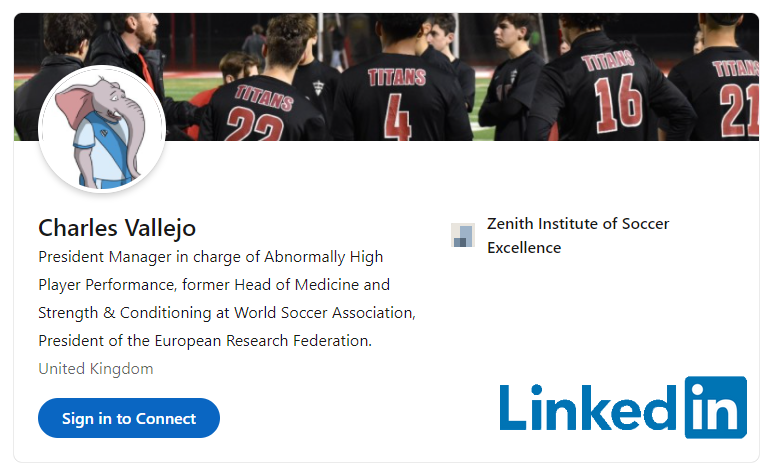
The truth is that performance is about winning or losing, so those “prestige” titles should be reserved for the coaches, not for supporting staff. But who wants to hear that?
“Performance engineer / architect” or just the title inflation where people who are fitness coaches are now “high performance managers,” but have no skill in management or leadership.
Now with the omnipresence of social media, it’s like you have to have an account to post videos and photos of you working with athletes to be perceived as a true professional. When a new head physio was appointed to the club last year, I was surprised – but it’s a fact- that we all checked his Instagram account when we heard about his signing. When we saw that he had more followers than most of us combined, even though we hadn’t met him yet, it pushed us to implicitly feel that he was competent!!??
I have witnessed many practitioners who, as soon as they are appointed to a now role, the first thing they do is add their new title to their Twitter profile. Most of the time I bet that the organization doesn’t even know it, and if they were to ask they would probably not be allowed to do so. I also like the people mentioning their previous role in their profile, especially if now they hold a position in a less prestigious club.
One day I received an email from a tech company. They were selling new products on the back of a few experts in the field. One of them had worked at the club a few years ago, in a field operating type of position. In the email, he was introduced as the head of one of the departments in my club and another where he never worked, and his job description was, in fact, an exact copy-paste of mine from my LinkedIn profile.
Social media is a lot like ego. At its best, it communicates who you are, and how you view yourself and those around you. It can help you gain recognition from your peers; lead you into conversations and relationships you otherwise wouldn’t have; and help promote your career.
But how often is social media at its best? Even less than ego, we’d say.
EGOals: Exercising Your Ego in High-Performance Environments by Martin Buchheit and George Perry is available on Amazon. Follow @egoalsbook on Instagram and visit egoalsbook.com.