

Original article written by Mark Burnley, Shawn Bearden and Andrew Jones
Background
Polarized training is an endurance-training model that emphasizes the distribution of low and high intensity exercise respectively to manage the building of fitness, whilst managing fatigue over time[1,2].
- Most of the training (approximately 80%) occurs at low intensity (in zone 1 below) that is below the first lactate threshold.
- Approximately 20% at high intensity, which is above the second lactate threshold. Note critical speed is not measured in this protocol but sit at the low end of zone 3.
- With relatively little training in the moderate intensity, zone 2.
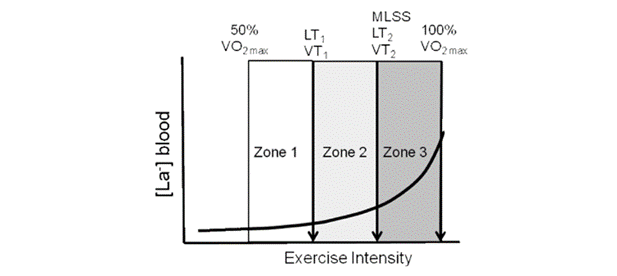
Endurance athletes, herein will refer to middle-long distance events (>5 mins,[3,4]. Where these athletes training model has a large emphasis on intensity zones below VO2max[5,6], the focus of this ‘polarized training model’.
What the authors did
Polarized training has gained widespread traction as the ‘optimal’ way to train endurance athletes[1,2]. The authors tested this assumption, by reviewing the published and applied evidence for this claim.
This paper[1] is part two of a point-counterpoint series (In part 1, the case for polarized training is made[6]).
What the authors found
Elite athletes rarely perform polarized training and there is limited to-no evidence that this is optimal for endurance athletes[1]. In fact, there is evidence contradicting polarized training is optimal and instead most elite endurance athletes use a pyramidal distribution.
A pyramidal distribution is one that emphasizes relatively similar zone one to a polarized model (~80%), but greater zone 2, than zone 3. Meaning more threshold/critical speed work and less high intensity/speed endurance components.
When ‘distribution’ is assessed as ‘time spent’ or ‘distance covered’, rather than number of sessions. The training often described as polarized in the literature is in fact a pyramidal distribution. Division of these distinctions is critical because misclassification creates more zone 3 or zone 1 and less zone 2.
Zone 2 threshold training (improving the critical speed) is a key training focus of elite endurance athletes because your critical speed determines the percentage of your VO2max you can sustain from almost exclusively aerobic metabolism. To therefore suggest a polarized model, that almost excludes any training at zone 2 is extremely problematic if you are trying to maximize aerobic conditioning of athletes.
In fact, the notion that more zone 3, is better than zone 2, for minimizing fatigue is actually counter to the physiology reality. In that working in zone 2, you can still establish steady state, and we know that greater fatigue is created when working beyond critical speed (zone 3), where steady state in breathing, heart rate, muscle recruitment cannot be achieved.
The recommendation is not to avoid zone 3, and only do zone 2. More so, that being strategic with implementation of zone 2 consistently, is an important element of aerobic training and should not be overlooked based on ‘polarized’ recommendations.
Polarized training has largely been mis-represented as it has spread in popularity, and so the adopted practices on the ’80-20’ distribution bases are somewhat misguided in application.
Limitations
- The paper did not address periodization across a season, as periodization can look substantial different in specificity from general preparation to specific and competition phase[7].
- Did not acknowledge training zones beyond VO2max, which form a large part of sports that concurrently need endurance and speed such as team sports, middle distances etc.
- Did not discuss the cultural bias of the polarized training model, primarily (but not only) out of an excellent Norwegian research group[2,5,7]. For example, do you find the same athlete profiles and training distribution emphasis in the Caribbean[3]?
- The individual athlete profile bias of the model. We know middle-distance and team sport athletes have a large distribution of speed and endurance balances in anaerobic speed reserve profiles[8]. The polarized training model is biased to endurance profiles who may make up one third or more of a team sport squad, but still leaves hybrids and speed profiles that need the principles but not the model[8].
Practical applications
Focus on adaptation principles, not specific percentages
A polarized model is emphasizing our training programmes include both aerobic pathways diligently over time (figure 2). Rather than focus on a specific percentage, focus on targeting adaptation through the different pathways. Naturally, you will calibrate to a manageable distribution across the different paths, because you cannot do high-intensity all the time sustainably.
Here is a breakdown of what each zone gives us physiologically speaking (note this is not an exhaustive list; refer readers[5,9] for more information).

What adaptation does zone 1 give us?
- Increase in mitochondria content and respiratory capacity of primarily slow twitch muscle fibers[1,2,4,9,10].
What adaptation does zone 2 give us?
- Creates significant aerobic stimulus, without entering non-steady state. In practice can therefore be performed more regularly, with lower cost than zone 3. If executed correctly, consistently (not too fast). The adaptation benefit is that the higher this speed is, the more intensity we can endure, before we require large contributions from anaerobic capacity[4,8,9]. Delaying this change in energy supply, delays the process associated with increased fatigue.
What adaptation does zone 3 give us?
- Drive mitochondria adaptation in fast twitch muscle and increase capillary density, a key adaptation for oxygen delivery[1,2,4,9,10].
Reviewer’s comments
The first two steps I would take:
Step 1. Assess your current training distribution. Calculate this from time spent in the different zones, rather than number of sessions.
Step 2. Check the difference between prescribed distribution and actual athlete executed distribution. This is a common place of disconnect in training execution.
Next, rather than chase a specific percentage, a better question is to focus on the training response to your current prescription. Here are some questions to guide you:
Step 3. Reflective questions for practitioners to start implementing these principles.
- Are people improving or plateauing with what we are doing?
- Ask what the limiting factors are in this moment to get to the next stage, balance training towards addressing that. Then repeat. Note, this does not mean remove everything else, just adjust emphasis.
- Do they have enough balance between high and low intensity for them to complete the high intensity with quality?
- How good is recovery between each different zone stimulus?
- Are athletes improving the volume of high intensity they can do over time?
- If not, are we building low intensity into the programme sufficiently?
- Are we training the aerobic pathways sufficiently (figure 2) to stimulate the aerobic system?
An optimal training model is one not built only on physiology but considers a multidisciplinary perspective. For example, technical, tactical, psychological and mechanical skills are not part of this model.
Much of the learning here is rather than having a specific percentage distribution, more so actually ensuring the athletes are executing the intended distribution of the coach, and adapting consistently. By diligently adjusting training to the athlete’s adaptive response, you give yourself the best chance of long-term improvements.
Recommended resources
Article – Polarized training is optimal for endurance athletes – Carl Foster and colleagues
Article – Anaerobic speed/power reserve and sport performance: Scientific basis, current applications and future directions – Gareth Sandford and colleagues
Podcast – Anaerobic speed reserve; maximising training prescription (part 1) – Gareth Sandford