

Original article written by Emma Neupert, Luke Gupta, Tim Holder and colleagues.
Background
Navigating the multitude of software systems available for handling athlete data is now a firm part of the job description for modern-day sport scientists. Dr Trent Stellingwerff from the Canadian Sports Institute Pacific laid the full dilemma out nicely in this recent Twitter post:
In the face of this overload, most teams and organizations opt to integrate data streams from these various pieces of software into an overarching Athlete Monitoring System (AMS). These systems generally incorporate data from performance, lab and/or field tests and athlete self-report measures (e.g., soreness, sleep quality, etc.), for the purposes of helping practitioners and coaches better understand an athlete’s response to training.
In theory, a well-functioning AMS helps do a lot of the tedious, time-consuming work (things like streamlining data sources, automated reporting, and flagging trends), freeing up practitioners to focus on making sense of their data and having the right follow-up conversations with coaches and athletes. In reality, they sometimes create new problems of their own, like turning practitioners into full-time enforcers, doggedly chasing athletes around for survey responses, buy-in and engagement.
So how are elite practitioners currently using AMS within their sports? Which ways are they most useful, and where are there still unanswered questions or scope for improvement?
What the authors did
They created an online survey for elite sports practitioners based in the UK, covering the following:
- Background information and how AMS data are collected
- How data are analyzed and how feedback is given to athletes and coaches
- Athlete adherence
- Open-ended questions on monitoring, e.g., “How could athlete monitoring be improved in your sport?”
75 practitioners (working with national-team athletes – tiers 3-5) were invited to participate. 30 responded (40%), who represented 14 Olympic & Paralympic sports (athletics, boxing, canoeing, cycling, gymnastics, hockey, judo, rowing, rugby 7’s, sailing, swimming, taekwondo, and triathlon).
What the authors found
Most practitioners (83%) used an AMS, for the primary purposes of reducing illness and injury rates (36%) and to maintain or optimize performance (36%). However, 16% who did felt that their team didn’t have a clear rationale for collecting and using athlete monitoring data.
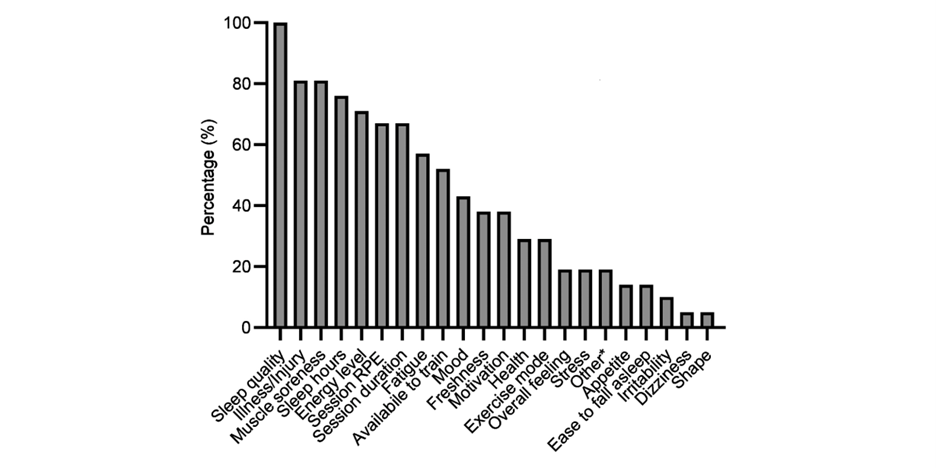
Those who didn’t use an AMS were willing to implement one, but weren’t currently doing so because of poor athlete buy-in, logistical issues (e.g., remote support) and being in the process of planning a new AMS. In terms of data collection, athlete self-report measures were most common (Table 1), with the most common variables collected shown in Figure 1. These were often custom questions (as opposed to research-validated ones), using Likert scales that varied in length, with 57% of practitioners being unclear why their response-scale length had been selected. Most AMS data were collected daily (76%) via mobile devices (72%), although 20% of practitioners employed a varied data collection depending on training phase.
| Data type | Practitioners collecting this data % (n) |
| Athlete self-reported measures | 96 (24) |
| Performance tests | 84 (21) |
| Gym loading data | 80 (20) |
| Performance tracking during normal training | 64 (16) |
| Cardiovascular parameters | 60 (15) |
| Blood profiling | 32 (8) |
| Other (e.g., DEXA, bodyweight, training load) | 12 (3) |
| Hormonal profiling | 8 (2) |
In terms of analysis, 24% of practitioners didn’t have a defined approach to assessing meaningful change within datasets. Those who did most commonly used standard deviations and raw scores (36%) rather than “best-practice methods” described elsewhere in research literature, such as rolling averages and linear and non-linear modelling.
Feedback-wise, only 36% of practitioners felt that sufficient feedback was given to athletes, with most frequent AMS discussions being within the multi-disciplinary support team (Table 2). Interestingly, a few practitioners never discussed AMS data with athletes or coaches!
| Frequency of respondents’ discussion with: | MDT % (n) | Athlete % (n) | Coach % (n) |
| Daily | 44 (11) | 28 (7) | 28 (7) |
| Weekly | 48 (12) | 40 (10) | 36 (9) |
| Fortnightly | 4 (1) | 16 (4) | 12 (3) |
| Monthly | 4 (1) | 12 (3) | 12 (3) |
| Biannually | 0 (0) | 0 (0) | 4 (1) |
| Never | 0 (0) | 4 (1) | 8 (2) |
Limitations
Less than 50% of practitioners who received the survey responded, which may have created some non-response bias – perhaps some practitioners view the value derived from their AMS use as a competitive advantage not to be shared? Or some are reluctant to admit they haven’t found value in it no matter how hard they’ve tried?
It’s also possible that findings only represent the Olympic & Paralympic sports networks within the UK, and can’t be generalized across professional sports and/or to other nations.
What this means for practitioners
Go slow to go fast. Before jumping straight into implementing an Athlete Monitoring System, take the time to develop a coherent strategy including your ‘why’ behind the system, and how you plan to analyze the data and communicate any results or outcomes back with athletes and coaches.
Likewise, take the time to test the sensitivity and validity of any custom athlete self-report measures you want to use – is the question wording clear and consistently interpreted as intended by your athletes? Do you have a rationale for the number of Likert scale response options available when using closed questions? (The optimal number is suggested to be between 4 and 7, and anchored by clear written descriptors, Lozano et al., 2008).
Reviewer’s comments
Having the best Athlete Monitoring System in the world isn’t sufficient to make your athletes any better. In fact, responses from these practitioners suggest rushed, or ill-thought through AMS implementation might do more harm than good for practitioner coach and athlete relationships.
As Trent Stellingwerff alludes to in his tweet, the key might be to take a flexible approach to available software tools, in line with what works best for you and your athletes. Rather than being a slave to daily data collection, perhaps periodizing data collection in line with goals of different training phases could minimize athlete monotony while still providing value? Rather than forcing athletes to respond in nice, neat boxes on a screen, maybe the creative freedom of pen and paper every so often could unlock meaningful reflection and insight vs autopilot responses?
Recommended resources
Article – Monitoring of training in high-performance athletes: what do practitioners do – Hannah McGuigan and colleagues
Article – Developing athlete monitoring systems in team sports: data analysis and visualization – Heidi Thornton and colleagues