

Original article written by Bryan Mann, Jerry Mayhew, Marcel Lopes Marcel and colleagues
Background
Speed testing is commonly used in collision sports to monitor progression, but also with the aim to predict athlete success. This can be seen in events such as the NFL combine, where collegiate players hoping to get drafted perform such tests as the 40-yard sprint, the L-drill, and the pro-agility shuttle[1–3]. Although varying between positions, for the most part American football studies also support to some degree increased likelihood of career success with higher speed capabilities[2,3]. However, during collegiate football years, performance in the combine speed tests have shown to often stagnate or even decline for some[4,5]. Some reasons for this have been proposed to be an increase in body-mass due to physical maturation or the increase in additional training[5,6]. Although attention should be devoted to solving how speed stagnation during collegiate years can be avoided, the authors of Mann et al[7], argue that a key metric that could be calculated from these tests might be overlooked. Specifically, quantifying the players momentum during the tests is potentially essential to consider when determining athlete development (figure 1). This means that if a player has an identical top speed between season X and Y but has a higher body-mass in season Y then they will have a larger momentum potential. Having a higher momentum in any given situation means that it is more difficult to slow you down from your chosen path of movement, an arguably desirable trait in any collision sport. Results from other collision sports such as rugby support the promise of quantifying momentum, with one study showing that momentum was better at distinguishing between playing levels than velocity alone[6]. Therefore, if an American football players momentum has developed during collegiate years despite their speed stagnating, this could arguably be considered still developing towards a desired direction. Higher mass has higher inertia, thus if an athlete can achieve the same velocity with a higher mass, they likely are stronger than before.

What the authors did
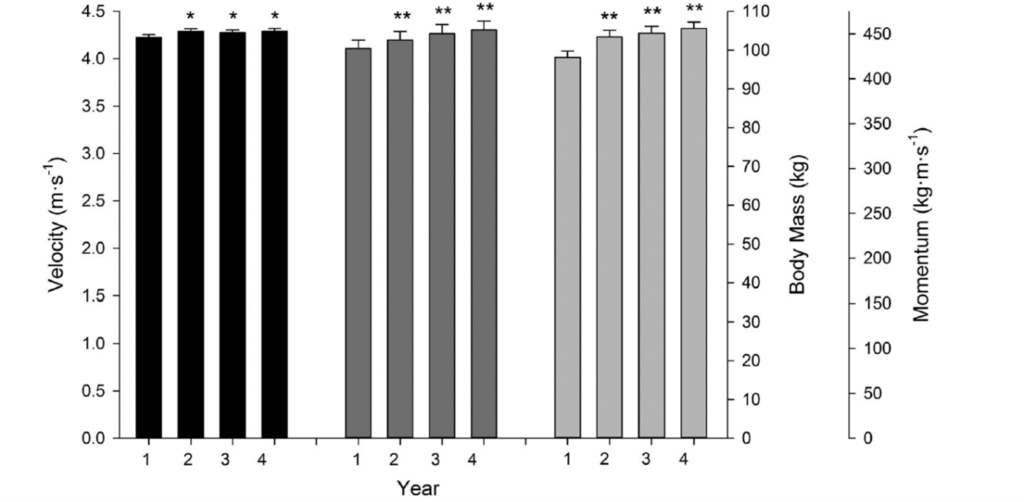
The authors analyzed results from 512 Division 1 football players speed test data during their 4-year careers (Height: 1.86 ± 0.06, Body-mass: 103 ± 18.8). Complete data (i.e., athletes were available each college year for testing) was derived for the 40-yd sprint (n = 82), the pro-agility shuttle (n = 73), and the L-drill (n = 73) from the same NCAA team. Test times were used to calculate average velocity during the test, which was multiplied with body-mass to get average momentum. Statistically significant changes were observed for average velocity between college years 1-3 (p < 0.05), but not 2-4. Body-mass increased significantly each year, leading to a significant increase in momentum per year (p < 0.00010) (Figures 2-4).


Limitations
There was no sub-division of positions in this study, which may have shown differences in the degree of change. However, momentum might be a universally positive attribute to improve in collision sports such as American football. The study did not either quantify whether momentum is associated with increased rate of career success (tackles, rushing yards etc.).
What this means for coaches
- In collision sports it is likely beneficial to also monitor momentum capacity (mass*velocity) in specific performance tests instead of only isolating velocity properties.
- A simple way of calculating average momentum: take the time to perform a specific speed test, divide it by the sprint distance of the test (average velocity), and thereafter multiply it by body-mass.
- Verify the relationship between linear sprint momentum and COD momentum, is there a deficit? Might be a need to work on deceleration capacity.
Reviewer’s comments
The capacity to create a high momentum is arguably important. You are more difficult to stop and thus you are more likely to gain important distance. However, it would be logical that you would need to be equally as good at slowing down your own momentum, as collision sports are all change of direction sports. Therefore, quantifying momentum in both sprint and COD tests is likely essential. This relationship could be used to identify whether newly gained mass that contributes to an increase in linear sprint momentum can be efficiently controlled when changes of direction are added.