

Original article written by David Johnson, Sean Cumming, Ben Bradley and Sean Williams
Background
Young athletes are unique and provide challenges for practitioners as they experience periods of rapid and non-uniform growth in skeletal structures, which not only alter both physical performance and motor skill development[1], but may also heighten injury risk[2].
The period around peak height velocity (circa-PHV) has been associated with a significantly higher risk of injury in youth, compared with pre- and post-PHV players[3,4]. Recent research has identified that growth-related injuries follow a distal to proximal pattern, with Sever’s disease (ankle) more prevalent in the less mature players, Osgood-Schlatter disease (knee) common in the pre- and circa-PHV group, and injuries to the hip and spine (e.g., Spondylolysis) more frequently at the post-PHV stage[5]. Growth rates of ≥7.2 cm/year in stature or ≥0.3 kg/m2 per month in body mass index are associated with increased injury risk[2].
What the authors did
Within this study, the authors aimed to identify the influence of total exposure (training and match), growth, and maturation on injury risk in young male soccer players.
Forty-nine young males from an English soccer academy, consisting of U13 – U16 age groups, were tracked across one full competitive season. Player’s stature, seated height, and body mass were assessed 3 to 5 times per year, by an ISAK trained member of staff to estimate growth rate. Growth rates were calculated as the change in stature over the change in time. Maturation was estimated using percentage of predicted adult height and this data allowed the researchers to quantify whether players were pre-, circa-, or post-PHV. Exposure time was calculated in minutes, and included all match, training, and gym time. Time-loss injuries were recorded by the academy medical professional, and only non-contact injuries were analysed. Injuries were represented as a total value, and as the number of injuries per 1,000 playing-hours. Injury severity was given by the number of days elapsed between initial injury date and the players return to full availability. Injury burden was given by the injury incidence rate multiplied by the mean days missed per injury, giving the days of absence per 1000 hours.
What the authors found
The authors found that the mean value for percentage of predicted adult height was 92.14 (± 4.89) %, and mean growth rate was 5.39 (± 3.54) cm/year, for the whole sample. The authors reported 53 injuries in total, with 8,843 hours of total exposure. The mean exposure for each player was 180.4 (± 40.6) hours, across the whole season. The overall injury incidence rate was 6.0 injuries per 1000 hours, the mean severity of injuries was 31 days, and the mean injury burden was 184.1 days absent per 1000 hours. The mean exposure, and injury incidence, severity and burden for each age group is shown in table 1.
| Age group | Exposure (hours) | Injury count | Injury incidence (per 1,000 hours) | Mean severity (days) | Injury burden (per 1,000 hours) |
| U13 | 3,873 | 23 | 5.9 (3.9–8.9) | 36 (24–54) | 213.8 (142.1– 321.7) |
| U14 | 1,797 | 16 | 8.9 (5.5–14.5) | 17 (10-27) | 148.0 (90.7– 241.6) |
| U15 | 1,376 | 10 | 7.3 (3.9–13.5) | 48 (26–89) | 347.4 (186.9– 645.7) |
| U16 | 1,797 | 4 | 2.22 (0.8–5.9) | 14 (5–37) | 31.2 (11.7– 83.0) |
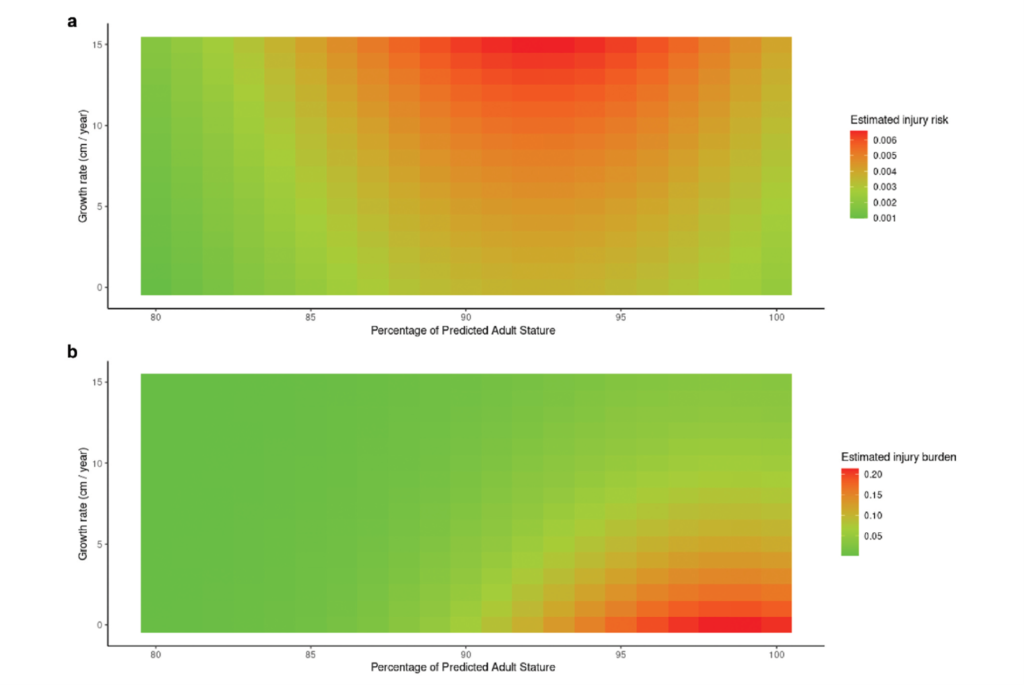
Players experiencing a greater growth per year rate had an increased injury incidence risk. Additionally, there was a greater likelihood of injury for players with growth rate > 7.2 cm per year, and a peak injury burden greatest for players with a growth rate of 4.17 cm/year (figure 1 a and b).

There was a non-linear relationship between percentage of predicted adult height and likelihood of injury incidence, with the greatest injury incidence risk being at 92% of predicted adult height. There was also a slightly greater injury risk for players between 83 and 92% of predicted adult height, compared to players between 92 and 100% of predicted adult height. Again, a non-linear relationship between percentage of predicted adult height and injury burden was found, with players at 95% of predicted adult height at risk of greatest injury burden. The influence of maturation (percentage of predicted and adult height) and growth rates on injury incidence and burden are summarised in the heat map below (figures 2a and b).
The week to week change in total exposure demonstrated a linear relationship with likelihood of injury incidence, highlighting a greater change in weekly total exposure increased injury risk. Additionally, a non-linear relationship between week-week changes in exposure and injury burden was observed, with greatest injury burden occurring when week-week change in exposure was -68 minutes, suggesting that reducing training load week to week may increase injury burden.
Limitations
A limitation of the current study was that the influence of exposure, growth and maturation on injury risk was only conducted in a single English football academy. The training load, especially training and gym load, will differ across academies, so this needs to be factored in when interpreting findings across different populations. Furthermore, including a single academy with a total of 49 players and 53 injuries results in a small sample of injuries, and caution should be exercised when extrapolating results across a larger population. Additionally, the type of injuries were not reported within the current study, and it was only stated that non-contact injuries were analysed. All non-contact injuries are going to have different mechanisms, and while some injuries will be influenced by exposure, growth and maturation, some will have different mechanisms, and pooling all injuries together could limit the findings. Additionally, with the small sample size, different types of injury could have influenced findings. For example, a single longer-term injury could skew the findings.
What this means for coaches
The findings from this current study can be used by practitioners to highlight at risk players, based on growth rate, maturation status, and training exposure (see table 2 for maturation, growth rate and exposure peak injury incidence and burden). The findings from the study suggest that there is a need for practitioners to monitor growth, maturation, and training exposure, as these can all influence injury risk. Once these are being monitored, players in high-risk areas (e.g., growth rate, maturation or training load) can be given a specific intervention to reduce the risk of injury. For example, players around 92% of predicted adult height may be at greatest risk of injury incidence. Research that has collated longitudinal data has highlighted that PHV occurs around 92%–93% of predicted adult height[6] and therefore those that are experiencing the growth spurt may be at risk, and require alteration in their training. During the growth spurt, training may need to reinforce the re-learning of movement skills, condition players to protect them against specific injury risks, as well as reducing high-volume repetitious training and potentially allowing for more recovery time between training sessions to prevent overuse injuries. Additionally, players with growth rates of greater than 7.2 cm/year are at a greater risk of injury incidence, and these players should be monitored and training adjusted where necessary.
| %PAH | Growth rate | Exposure (mins) | |
| Peak injury incidence | 92% | >7.2 cm/year at more risk | Greater week to week changes in exposure increased injury risk |
| Peak injury burden | 95% | 4.17 cm/year | -68 minutes |
Reviewer’s comments
This injury risk study in youth adds a great element to the current literature base. The findings are novel, and highlight how injury incidence and burden can be influenced by growth, maturation, and exposure. These findings can be used by practitioners to help reduce injury risk in academy soccer players, with simple strategies to help identify at risk players. Cost effective strategies can be implemented, such as monitoring growth rate with multiple measures of stature throughout a season, monitoring maturation with the use of predicted adult height, and monitoring training exposure with training minutes, and can be used by all levels to help reduce injury in youth.
Recommended resources
Video – LTAD chat – Integrated LTAD – Joe Eisenmann and David Johnson
Podcast – Growth and maturation – David Johnson