While many of us are battling to keep up with handling and interpreting the reams of athlete data available from training and competition, a new challenge looms large on the horizon for sport scientists and performance coaches. How do we deal with and make sense of 24/7 athlete data from the wearable technology revolution?
These days, measuring athlete data can be as straightforward as strapping a wristwatch or ring on them, then pressing a button to sync their data to an app. How well an athlete slept, deviations from normal or understanding whether they’re showing signs of illness or fatigue are literally a swipe away.
Or that’s what the wearable technology hype-machine would like us to believe.
Looking under the hood of these devices often reveals the complexities that actually exist. Are the raw data accurate enough to make meaningful decisions from them? Does seeing how badly they slept cause an athlete more harm from anxiety than good? How should we use the composite metrics of “Readiness” or “Recovery” that the different devices and their algorithms spit out? These questions, along with the nuances of understanding and interpreting the data, are a lot more challenging than you might think.
In this 3-part series, we’ll first break down what we’ve found useful to consider before introducing wearable technology to athletes and teams. In Part 2, we’ll share real life data examples comparing and contrasting some of the most popular wearable devices on the market. Finally, in Part 3, we’ll pull together a series of practical recommendations for practitioners on how to best implement and leverage wearable technology for athlete health and performance.
Quality of your questions determines the quality of your answers
Wearable technology may seem shiny and appealing, but if it can’t offer data that’s relevant for answering your biggest and most important performance questions then do not pass go, do not collect £200. Before jumping into solutions, first focus on defining your key problems well. This will help you decide if wearable technology is indeed an appropriate solution. Then you can get specific on what kind of devices to use, and how, why, and when to deploy them.
Over years of athlete monitoring, we’ve found using the following characteristics to help ask the right performance questions has been an invaluable first step in ultimately landing on impactful solutions:
- Meaningful: related to the variables that most strongly support health, or determine performance that will provide a competitive advantage to your athlete/team
- Actionable – generates information that athletes or coaches can act upon to positively effect performance
- Falsifiable: tests something that can be proved wrong
- Novel / Non-obvious: isn’t something that coaches or athletes already know, or that they can more easily figure out themselves
Just because you can measure something, doesn’t mean you should
Having clearly defined our questions, we can assess the technology options available to provide solutions. This usually starts with scoping out the devices that measure your main variables of interest, and then firmly attaching your skeptic’s hat as you sift through their various performance claims for the signal among the marketing noise:
“Measure and accumulate your training activities and daily effort with a Strain Score that helps you understand when to rest or push.”
“Your Readiness Score answers, ‘how much can you and your body take on?’ It takes into account your sleep, activity, and body stress signals like body temperature and HRV.”
Tweet This“Just because you can measure something, doesn’t mean you should”
@drpetertierney and @DrSianAllen
As great as these claims sound on paper, if something sounds too good to be true, it often is! Here are four key things to look for when engaging with any wearable technology company regarding their product and its claims:
Accuracy and Reliability
Does it measure what it claims to measure, And does it do so consistently and repeatedly?
The best level of evidence here is independently conducted high quality research studies. In the absence of these, ask the company if they can share white papers with their own validity and reliability statistics. Ask friends and colleagues at other teams or organizations if they’re willing to share insights or numbers from any testing they’ve done on the product. On top of all of these, test the product in-house yourself and collect your own validity and reliability measures.
Red flags will obviously arise if your numbers differ from what the company or trusted others share. But another consideration is the level of validity and reliability that’s acceptable to answer your key questions. For example, do you need to know down to the minute exactly how long an athlete slept, or is identifying nights where they slept <6 hours vs >8 hours enough fidelity for what you need?
Usability
Is it easy to use? Is it comfortable to wear and won’t impede training or lifestyle? What additional asks will it impose on athletes?
The easier and more convenient something is for an athlete to use, the more likely they are to do so. And the longer they’re able to wear something, the more repeated measures data you’ll have to mine for meaningful insight.
For example, the Apple Watch requires removing and charging every ~24 hours, whereas a Whoop band can be charged on the wrist every ~5 days. An Oura Ring can be so discrete that athletes often forget they have it on, whereas a chunky wristwatch may be uncomfortable to sleep with.
Collaboration
Is the company willing to engage with you, answer your questions and/or incorporate your feedback to find solutions that fit your needs?
The best companies we’ve engaged with are always willing to send a demo version for you to try so you can test usability, accuracy and reliability yourself. We imagine this is because they have done their own robust data collection and testing that gives them confidence in how the product will stand up in your hands.
Another thing to be wary of: if the company folded tomorrow, or changed how they presented their metrics or data, what would it mean for your ability to monitor your athletes? Having a strong relationship with the company could help mitigate this risk with either advanced warning or alignment on finding workable solutions together.
Transparency
Will you be able to access all your athletes’ raw data and export it easily for your own analysis?
Not having access to your athletes’ raw data is a massive red flag, both from a privacy and ownership perspective, and for your ability to properly answer your key questions. Using a company app or dashboard limits you to viewing data certain ways, whereas having a quick and easy data export function gives you much more flexibility in how you make sense of the data.
It’s also important to consider that different devices often optimize for different things. With the current options available, it’s unlikely that there’s one piece of kit that will solve every problem you have. More on which device is good for which purpose in Part 2. For now, be mindful that you’ll likely need to prioritize your questions, knowing that asking athletes to wear multiple devices at once might be a stretch.
That said, it’s worth asking yourself and your staff, if you could only use wearable technology to answer one question really well, which question would you want it to be?
Context is king and queen
The numbers collected by wearable technology can do a great job at revealing what is going on in an athlete’s life, but on their own they tell us very little about why this is the case. Take the example of a very diligent swimmer I (Sian) used to work with, whose data often showed suboptimal amounts of sleep, which seemed strange given the attention to detail they put into each aspect of their training and preparation. With a bit of digging, I learned they were staying up late to fit an evening stretching and mobility routine into their schedule, believing they were doing everything they could to support their recovery.
Without this context it would have been easy to jump into lobbying the coach for later morning training times or trying to optimize the precise details of their sleep environment. Instead, it prompted a previously overlooked conversation within the multidisciplinary support team about the best individualized recovery plan for this specific athlete within their busy schedule.
This was a great example of how data from wearable technology should be treated like a smoke signal – a sign of where to look to uncover deeper insight and meaning – rather than a full-blown fire that you need to fan or douse with water straight away. Solve the right problem!
Tweet This“Wearable technology should be treated like a smoke signal – a sign of where to look to uncover deeper insight – rather than a full-blown fire that you need to fan or douse with water straight away”
@drpetertierney and @DrSianAllen
Collecting a lot of subjective (i.e., self-reported) data alongside objective (i.e., wearable technology) data can often seem like doing double-duty, and something many athletes may not buy into initially. However, it’s important to gather both objective and subjective data, as they offer different insights and, when combined and compared, help provide a more holistic understanding of an athlete’s response to stressors.
One size does not fit all
Athletes we have worked with who are highly driven often seek things that may give them an advantage. This may be through additional athletic development sessions, enhanced recovery strategies or, in a lot of cases, the adoption of wearable technology – independent of the organisation’s strategies.
Instead of ignoring this or assuming your athlete management systems cover all bases, this is where you need to be humble, curious and interested, and engage your athletes around your team’s systems.
Some questions you can ask your athletes if (and when) this situation arises:
“I see you have a new wearable device. I know you are always on top of your recovery and sleep. Are there any questions you have or any things I can better help you with?”
“If you are happy to share your data with me, can we blend the wearable data with what we already collect to gather a more complete picture of your preparedness and recovery?”
“Is there any support that you feel you’re missing that prompted you to adopt this technology on top of what we have already?”
These can act as conversation starters to better understand the problems your athlete is trying to solve. To best define these problems, alignment with and education of athletes and coaches in this space is paramount. For example, if an athlete purchases a wearable device to quantify their sleep, some key questions may help us better understand the specific performance problems to be solved:
- Is this athlete struggling with sleep? If so, why?
- What are this athlete’s typical recovery and fatigue levels like?
- Are other athletes in our group thinking the same thing?
- Is there value in quantifying the whole team’s sleep data?
- How can we support the athlete interpreting their data with the correct context, away from generic and biased manufacturer messages?
Where multiple athletes start to use different devices from different manufacturers is where things can get more challenging. This can be hugely time consuming for sport scientists as it involves managing multiple different data streams (making combining and comparing harder), and layering on the need to research, understand and self-validate multiple different devices. On top of day-to-day roles and responsibilities, this can add unwelcome and unsustainable workload.
If there are a few athletes who have sought a common solution (i.e., the same wearable), running a small pilot project with this group could be a good place to start, either to demonstrate value and drive engagement from a wider group, or invalidate the need to continue to collect one set of metrics if they don’t add any value. While there will be some up front due diligence and extra effort required to understand how best to leverage wearable tech with your athletes, it’s important to be aware of the fact they could just be an expensive distraction if you find they’re not adding more than they’re costing you in terms of time, energy or money.
From wearable technology information to impact
Ultimately, the success of any actions you take involving data likely lies in the integration of multiple types of data, layered with contextual information, produced and discussed in an engaging and appealing manner.
Making an impact with information from wearable technology involves defining the key problems the information provided may be able to help solve, and then translating this information to actionable insight. Understanding what and when athletes and coaches need to see data is a valuable skill and nuance that a sports scientist should aim to develop.
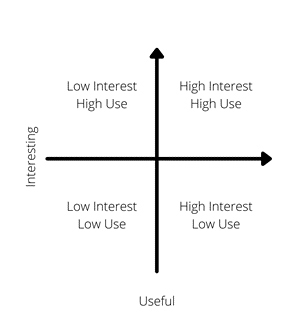
The Interesting–Useful Matrix provides a simple guide to help determine which problems are most important to pursue and, subsequently, what kind of data and what level of insight are worth sharing with coaches and athletes.
Tweet This“Making an impact with information from wearable tech involves defining the key problems the information provided may be able to help solve, and then translating this information to actionable insight”
@drpetertierney and @DrSianAllen
Given the limited time most sport scientists have, the only questions and insights worth prioritizing are those of high interest and high utility. A common trap is pursuing questions of high interest but low utility, particularly with wearable technology where the “cool factor” can distract from the things that matter most for health and performance. For each problem you encounter, ask yourself, “Is it useful, or is it just interesting?”
Part 2 preview: So which device should we get…?
With the social media hype-machine in full swing over different wearable technology devices, this is likely the first question you’ll have to field. Like most questions of human behaviour and athletic performance, the honest but inconvenient answer is “it depends”. It depends which variables you’re interested in, what level of accuracy you need and what your biggest barriers to adoption with your athletes are.
That said, we’ll take a look at some of the key variables of interest for athlete health and performance, and dive into the details of some of the most popular devices.