
Elite level coaches deal with a range of demands that may contribute to mental health challenges. Coaches operating within high performance environments encounter a number of diverse stressors, including performance related pressures such as poor performance outcomes, inadequate time to prepare for competition, substandard training sessions; organisational challenges, like job (in)security, long working hours, lack of resources; and personal difficulties, like social isolation and relationship issues [1–3]. These stressors are often combined with intense workloads that can require coaches to remain on duty around the clock.
Ange Postecoglou, current Tottenham Hotspur head coach, describes the role as a lifestyle rather than a job. He explains that as a high performance coach “you’re literally 24/7. It’s just that kind of occupation, and I’ve heard managers who say they try and switch off, but the reality is it’s very difficult to [4].”
Compounding these demands is the common expectation that elite coaches must be capable of handling the psychological pressures that emerge from the role.
Leigh Nugent, former head coach of Swimming Australia, argues, however, that “the true extent of overwork, stress, anxiety, depression and associated health issues would not be known amongst the coach population, because it is generally accepted that if they choose to coach it goes with the job and they will cope and not succumb to such conditions [5].”
Although the stresses and strain of elite coaching are part of the role, high performance coaches are not immune to mental health challenges. Sports organisations, therefore, need to establish support systems to protect and preserve the mental health of their coaches and other sports performance practitioners in order to reduce the risk of these individuals developing more serious or persistent mental health conditions.
Before these organisations can take those steps, we must first identify and understand the range of factors that may influence high performance practitioners’ mental health.
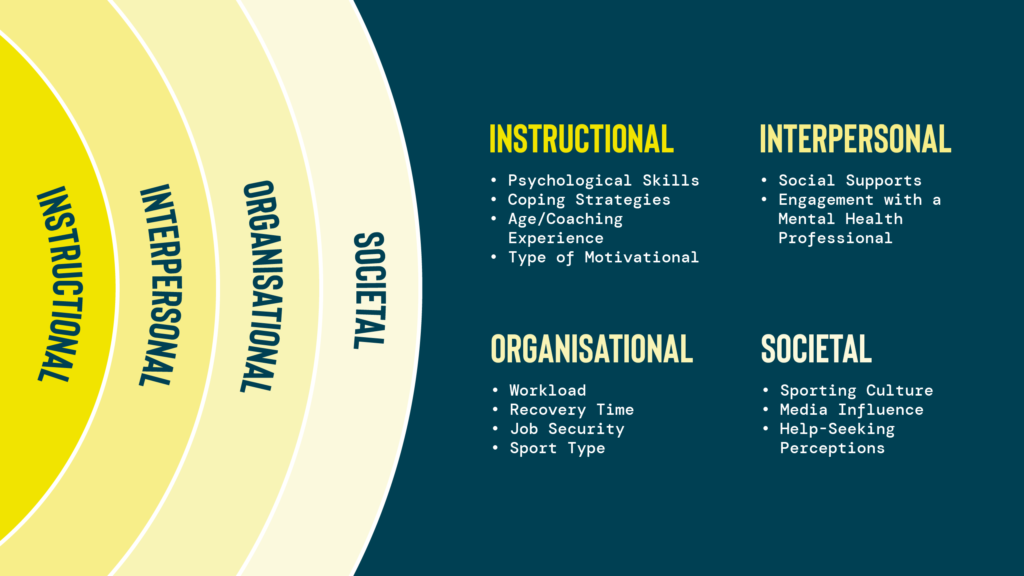
Ecological systems models can help explain the range of factors at play in elite sports; and how the interplay of these factors at the individual, interpersonal, organisational and societal levels may influence mental health outcomes [6, 7].
Tweet ThisElite coaches face immense pressures, including performance expectations, organizational challenges, and personal issues, necessitating around-the-clock commitment. This lifestyle significantly contributes to their mental health risks
@JoshFrost77
Factors influencing the mental health of elite sport coaches
While evidence is emerging in the field of coach mental health [8], our review identified several risk and protective factors that influence the mental health of elite coaches at the individual level [35,39]. For instance, the proliferation of stressors, when accompanied with maladaptive coping strategies (e.g., over-reliance on alcohol), negatively impact the mental health of elite coaches [9–11]. Conversely, elite coaches who possess robust psychological skills like resilience and self compassion, and adopt effective coping strategies (e.g. emotion focused strategies), may have greater protection against mental ill health [12, 13].
Despite the value of examining these dynamic individual characteristics and qualities, we should incorporate and adopt a broader holistic approach when exploring the mental health of elite coaches. Attributing their mental health outcomes solely to individual factors limits options for intervention.
Among interpersonal factors, the influence of a practitioner’s support network in supporting their mental health is among the most significant. A coach’s family, friends and peers provide advice, support and comfort, all factors that may help to reduce stress among high performance coaches [14]. Like all people, sports performance practitioners should aim to establish and maintain robust social networks to support their mental health. The demands of the role, including frequent travel, have interpersonal implications that can complicate these networks and relationships.
Organisations and sporting bodies have a decisive role in supporting the mental health of the high performance coaching community. Organisational and federation based support (or lack thereof) can greatly influence the mental health outcomes of coaches in these structures.
Darren Lehmann, former coach of the Australian men’s cricket team, describes how coaches are often worked to the bone in their job, and that “you are trying to keep so many people happy and engaged you have no time for yourself [15].”
Elite coaches who manage excessive workloads may be more susceptible to burnout, particularly when they do not have sufficient psychological and physiological recovery time [16, 17]. Persistent job insecurity [18], a lack of organisational support (e.g., lack of resources) [19] and excessive organisational influence [19] all negatively influence coaches’ mental health. Sporting organisations should be conscious of the expectations and demands they (and other stakeholders) place upon their coaches, and aim to find practical and engaging ways to support the mental health of these professionals.
Considering these challenges, organisations also have a significant role in preserving coaches’ mental health from broader societal pressures.
Media scrutiny [20] and unhealthy sporting cultures (e.g., hypermasculinity) [21] are mental health risk factors for coaches. Organisations should try to identify ways to mitigate the media pressures elite coaches face. They should also aim to cultivate sporting environments and cultures that adopt psychologically safe principles, allowing elite coaches to feel comfortable in discussing matters associated with mental health.
An important societal factor to consider is stigma towards mental health issues and seeking help, particularly within elite sport.
Those in leadership positions may be increasingly susceptible to mental health stigma, as leaders are commonly expected to showcase strength and resilience – traits that may be inaccurately perceived as incompatible with seeking mental health support [22]. Preliminary evidence suggests that elite coaches might be hesitant to seek or engage with psychological services, possibly due to this stigma [20, 23]. Mental health services and pathways to support are critical to supporting the mental health of elite level sportspeople, and organisations play a crucial role in facilitating engagement with these services.
Given these factors, the following sections address ways both individuals in sport and their organisations can support the mental health of high performance practitioners.
Tweet ThisFor elite coaches, developing psychological resilience and effective coping strategies, like mindfulness and self-compassion, is crucial. These skills help manage stress, reducing the risk of mental health challenges in the demanding world of high-performance coaching
@JoshFrost77
What can elite coaches do to support their mental health?
Coaches can actively manage their mental health in a variety of ways. For instance, strengthening and developing dynamic psychological skills may help preserve mental health.
Mindfulness is associated with increased self awareness and self compassion in high performance coaches [13, 24]. Practicing mindfulness may help elite coaches effectively manage the demands of their profession and foster greater self compassion. Cultivating self compassion, then, can aid coaches in learning from mistakes and reducing rumination. Activities like self reflection and mindful breathing can have positive effects on the mental well being of elite coaches over both the short (< 6 months) and long term (12 months) [13].
High performance coaches should also be cognisant of their motivations to coach. Coaches who internally value their role and have a personal satisfaction towards coaching may be less vulnerable to poor mental health [16]. Conversely, coaches who are largely driven by external forces or motivations (e.g., renumeration) are more susceptible to burnout [19, 26].
Not only should elite coaches examine their professional motivations in order to boost their mental health, but motivation may also influence one’s coaching style. Those who may look to satisfy the needs and expectations of external parties, like the board or management, might be more likely to adopt a less collaborative leadership style. This type of coaching style increases coaches’ susceptibility to occupational burnout [27]. Practitioners who adopt a more collaborative leadership style may have greater protection against mental ill health.
Beyond the development of psychological skills, elite coaches should also consider factors that may influence or support their mental health outside of coaching.
Engaging in regular recreational exercise can protect coaches from experiencing poor mental health [21, 25]. In other professions involving leadership responsibilities, incorporating exercise into one’s routine improves the ability to cope with stress more effectively [28]. Similarly, supervisors can mitigate the negative impacts of stress and exert less pressure upon their subordinates when they engage in regular physical activity [29].
Taken together, finding ways to integrate physical activity into one’s schedule may help elite coaches better manage the demands of the profession and alleviate stress for themselves and those around them.
Elite coaches should also be cognisant of their social supports and networks, as members of a coach’s interpersonal network are a prominent protective factor against poor mental health [20, 30]. Elite coaches should establish or preserve strong social networks. Whether those include family members, friends or other coaches, they help reduce the risk of isolation, which may exacerbate symptoms of mental ill health.
Spending time or connecting with people outside of the elite sports environments may also help to foster non-coaching identities.
If a coach predominantly bases their identity as a person on being a coach, poor results or performances may have a more influential impact upon their mental health and well being. Taking the time to interact and engage in social settings outside of the elite sports environment may help coaches to detach and psychologically recover from the job and the coaching role.
Tweet ThisIntegrating physical activity and maintaining strong social supports are vital for elite coaches to manage stress and avoid burnout. These practices, alongside organizational support, form a comprehensive approach to safeguarding mental health in high-performance sports
@JoshFrost77
What can sports organisations do to support the mental health of elite coaches?
Although there are things that elite coaches can individually do to optimise their mental health, organisations play a fundamental role in providing the time and support to implement these strategies.
Researchers at the University of Melbourne recently published a paper discussing the importance of implementing early intervention strategies to support the mental health of elite coaches prior to the onset of a mental health disorder or mental health crisis [31]. The article discusses four early intervention strategies that organisations might employ to support the mental health of elite coaches: mental health screening and monitoring, the psychological safety of high performance environments, practitioners’ mental health literacy, and tailored pathways to support.
To assess the mental health status of elite coaches, organisations might adopt mental health screening measures to detect mental health symptoms prior to the onset of a mental disorder or mental health crisis. Qualified mental health practitioners or sports medicine physicians should oversee and manage such processes.
Screening processes should factor in the time of the competitive year, as high performance coaches’ mental health may vary between competitive and non-competitive periods.
Although there are no validated measures that assess the unique stressors and symptoms experienced by sport coaches, we recommend that screening processes employ disorder specific tools proposed in the Sport Mental Health Assessment Tool 1 (SMHAT-1) to assess the mental health of this population (e.g., the GAD-7 for symptoms of generalised anxiety; PHQ-9 for symptoms of major depression) [32].
Both coaches and their sports organisations should be mindful of the knowledge, beliefs and attitudes that elite coaches hold towards mental health.
Mental health literacy has a critical role to play in preserving the mental health of the general population, for example, through help seeking behaviours [35]. Parallel studies in high performance coaches are lacking. Possessing an adequate level of knowledge and education around mental health may help sports performance personnel identify symptoms of poor mental health, such as low mood. Beyond detection, mental health literacy may also help shape positive attitudes towards mental health, challenging stigmatising perceptions about mental health.
Elite coaches with high levels of mental health literacy may also be more aware of help seeking opportunities and be more likely to engage with these services. Organisations should, therefore, empower their coaches with mental health education programs, to ensure coaches are equipped to address mental health challenges.
Organisations should also look to cultivate psychologically safe environments for their coaches. Psychologically supportive working environments may allow employees to take greater interpersonal risks, as there are fewer perceived consequences attached to voicing vulnerabilities, errors, or failures.
In high performance settings, emerging evidence indicates that psychologically safe environments may contribute towards improved mental health and performance outcomes, including reduced anxiety at the individual level and improved team effectiveness [37]. Building on these results, organisations might set out to assess the psychological safety of their high performance environments using measures such as the SPSI, to ensure that elite coaches feel comfortable in raising issues or sharing sensitive information about mental health [34].
Finally, it is imperative that sporting organisations provide elite coaches with appropriate and tailored pathways to mental health support.
Accessing mental health services or support may help prevent experiences of stress and burnout into more serious mental health symptoms or disorders. Organisations should set a goal of providing practical services that elite coaches can access to ensure these individuals can receive treatment if necessary. Pathways to mental health supports may also help to reduce stigma associated with seeking help for mental health concerns. For example, the Mental Health Referral network funded by the Australian Institute of Sport offers useful insights into services to that elite coaches can use to support their mental health [38].
Contribute to our understanding of high performance coach mental health
Research is still emerging about the intersection of mental health and high performance sports coaching.
Researchers at Orygen and the University of Melbourne are addressing this area of research by conducting a study examining the beliefs and attitudes that elite level coaches hold towards mental health. The research project asks high performance coaches to complete an anonymous 10-15-minute online survey. Upon completion, participants will have an opportunity to enter a prize draw to win one of 10 Amazon vouchers of AUD $100. Insights that emerge from this study may help inform coach-specific interventions and frameworks that aim to protect the mental health of elite coaches.
To participate or learn more, please visit this link.
For further information about the research project – or if you’re reading this after that project is completed but you want to learn more about the current state of the topic – please contact the lead researcher, Josh Frost, at josh.frost@orygen.org.au
If this article has raised issues for you, please find a list below of resources you can reach out to if you would like support.
| Country | Organisation | Contact |
| Australia | Lifeline | 13 11 14 https://www.lifeline.org.au/ |
| Canada | Canadian Mental Health Association | (416) 646-5557 https://cmha.ca/ |
| USA | 988 Suicide and Crisis Lifeline | 988 https://988lifeline.org |
| UK and ROI | Samaritans | 116 123 https://www.samaritans.org/ |
| New Zealand | Lifeline New Zealand | 0800 543 354 https://www.lifeline.org.nz/ |
| Anywhere in the world | Befrienders | https://www.befrienders.org/ |