

Original article written by Essi Ahokas, Johanna Ihalainen, Helen Hanstock and colleagues
Background
In recent times, traditional and infrared (IR) sauna usage has gained massive popularity with people attempting to improve health and also accelerate recovery from exercise and training. Currently, research exploring the effects of IR sauna is lacking in both improving health and accelerating recovery. Some research has reported that IR sauna can improve recovery of counter movement jump (CMJ) performance & reduce soreness. This is thought to be through increased blood flow from vasodilation, as IR heat penetrates deeper than hot air. It has also been reported that repeated IR sauna can improve sleep quality in people with chronic pain. Given the previous literature, the authors of the current study hypothesized that IR sauna following resistance training might accelerate neuromuscular performance, improve nocturnal HRV, and decrease muscle soreness.
What the authors did
The authors recruited 16 male basketball players, of which players played in the first- and second-team of the same club. Participants completed 2 trials over 2 days, separated by 1 week. The trials consisted of a resistance exercise protocol, and included pre- and 14 hours post-session testing – but the recovery protocol varied between trials; one being passive recovery, and the other being IR sauna recovery. Fluid intake, post-session recovery shake and food intake was controlled and kept consistent between trials.
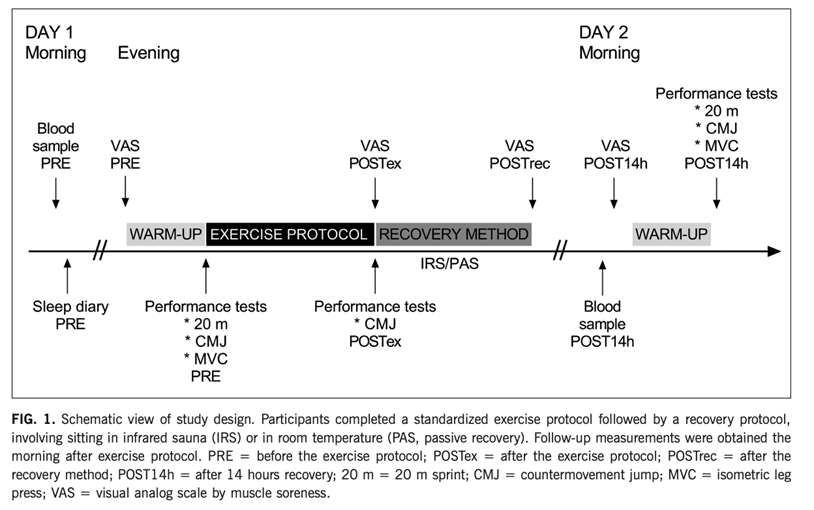
The duration of the resistance exercise session was 60 minutes, and both recovery (Passive and IR sauna) were 20 minutes. The sauna seats had IR-emitting panels at the front and back of the participants, about 55cm and up to 15cm away from the participants front and back respectively. The sauna temperature was set to 50°C, and air temperature was recorded at 43 ± 5°C and relative humidity 21 ± 1%.
What the authors found
IR sauna reduced the post-session decrease in CMJ performance, whereas passive recovery did not. In other words, there was a significant difference in CMJ height 14 hours post-session in the passive recovery trial, but no significant difference between CMJ height 14 hours post-session in the IR sauna trial. There were no significant differences in 20m sprint performance and isometric leg strength pre- and post- either recovery intervention.
IR sauna significantly reduced muscle soreness both immediately after the recovery intervention, and also 14 hours post-session. These differences were not evident with passive recovery. This trend is also evident with respect to perceived recovery.
There was, however, a decrease in cortisol 14 hours post-session in the passive recovery group, which was not evident in the IR sauna intervention. In other words, it appears that IR sauna maintained heightened cortisol levels after a resistance exercise session. IR sauna had no effect on overnight heart rate variability (HRV) or sleep quality.
Limitations
- It was not possible to blind participants to the fact they are doing a passive recovery versus an IR sauna recovery protocol, or offer a placebo to IR sauna, and as such their perceived soreness and recovery may be influenced by this.
- Future research conducted in a similar manner might try to utilise a different alternative strategy instead of passive (for example, cold water immersion) or in comparison to other heat strategies, which may negate the above points.
- It is also unclear the effect of sustained, repeated IR sauna use would have on recovery in athletes. Athletes must recover from multiple training sessions and competitions in a week, it would be useful to understand how repeated IR sauna sessions effect recovery over the course of a week or multiple weeks.
What this means for coaches
- If you have access to an IR sauna, it might be a useful additional recovery strategy to reduce soreness and improve perceived recovery with your athletes, and also attenuate the drop in CMJ performance following resistance exercise.
- However, sauna practices should also be considered as additional stress on the body, and this should be factored into the overall load of athletes.
- There were no significant changes in heart rate or HRV variables in the night following IR sauna compared to passive recovery, suggesting that overnight sleep and recovery are likely not affected by the additional heat stress.
Reviewer’s comments
- With the growing popularity of sauna use for health and recovery, it is essential that further research (such as the current paper) examines the true effect (if any) on both acute recovery from exercise, and also longer term health measures.
- This paper demonstrates the potential utility of IR sauna, and considering the results, it could be added as a ‘tool in the toolbox’ to reduce soreness, improve perceived recovery and potentially reduce CMJ fatigue acutely without having negative effects on sleep.
- This research is well conducted and factors both objective and perceptual data streams, which are both critical in understanding athlete recovery. This research could act as a template to assessing the effectiveness of other recovery strategies.
Recommended resources
Read – Effects of far-infrared sauna bathing on recovery from strength and endurance training sessions in men – Antti Mero
Read – Is hot the new cold for athlete recovery? – Calvin Philp