

Original article written by Cristiano Behenck, Haroldo Sant’Ana, Juliana Brandão Pinto de Castro and colleagues
Background
Fundamentally, resistance training is made up of acute prescriptive variables that can be altered to manipulate the stimulus that is applied to an athlete. We often discuss loading and volume, muscle action (e.g., concentric vs eccentric), exercise selection, frequency of training, and repetition velocity but, perhaps less frequently, we discuss the rest periods between sets that are used. This is interesting because recovery between sets often makes up >85% of a strength training session and can substantially alter the stimulus. For example, if recovery periods are too short during resistance training, the session will quickly become a conditioning session and quality starts to suffer. Alternatively, if you spend too long recovering between sets, while the quality of the repetitions may be maintained, the session duration becomes unfeasible for athletes. Therefore, finding an ‘optimal’ amount of recovery time between sets is essential for athlete programming.
When resistance training, exercise sets are traditionally programmed one after the other. For example, if you are programmed to do three sets of back squats and bench press, you would do three sets of the back squat followed by three sets of the bench press. However, there is no reason why you cannot alternate exercises. Additionally, because these exercises use disparate muscle groups (i.e., legs and arms), you can pair them together so that they are completed with no break (i.e., a superset)[1,2]. While there are several forms of superset, the most common is an agonist-antagonist pairing (e.g., bench press followed by prone row).
What the authors did
In this study by Behenck et al.[3], the authors attempted to identify the effects of providing self-selected rest duration, or one, two, or three minutes between agonist-antagonist superset on total training volume, session duration, and training efficiency.

What the authors found
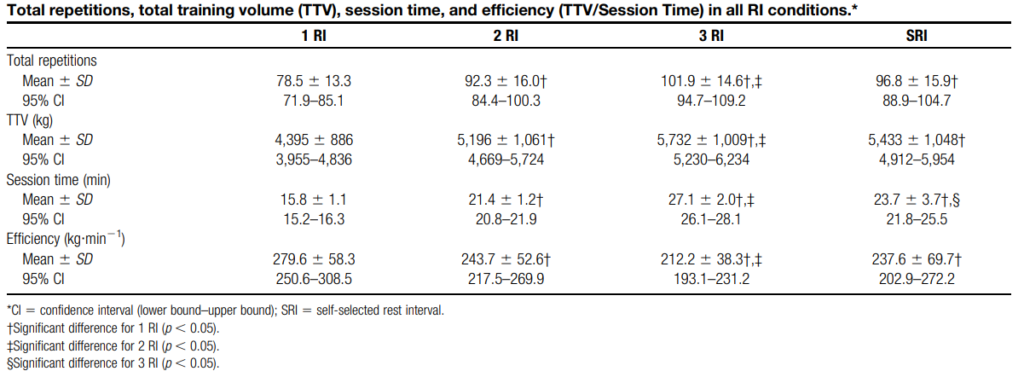
The authors found that when greater time is provided between supersets, greater volumes are completed. Additionally, when more time between sets is provided the session duration increases. This is logical and did not require a scientific study. However, the most important details can be found when looking at the ‘Training Efficiency’ outcomes (i.e., total tonnage divided by total training time) across the conditions and when making comparisons to the self-selected recovery condition.
Briefly, the greatest training efficiency occurred in the one minute recovery condition, followed by the two minute and self-selected conditions, and then finally the three minute condition. This was accompanied by progressive reductions in training volume across each superset due to the accumulation of fatigue as training went on. Average recovery time for the self-selected recovery group was ~2.5 minutes (146 ± 48 seconds, to be exact), with this fluctuating depending on the set and the exercises being completed (i.e., prone row and bench press or lat-pull down and overhead press).


Limitations
While the premise of this paper is fair and the findings are acceptable, I couldn’t help but feel like I wanted more. What were the perceptual responses during and throughout the session? What were the fatigue responses immediately post-training, later that day, 24 hours post-training? What were the exact instructions given to the participants during the self-selected recovery condition – this could make a huge difference because if they were trying to maximise volume or trying to maximise efficiency, the athletes would have selected different pacing strategies. It also wasn’t quite clear why agonist-antagonist sets were implemented. Would the results have been different with another approach…?
While the study was of acceptable quality, by having additional training outcomes it would have given the reader a better understanding of the true effects of these different conditions. Additionally, it would have helped the practitioner make a more informed decision if they are considering using different rest times between sets.
What this means for coaches
Despite some of the limitations, the practical applications of this are relatively clear and useful. Training is often a trade-off of training volume and fatigue. When implementing this form of training, it seems like there’s a sweet spot around the two minute mark where athletes have had roughly enough rest to undertake the next set and be able to complete enough volume. Additionally, if your athletes are relatively conscientious (and don’t get side tracked by chatting, cell phones etc), you can simply ask them to take as long as they require until they are prepared for the next set. Personally, I like this approach with trained individuals because each athlete you work with has vastly different recovery capabilities (something not discussed in the paper and a reason why auto-regulatory training methods are useful). Furthermore, we can see the detrimental effects of not providing enough recovery and substantial amount of fatigue that accrues when we ask athletes to take each set to failure.
Reviewer’s comments
In conclusion this study investigates an interesting topic and helps demonstrate that you can let your athletes select recovery times that suit them, and this will likely have more favourable training responses (if greater volumes and training efficiency are desirable). If this is not your style and you want to dictate how much recovery should be provided, then two minutes will do roughly the same job. I will admit, I would have loved to have seen a bit more depth in this study so that I could have had a greater understanding of the effects of these different rest periods on metabolic and perceptual responses during training, and recovery responses following training. However, there are some nice take home points for coaches, and we can clearly observe the diminishing benefits of rest time on subsequent volume. The trick is finding ‘how much recovery is enough’ to minimise fatigue and augment performance. This study should help coaches answer this question.
Recommended resources
Article – The effects of traditional, superset, and tri-set resistance training structures on perceived intensity and physiological responses – Jonathon Weakley, Kevin Till, Dale Read and colleagues
Article – The effects of superset configuration on kinetic, kinematic, and perceived exertion in the barbell bench press – Jonathon Weakley, Kevin Till, Dale Read and colleagues