

Original article written by Gerald Mangine, Paul Serafini, Matthew Stratton, Alex Olmos, Trisha Van Dusseldorp, and Yuri Feito
Background
Resistance training is traditionally prescribed with a set (e.g., 5 sets) and repetition (e.g., 10 repetitions) structure that requires a predetermined weight to be used (e.g., 75% of 1 repetition maximum (1RM)). However, fundamentally, this method does not account for changes in strength that occur during a training cycle, nor does it consider the fatigue that athletes experience. Consequently, athletes very rarely (if ever) train at the intensity (as a percentage of their respective 1RM) that is prescribed/intended. Therefore, auto-regulatory prescriptive methods (e.g., repetitions-in-reserve (RiR), rating of perceived exertion (RPE), velocity-based training (VBT)) are commonly used and allow for accurate training prescription. Furthermore, these methods have also been shown to promote more effective training while enhancing training quality and reducing fatigue[1-3].
Briefly, the use of RiR prescription requires athletes to exercise with a given load until they perceive that they cannot exercise beyond a certain point[4]. For example, if an athlete was to train with 3 RiR, then they would exercise until they perceived they could only complete 3 more repetitions. This method of training helps to account for differences in work capacity and reduces the risk of athletes training to failure. Furthermore, it helps ensure that an appropriate amount of fatigue is induced. However, the effects of this prescription method on within-session responses and subsequent fatigue is limited. Therefore, this study aimed to determine whether performing sets to momentary muscular failure or a self-reported 3 RIR during an acute bout of bench press altered training volume, performance, perceived effort, and recovery.
What the authors found
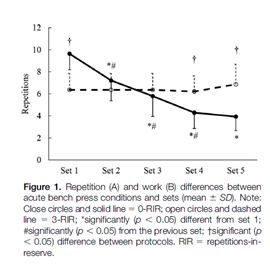
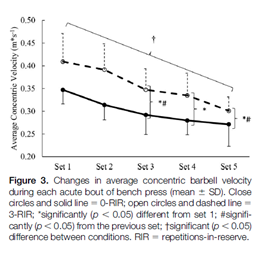
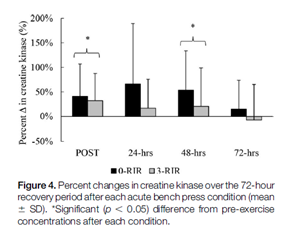
The researchers found that, despite not training to failure for the first 4 sets, the use of training with 3 RiR in comparison to 0 RiR (i.e., taking each set to failure) allowed for similar absolute training volumes (Mean ± standard deviation; 0 RIR: 30.9 ± 6.8 repetitions; 3 RIR: 32.1 ± 6.3 repetitions), substantially lower perceived exertion, increased training quality (assessed through greater velocity and, although not reported, power output), and similar levels of recovery at 6 hours (h), 24h, 48h, and 72h post-testing. These findings are important because they demonstrate that auto-regulatory training methods can increase training quality, reduce perceived exertion, while allowing similar (if not greater) levels of overall training volume in the same amount of training time.
Limitations
First, it should be acknowledged that the researchers have done a good job with this study. Furthermore, it is clear that they took their time designing and developing the protocol so that it was robust and answered applied questions. However, as always in research, there are some limitations. For example, to assess neuromuscular recovery following the training interventions, the researchers have presented mean concentric velocity, impulse, and rate of force development (RFD). Unfortunately, despite the attention RFD receives within the S&C literature, it is a notoriously unreliable measure. Furthermore, absolute impulse would largely be dictated by the mass on the bar. Finally, due to the (small) braking phase that would be required with a bench press at 80% of 1RM[5], mean concentric velocity may not be an ideal outcome measure and peak concentric velocity may have been better. This information would have been available from the monitoring device and may be able to tease out the small differences in neuromuscular fatigue.
A second limitation that may have shrouded the true effects of RiR on fatigue and recovery was that the final set of the 3-RiR condition was to failure (i.e., three repetitions were not left in reserve). While not so much a limitation as this could genuinely be programmed in a training session, by training the last set to absolute failure, the participants in the study likely exhibited substantially greater fatigue than if they had completed their last set with 3-RiR. This means that we do not have the true effect of solely prescribing with this method.
What this means for coaches
This study has some nice practical takeaways for the strength and conditioning coach. First, this study demonstrates that RiR can be a feasible way to train your athletes. Second, it emphasises that maxing out sets in your training routine, while counterintuitive, may not be the best or most conducive method of maximising training volume. Indeed, training within close proximity to failure with short recovery intervals (e.g., 90 seconds) may allow practitioners to get similar training volumes without forcing your athletes to train at their absolute max. Finally, this study again shows that training with auto-regulatory prescriptive methods can allow for similar training outcomes (in this instance volume), while enhancing the training quality (e.g., power output) and minimising the exertion of the athlete. This is important as higher training quality has been shown to promote greater strength and power adaptations in athletes[6.7]. Furthermore, training to failure consistently can substantially increases the exertion of your athletes and likely places them at greater risk of injury.
Reviewer’s comments
In summation this study investigates an interesting topic and answers important questions for coaches. It demonstrates the importance and benefits of auto-regulatory training methods and adds another nail in the coffin of pre-determined loads that must be lifted for a set number of repetitions (which often is not feasible/possible). Additionally, it shows that it is possible to maintain training volumes while augmenting the quality of a session without increasing total training time. However, I would have loved to know whether the lack of differences would have still occurred if the authors had not taken the final set to failure in the 3 RiR condition. Additionally, it would have been extremely interesting to have some additional outcome measures (beyond creatine kinase – which is quite a fickle measure – and mean velocity/impulse/RFD) like perceived soreness/recovery and peak concentric velocity to help assess fatigue/recovery in the following hours/days. Irrespective of these minor qualms though, the authors have done a great job in answering questions that help support better prescription.
Recommended resources
- Article – Application of the repetitions in reserve-based rating of perceived exertion scale for resistance training – Eric Helms and colleagues