

Original article written by Dragan Mijatovic, Dragan Krivokapic, Sime Versic and colleagues.
Background
There is a lot of research that relates fitness to injury risk in team sport athletes. This study focussed on the association between change of direction speed (CODS) and agility to injuries in professional football (soccer). The authors hypothesised that players who are poorer at these two qualities would be more likely to experience injuries during the season.
What the authors did
The participants were 129 male professional soccer players from Bosnia and Herzegovina. The players were assessed in the first half of the season and then injuries were recorded during the second half of the season over a 6 month period. The main tests were CODS and agility, which required the same movement forward, followed by a shallow cut (about 45 degrees) to the left or right. The player had to run to a cone, kick a stationary ball to a goal, turn and run back to the start, with the total time recorded by an electronic timing system (see diagram).
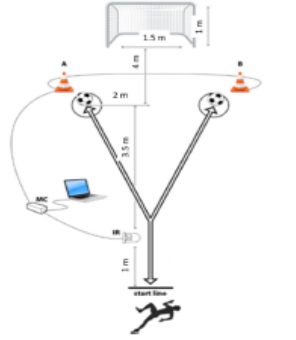
The difference between the CODS and agility tests was that in the agility test, a flashing light on the cone was triggered by the moving athlete indicating which direction to run, whereas in the CODS test, the direction was known before the athlete started. The dominant side was designated as the side producing the faster total times. Injuries were recorded from the Oslo Sports Trauma Research Centre Overuse Injury Questionnaire (OSTRC), which takes into account all types of injuries.
What the authors found
There were 35 players who were classified as injured and 75 players in the non-injured group. The Table below summarises the results.
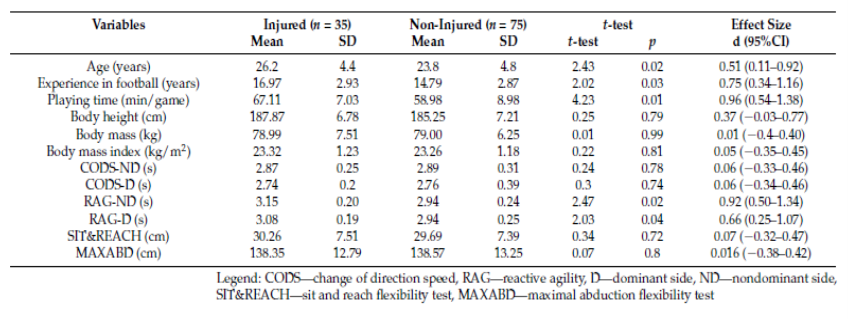
There were only 5 variables where the two groups were statistically significantly different (P<0.05), and these are highlighted in the table. This shows that the injured group were significantly older, had more experience, and greater playing time, which were expected results. They were also poorer at agility (especially on the non-dominant side), but there was no significant difference between the groups in CODS.
Limitations
A key limitation of this study was that it used a test of agility that used a flashing light as a stimulus to change direction. The problem with this approach is that this assesses simple reaction time rather than the ability of an athlete to use anticipation to react to opponents actions, and therefore is not representative of the types of stimuli that occur in a soccer match. Another limitation is that all injuries were recorded, which includes injuries relating to contact that may not be expected to be related to physical capacities.
What this means for coaches
The finding that injured players were poorer at the agility test but not the CODS test suggests that a deficit in the ability to react and move quickly in a skill under time-pressure may indicate a greater likelihood of injury. This in turn suggests that players found to be deficient in this type of agility test should be prescribed some agility training (with reaction), which might reduce their risk of injury.
Reviewer’s comments
We should be aware that an association between a fitness test and injury is a type of statistical correlation which doesn’t prove cause and effect. However, it seems logical that a player who performs poorly at the agility test used in this study might suffer from an inability to quickly adjust their body position to achieve efficient movements that follow. Therefore, there might be some merit in training methods involving reacting to a non-specific visual stimulus in order to create a time-stress for the athlete to learn to quickly adjust body positioning. If the athlete has an improved control of their body, they may become less injury-prone. In order to develop anticipatory skill, I would also recommend including activities that involve reacting to opponents actions.
Recommended resources
Article – Lower physical fitness is associated with injuries in Iranian national futsal teams: A prospective study – Hooman Angoorani, Zohreh Haratian, Hamedreza Farmanara and Paniz Jahani